Evolution for Art's Sake

Church


CITY JOURNAL
"Evolution for Art’s Sake"
Denis Dutton’s Darwinian aesthetics
by James Panero

a review of The Art Instinct: Beauty, Pleasure, and Human Evolution, by Denis Dutton (Bloomsbury, 288 pp., $25)

This year marks the bicentenary of Charles Darwin’s birth and the 150th anniversary of the publication of On the Origin of Species by Means of Natural Selection. An international Darwin Day is set for February 12, the biologist’s birthday. But the annus mirabilis is off to an early start with the publication of Denis Dutton’s The Art Instinct: Beauty, Pleasure, and Human Evolution, a Darwinian attempt to explain humanity’s interest in art. Dutton may not be a household name, but his Web portal Arts & Letters Daily has become an international phenomenon, a virtual Galapagos of cultural interest, since he formed it out of an e-mail newsletter in 1998. A professor in the philosophy of art at the University of Canterbury, New Zealand, Dutton has now written a book full of observations that again demonstrate his uncanny ability to collect complex arguments and present them as thought-provoking statements.

Dutton builds a bold cross-cultural argument: we all have a prehistoric “art instinct” programmed into our genes through natural and sexual selection. The Art Instinct begins with the results of a recent survey of international artistic taste, which concluded that “people in very different cultures around the world gravitate toward the same general type of pictorial representation: a landscape with trees and open areas, water, human figures, and animals”—images that we often find in the kitschy world of calendar art. How to explain such universal taste? “The calendar industry has not conspired to influence taste,” Dutton writes, “but rather caters to preexisting, precalendrical human preferences.”

Dutton’s belief in a universal urge for art finds common ground with older aesthetic theories, from the metaphysics of Immanuel Kant to the spiritualism of Emanuel Swedenborg to the Kunstwollen of Alois Riegl. But the idea of universality in the arts has been under attack ever since Continental critical theory took over the academy and went after connoisseurship as a social construction. “The whole idea that art worlds are monadically sealed off from one another is daft,” Dutton counters. “Do we need to be reminded that Chopin is loved in Korea, that Spaniards collect Japanese prints, or that Cervantes is read in Chicago and Shakespeare enjoyed in China? . . . Darwinian aesthetics can restore the vital place of beauty, skill, and pleasure as high artistic values.”

Dutton devotes quite a bit of space to setting up his premise, arguing exhaustively with theorists like Arthur C. Danto about the definition of art. Dutton’s philosophical ground-setting may be academically responsible, but Chapters Three and Four (“What is Art?” and “‘But They Don’t Have Our Concept of Art’”) are uphill work—directed, it seems, more at a university audience than at the general reader.

Once Dutton arrives at his central thesis, The Art Instinct becomes an altogether better read. The Pleistocene age lasted for 80,000 generations of humans and protohumans, Dutton writes, “against a mere five hundred generations since the first cities.” For the human race, the survival of the fittest—a term coined by the social Darwinist Herbert Spencer, not by Darwin himself—played out in these long years. The people of the Pleistocene most likely found time for leisure, Dutton argues, and in the arts they developed the adaptive traits that aided in socialization and sexual selection. “It is inconceivable that Pleistocene people did not have a vivid intellectual and creative life,” he writes. “This life would have found expression in song, dance, and imaginative speech—skills that matched in complexity and sophistication what we know of Pleistocene jewelry, painting, and carving.” Through the arts, early man learned to see the world. “This intense interest in art as emotional expression derives from wanting to see through art into another human personality: it springs from a desire for knowledge of another person. . . . Talking about art is an indirect way of talking about the inner lives of other people.”

Here Dutton cites Darwin’s most controversial book, The Descent of Man, and Selection in Relation to Sex (1871), and its portrayal of “the mind as a sexual ornament.” Think of the arts as something akin to the peacock’s tail, Dutton writes. The peacock’s wasteful piece of plumage is useless—in fact, a hindrance—when it comes to foraging for food or escaping from predators. Nevertheless, its tail is attractive to peahens precisely because it is an opulent display of extra resources, one that says this peacock is doing better than just scraping by in the world of peafowl. For early man, a social animal, survival likewise not only favored the strongest, but also “the cleverest, wittiest, and wisest.” Just as “the evolutionary function of language is not only to be a means of efficient communication but to be a signal of fitness and general intelligence,” Dutton writes, “sexual selection was building a more interesting human personality, one that we have come to know as convivial, imaginative, gossipy, and gregarious, with a taste for the dramatic.” The art instinct is closely connected with this sexual selection. Simply put, the arts have sex appeal, and it should come as little surprise, Dutton writes, that “love is poetry’s natural subject.”

There are, of course, plenty of counterarguments against Dutton’s “art instinct.” The most obvious is that artists in recorded history often seem to have little interest in procreation, whether because of homosexuality, social dysfunction, or simple lack of interest. Cyril Connolly was on to something when he tartly wrote that “There is no more sombre enemy of good art than the pram in the hallway.” Art-making often seems to be a distraction from, or even a stand-in for, sexual reproduction.

Another concern is that art history is already besotted with theory. About the only place one finds Marx or Freud read with any sense of relevance nowadays is in the study of the humanities, with art history being no exception. (By contrast, try finding Freud discussed in a psychology class with anything but historical interest.) Does Dutton expect us to add Darwinism to the dysfunctional set of Marxist and Freudian master keys? Fortunately, it appears not: “No philosophy of art can succeed if it ignores either art’s natural sources or its cultural character,” he writes, hoping to expand our range of inquiry rather than limit it.

Darwinism is, nevertheless, still a theory of its own, no more so than in the study of Dutton’s “art instinct.” Dutton builds his case on speculation. He constructs a story line that must be reverse-engineered back from the present day. He devotes little attention to what early artistic evidence we do have, such as the cave paintings of Lascaux. Likewise, Dutton could have compared the art of early recorded civilizations: they should exhibit similar artistic practices, according to Dutton’s thesis, even if they developed at opposite ends of the globe.

Still Dutton’s central premise is worth repeating. “What sexual selection in evolution does,” he writes, “is give us an explanation of why so much human energy has been exhausted on objects of the most extreme elegance and complexity—not just the massive symmetry of the Pyramids, but the poignancy of Shakespeare’s sonnets or the Schubert Quintet in C.” It’s a remarkable idea and one that deserves exploration through the historical evidence, both what we have on hand and what remains to be uncovered. The Art Instinct is an important first step in that process—a hyperlink to future conversations.
Gallery chronicle (January 2009)

Frankenthaler_ca27958

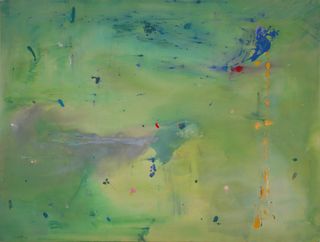
Helen Frankenthaler, A Green Thought in a Green Shade (1981),
© Helen Frankenthaler / courtesy Knoedler & Company

THE NEW CRITERION
JANUARY 2009

Gallery chronicle
by James Panero

On “Frankenthaler at Eighty: Six Decades” at Knoedler & Co., New York.

Living masters have it rough, and Helen Frankenthaler has been living as a master for over half a century. In 1952, at the age of only twenty-three, she created Mountains and Sea, an iconic painting that forever secured her place in the history of art. It was a work that at once defined Frankenthaler’s style and changed the visual texture of abstract painting. Mountains and Sea built on the achievements of Jackson Pollock with its poured paint and rolled-out canvas—but it also outdid Pollock. With its thinned pigments soaked directly into linen, it displayed a new artistic temperament, subsuming the artistic ego into forms of color that absorbed the Abstract Expressionist gesture into an all-over stain. It paved the way for an entire new school of American abstraction known as Color Field, with Frankenthaler’s experimentation leading to the lush mannerisms of Kenneth Noland and Morris Louis.

Unfortunately, nothing hurts a career more than an impeccable reputation, especially in the annals of modernism. Without a doubt, Helen Frankenthaler’s standing today has been diminished by her historical significance. Few would deny her importance, but the fidelity of her artistic vision, which has remained remarkably pure for half a century, has yet to receive its full due.

In a tribute to Frankenthaler’s eightieth birthday this past December, Knoedler has mounted a small survey of paintings spanning six decades, selected by Karen Wilkin from the artist’s own collection.[1] The best argument for Frankenthaler’s importance is not her textbook relevance but the authority of her work.

A Green Thought in a Green Shade (1981), the enormous work that looks back from the far wall of the gallery, comes off as a painterly ecosystem, with algae blooms swirling in a liquid medium. On one of my visits, I noticed two patrons transfixed by this painting, with their noses a few inches from the canvas for what must have been an hour. Frankenthaler employs such a masterly, easy touch that she can let her work, you might say, work on its own, with biomorphic forms bubbling up and dissolving from view not as a vision of the artist’s unconscious but rather as a vision of the canvas’s unconscious, if that’s at all possible.

American museumgoers were reminded of Frankenthaler’s particular touch over the past year. Mountains and Sea temporarily left its permanent home at the National Gallery in Washington for a multi-city tour as part of “Action/Abstraction,” an exhibition that looked at the evolution of American painting through the influence of the critics Clement Greenberg and Harold Rosenberg. In the court of public opinion, Frankenthaler’s reputation has been tied to Clement Greenberg’s own approval ratings, a disservice to the artist and to the historical record, as Greenberg’s theories of flatness and the direction of abstract art owe more to Frankenthaler’s development on canvas than the other way around.

And Frankenthaler’s public esteem has suffered in other ways as well. Consider her biography of family privilege, against which she never rebelled. There is also her cosmopolitan style and her physical beauty—not for nothing, the supermodel Stephanie Seymour portrayed her in the recent biopic of Jackson Pollock. Frankenthaler never bared the tortured soul that is often assumed to be at the heart of important art (one reason, perhaps, why the reputation of Joan Mitchell, a lesser contemporary of Frankenthaler’s and a notoriously foul-mouthed drinker, has recently been on the rise). There has also been Frankenthaler’s resistance to identity politics. She has made little of her position as a groundbreaking woman in the arts. This decision speaks to an inner confidence; she knows she is a groundbreaking artist, regardless of gender. And finally there is her resistance to serialism and the demands of a marketplace that says it wants newness but really seeks more of the same. She could have turned Mountains and Sea into a commodity, producing variations on the theme. Instead, she passed up ready-made labeling, packaging, and selling for a life of pure artistic pursuit.

Which was why seeing Mountains and Sea in “Action/Abstraction,” removed from its usual context in Washington, had been a delight. For such a well-known painting it is still awesome and strange, with its lyrical hints of landscape dissolving into sunspots, which further separate out into oil stains and untreated white canvas. There is an unexplainable beauty at its heart. Frankenthaler is the American Fauve, and she shares several similarities with Henri Matisse. Both artists staked their claim in color rather than tone, and both artists have been accused of bourgeois sentiment, choosing to channel their energies directly into their work rather than into their biographies. For Frankenthaler this process became quite literal. She never battled her way to a high style. There were no decades of experimentation before arriving at a signature work; her signature work began as experimentation filtered through her artistic intuition. Experimentation, in fact, has been the one quality that has defined her oeuvre as she has gone from painting to drawing to printmaking to metal sculpture to pottery and back again.

You might also say that Frankenthaler arrived on the scene at a soaking-in moment for American art. Her achievement was to develop a way to translate this mood directly to canvas. The battles against European surrealism and homegrown regionalism had been fought and won, if not in the public’s mind, then at least for its forward-looking artists of Abstract Expressionism. Frankenthaler never felt compelled to fight a Freudian-like death match with the Beaux-Arts in the manner of de Kooning or to channel Pollock’s Indian rain dance. To do so would have been pantomime. The language of abstraction had already evolved into a lingua franca, and it no longer required overt gesticulation. Frankenthaler purified this language in shapes and colors. Through her thinned pigments and nimble physicality, she discovered how to execute a vision on canvas that removed the evidence of artistic will and seemed to bring forward forms already buried deep in the picture plane.

Recently, in The Wall Street Journal, William Agee described Frankenthaler’s particular journey to Mountains and Sea:

In August 1952, Ms. Frankenthaler traveled to Nova Scotia, where she continued her practice of doing small landscapes. She painted in watercolor and oil on paper, working freely from nature. These studies helped to keep her limber and flexible, like a dancer or athlete tuning up or, as was the case here, a painter preparing for a major new effort.

On the afternoon of Oct. 29, back in New York, she tacked a large—roughly 7-by-10-foot—piece of untreated canvas to the floor of her studio to begin the largest painting she had ever undertaken. Her mind and her arms were filled with memories of the spectacular Cape Breton landscape. After roughing in a few charcoal marks as an initial guide, she poured highly thinned oil paint from coffee cans directly onto the canvas, as if she were drawing with color. She had no plan; she just worked, with control and discipline. At the end of the afternoon, when she had finished, she climbed on a ladder and studied the painting. She was not yet sure what she had done; she was “sort of amazed and surprised and interested.” … It soon became clear that what she had done was invent a new way of making art.

Once you understand Mountains and Sea as something altogether different from the premeditated “next step,” the unprogrammatic nature of Frankenthaler’s career-long output makes perfect sense. The catalogue that accompanies this latest Knoedler show is a delight, because it economically divides her paintings by decade, assigning a full-page studio shot to each. The 1950s photograph shows Frankenthaler with her hair loosely pulled back, her white shirtsleeves rolled up, waving her arm over the canvas like a conductor calling forth a response. Western Dream (1957), the work on display from this decade at Knoedler, is a diffuse assembly of sun shapes and pictographs resembling an accretion of graffiti, with flattened lizards and what might be a rabbit and who knows what else. There’s a little too much iconography here to work as a landscape and not enough to be read as a rebus, and so the picture never quite comes together as a whole, certainly not as well as Mountains and Sea. The image also suffers from the evidence of too much hand, too much artistic will, even with the poured-in oils.

The photograph of Frankenthaler from a decade later shows the artist taking another step back as she lets fuller fields of color bleed into the canvas through a sponge. Provincetown I (1961) takes the notion of the canvas as picture window and gives it a life of its own. The semblance of a drawn-in frame and the image it contained melts and folds into abstract shapes of blue, red, and brown. Pink Lady (1963), just two years later and now acrylic rather than oil, takes a further turn, as the paint spreads out from a center black line as if by tectonic process, without the artist anywhere in sight.

By the 1970s the internal rhythm of her paintings had shifted to a slower beat. The photograph from this period shows her walking away from a work in progress with a sheet of paper in hand while pointing back, as if issuing the watering instructions for something now growing on its own. Sphinx (1976), a closed-mouth assembly of orange, brown, and gray, really does keep its riddles to itself, perhaps a little too much, as a monument reduced to ruin.

The 1980s photograph shows Frankenthaler bending over a large canvas with a brush and paint can in hand, bringing a synthesis of stained and poured techniques to works like A Green Thought in a Green Shade, the highlight of the show. The 1990s, at least as represented here, come off rather poorly by comparison, as Snow Basin (1990) flirts with frosting, The Rake’s Progress (1991) attempts a visual pun (the paint has been scraped by the teeth of a rake), and Aerie (1995), with its looping swirls, seems too preconceived.

The current decade brings her back into her majesty. The athleticism required of her enormous earlier canvases has given way to repose and modestly sized work of great intellectual complexity. Knoedler’s 2003 exhibition of new Frankenthaler paintings demonstrated just how good she had become in the last several years, in many ways at the peak of her powers, and one of these paintings, Warming Trend (2002), has returned for this show.

“What I want,” Matisse famously said, “is an art of balance, purity, an art that won’t disturb or trouble people. I want anyone tired, worn down, driven to the limits of endurance, to find calm and repose in my paintings.” Luxe, calme, et volupté: All three are now on view at Knoedler.


Notes
Go to the top of the document.


  1. “Frankenthaler at Eighty: Six Decades” opened at Knoedler & Co., New York, on November 6, 2008 and remains on view through January 10, 2009. Go back to the text.

Brought to You by the Letter S

Panero-650
THE NEW YORK TIMES BOOK REVIEW
December 28, 2008

Brought to you by the Letter S
By JAMES PANERO

a review of
STREET GANG: The Complete History of “Sesame Street.”
By Michael Davis (Viking. $27.95)

In 1981, when I was 6, about 10 million American children daily tuned in to the PBS show “Sesame Street.” That same year, one of the writers for “Sesame Street,” my real-life neighbor, asked if I’d like to appear on the show. It was my golden ticket, but crossing over to the other side of the television screen can be a demystifying journey. The “Sesame Street” soundstage looked like a facsimile of the televised world — small and (surprisingly) indoors. The Muppets were controlled by operators; we were told not to look down at them. And there was Big Bird, stored in the middle of the set on a massive hook. When I reached out to pet him, a voice came from the sky: “Don’t touch those feathers!” admonished one of Big Bird’s creators, the remarkably named Kermit Love.

The address of 123 Sesame Street was never quite the same. Yet to be cast out of the garden of television-land can be a learning experience. “Street Gang: The Complete History of ‘Sesame Street,’ ” by Michael Davis, a former columnist for TV Guide, now offers the behind-the-lens story, the first comprehensive account, of this 39-year-old show.

The book details the awesome lengths that “Sesame Street,” undoubtedly the most workshopped and vetted program in the history of children’s television, went through to captivate its young audience. The show’s music and quick cuts concealed its educational ambitions. “Commercial breaks” advertised numbers and the alphabet through Jim Henson’s Muppet pitchmen: the Count, Grover and Cookie Monster. Kermit the Frog, wearing a trench coat, told fairy tales through news flashes from Rapunzel’s tower. Meanwhile, the urban street scenes at the center of the show communicated the social values of a progressive culture. Here was TV at its most sublime, but also an entrancing product of a liberal age, something Mom was happy for us to watch.

The “Sesame Street” story begins on a Sunday in December 1965. At 6:30 in the morning, 3-year-old Sarah Morrisett tuned in to the test patterns while awaiting her cartoons to begin a half-hour later. Her father, Lloyd Morrisett, an experimental psychologist and a vice president of the Carnegie Corporation, took note. “It struck me there was something fascinating to Sarah about television,” he says.

“Sarah Morrisett had memorized an entire repertoire of TV jingles,” Davis writes. “It is not too far a stretch to say that Sarah’s mastery of jingles led to a central hypothesis of the great experiment that we know as ‘Sesame Street’: if television could successfully teach the words and music to advertisements, couldn’t it teach children more substantive material by co-opting the very elements that made ads so effective?”

The thought of using the trappings of television for progressive ends seemed anathema to most intellectuals, who were wholly skeptical of this mass-culture medium, but Morrisett brought up his observation at dinner with Joan Ganz Cooney, the future creator of “Sesame Street.”

In the mid-1960s, as one of his grand social initiatives, Lyndon B. Johnson took up the cause of National Educational Television (later known as the Public Broadcasting Service), a lackluster confederation of chalk-dusted channels. Like the show she developed for PBS that would define the network, Cooney was steeped in the ideals of Johnson’s Great Society. In New York, while working in publicity for commercial television, she was introduced to William Phillips, co-founder of Partisan Review, the small but vastly influential journal of highbrow leftist opinion. In her spare time, Cooney did publicity for Partisan Review and produced a fund-raiser at Columbia that was attended by Norman Mailer, Mary McCarthy and Lionel Trilling.

Cooney’s ability to transcend the divisions between high and low culture defined her success at “Sesame Street,” which brought Madison Avenue advertisers and game show creators together with New York intellectuals and the education department of Harvard. Lloyd Morrisett, through his connections at the Carnegie Foundation, helped Cooney line up the millions in grants to cover the research, writing and production needed to create a show that could compete with the commercial networks. McGeorge Bundy, one of “the best and the brightest” in the Kennedy administration and by then president of the Ford Foundation, sharpened the show’s political edge by homing in on the children of the urban underclass. “Sesame Street” would be the television equivalent of Head Start, the federal child-welfare program founded by Johnson in the belief, Davis writes, that “the tyranny of America’s poverty cycle could be broken if the emotional, social, health, nutritional and psychological needs of poor children could be met.”

In its high ideals and comprehensive approach, “ ‘Sesame Street’ came along and rewrote the book,” Davis says. “Never before had anyone assembled an A-list of advisers to develop a series with stated educational norms and objectives. Never before had anyone viewed a children’s show as a living laboratory, where results would be vigorously and continually tested. Never before in television had anyone thought to commingle writers and social science researchers.”

“Sesame Street” turned the entertainment of children’s television into a science, as the program was extensively tested with nursery school audiences through a “distracter” machine that gauged children’s eye focus second by second during the run of each show. It is no coincidence that the program proved to be so popular. When early studies determined that its street scenes were faltering, Jim Henson brought about a final breakthrough. At the time, his Muppets were relegated to the “commercial” segments as cut-aways from the street-based story line. For this, Henson drew on his own experience. He had originally developed Kermit and the Muppets for commercial work; his 1950s show “Sam and Friends,” with its zany ads for Wilkins coffee, has now found a second life on YouTube. Over the objections of researchers, who had advised against mixing the fantasy of the Muppets with the reality of the street, Henson developed Big Bird and Oscar the Grouch to be central characters on the main stage, both driving and subverting the program’s self-seriousness.

Davis tracks down every “Sesame” anec dote and every “Sesame” personality in his book, and the result is more an oral history than a tightly organized narrative. The development of the show’s characters, as well as the performers’ own lives, can be illuminating. Bob McGrath, who has played Bob from the start, once enjoyed a pop singing career in Japan. Gordon, the neighborhood’s black role model, played by Matt Robinson and then Roscoe Orman, was named for the photographer Gordon Parks. The character Susan, Gordon’s stay-at-home wife, was once denounced by feminists. Emilio Delgado and Sonia Manzano joined the cast in the ’70s as Luis and Maria after protests against the show’s lack of Hispanic characters. Will Lee, who played the store owner Mr. Hooper, came through the Yiddish theater and the radical Group Thea ter, and was blacklisted in the ’50s; Lee’s death in 1982 became a defining moment when “Sesame Street” chose to address the news directly on the air. Northern Calloway, who played Mr. Hooper’s young assistant, David, proved to be an even more tragic case: by the time I appeared on camera with him, according to Davis, Calloway was medicated with lithium after a violent psychotic breakdown; a manic-depressive in and out of treatment, he remained on the show through the late ’80s, but died in 1990 after suffering a seizure in a psychiatric hospital.

Davis lingers on such gossip. I could do without dwelling on the drinking habits of Captain Kangaroo (Bob Keeshan, forever jealous of the acclaim for “Sesame Street”) or several of the book’s other trivial details. Do we really need to know that Cooney served boeuf bourguignon, “a traditional French country recipe . . . on Page 315 of the first volume of ‘Mastering the Art of French Cooking,’ ” to Lloyd Morrisett at their 1966 dinner?

Far more interesting are the failings and criticisms of the lavishly praised show. Terrence O’Flaherty, a television critic for The San Francisco Chronicle, accused “Sesame Street” of being “deeply larded with ungrammatical Madison Avenue jargon.” Carl Bereiter, a preschool authority, said, “It’s based entirely on audience appeal and is not really teaching anything in particular.” And Neil Postman complained that it relieved parents “of their responsibility to teach their children to read.”

The real challenge to the show came in the 1990s, around the time Joan Cooney retired as chairwoman of the Children’s Television Workshop, the program’s nonprofit governing body. Once revolutionary, “Sesame Street” came to be seen as a dated reminder of urban decay, while the purple dinosaur Barney took children’s television out to the clean suburban schoolyard. “None of Barney’s friends lives in a garbage can, and none grunts hip-hop,” National Review cheered. In response, “Sesame Street” made an ill-fated attempt at urban renewal, developing an extension to the set called “Around the Corner” that seemed “less like Harlem and more like any gentrified up-and-coming neighborhood in America,” Davis writes. Professional child actors were regularly employed for the first time.

The broken-window theory may have worked to clean up New York, but not so for “Sesame Street” — as its empire expanded abroad, ratings eroded at home, and the gentrified set was abandoned. “Sesame Street” ceased to be a reflection of its surroundings. Early on, the writer-producer Jon Stone rejected the traditional trappings of children’s television: “Sesame Street” would have “no Treasure House, no toy maker’s workshop, no enchanted castle, no dude ranch, no circus,” Davis says. But this is what “Sesame Street” had become, and perhaps what it really always was: an urban fantasy world born of ’60s idealism. Davis has written a tireless if not altogether artful history of this unique place. Here, finally, we get to touch Big Bird’s feathers.