All My Sons

CITY JOURNAL
September 4, 2009

All My Sons
by James Panero

Two memoirs of William F. Buckley outline his towering shadow.

A review of Losing Mum and Pup: A Memoir, by Christopher Buckley (Twelve, 272 pp., $24.99) & Right Time, Right Place: Coming of Age with William F. Buckley Jr. and the Conservative Movement, by Richard Brookhiser (Basic Books, 272 pp., $27.50)

Since the February 2008 death of his father, William F. Buckley, Jr., Christopher Buckley has courted his share of controversy. As last fall’s presidential election approached, he publicly backed Barack Obama on Tina Brown’s website The Daily Beast. He withdrew from writing for National Review, the magazine that his father founded in 1955. Then came Losing Mum and Pup, a tell-all memoir of his parents’ painful sickness and death—a book heavily promoted and embargoed until its publication date. An advance excerpt published as a cover article in The New York Times Magazine in late spring seemed particularly harsh, yet Losing Mum and Pup could not be easily dismissed. The book became a bestseller. Instead of being opportunistic or shameless or even a product of personal or political retribution, the book succeeded on its literary merits.

Losing Mum and Pup is the story of a political leader’s death, deliberately stripped of politics. Some might see this as a disservice or even a repudiation of Buckley’s beliefs. But what results is an engrossing, universal story of a son who confronts the death of both parents in less than a year. The lack of politics also distinguishes the book from nearly all other contributions to the growing Buckley memorial shelf. The spirit of the ailing WFB, the private WFB, shines from its pages. So does the figure of Chris’s mother Pat, the Norma Desmond of New York society, on whom WFB was a doting Max von Mayerling.

The particular resonance of Christopher’s story builds on more than the fame or gossip surrounding his subject matter. “There are seventy-seven million of us boomers,” he writes. “Many of us have already lost the ’rents, and the rest of us will be going through the experience later if not sooner.” Buckley’s story addresses generational division, specifically the divide between the Baby Boomers and the Greatest Generation. In the Buckley household, this divide seems to have been particularly pronounced. The neo-Edwardian WFB led the national consensus against much of what his son’s generation came to represent with its counterculture, its doubt, and its self-obsession. Christopher, in turn, took up the position of his father’s antagonist. “Pup and I exchanged, over the course of a lifetime,” he writes, “letters of deep and abundant affection. But we fought, and hard. Of the perhaps—I’m guessing—seven thousand or so letters and e-mails we exchanged, I’d estimate that one-half were contentious.”

Christopher plays the part of the Boomer con brio, and much of the book relates more to the author rather than to his subject matter. A father now in his fifties, Christopher declares himself an “orphan” after the death of his parents. “Today I got a call, and I cried. Grandfather dies, father dies . . . you’re next,” he writes. Many observations come off as similarly self-indulgent: “I suppose one way or the other I’ve spent a good deal of my life, despite my protestations to the contrary, trying to measure up to my father. . . . I felt—for the first time in my life—entirely independent of paternal authority or rebuke. . . . I stroked [my mother’s] hair and said, the words surprising me, coming out of nowhere, ‘I forgive you.’” For all of the faults he finds in his family, in fact, Christopher comes off worse—I would imagine, consciously so. At the outset he writes: “I hope to avoid any hint of self-pity, any sense that I’ve been dealt some unusually cruel hand.” That Losing Mum and Pup fails so dramatically in this regard elevates his story from cautious encomium to an engrossing discussion of family dynamics, one told through a certain reckless honesty.

The Buckleys’ only child, Christopher begins his story with the illness and death of his mother. Pat was going downhill fast after suffering through amputations made necessary by her poor circulation, the result of a lifetime of smoking. (Is it notable that Christopher, author of the satirical novel Thank You for Smoking, lost both of his parents to complications from tobacco?) A towering figure in the New York social scene, Pat could be one part Lenny Bruce and another part Wicked Witch. Christopher may have inherited his father’s literary chops, but his wounded wit comes off as 100 percent Mum. “One morning, during the Nixon administration,” Christopher writes of one of his mother’s more famous episodes, “the phone rang in Stamford at what Mum deemed an inappropriately early hour on a Sunday. ‘The president is calling for Mr. Buckley,’ the voice announced. Mum fired back in her most formidable voice—and trust me when I say formidable: a cross between Noel Coward and a snapping turtle—‘The president of what?’ To which the White House operator calmly replied, ‘Our country, ma’am.’”

William F. Buckley was only one-half of the family drama: Pat commanded her own marquee. Just as WFB “had a paladin code of conduct that the show must go on,” writes Christopher, “she’d once said to me, only half-kidding, ‘I’ve got the best legs in the business.’” Pat both deferred to and dominated WFB. “She took possession of her husband,” writes Christopher. “And he was desolate now that she had gone. It was only now, seeing him so helpless without her, that I saw the extent of his devotion to her. The phrase unconditional love has always been an abstraction to me. Now I understand. I think he even missed her being cross with him.”

Losing Mum and Pup traces the death of Pat to the descent of her husband less than a year later. “Industry is the enemy of melancholy,” Christopher writes of his father’s philosophy on grief, and in his last year WFB labored over his own mortality. He could be difficult in his own way. He confronted a host of failing bodily systems, brought on by emphysema and diabetes and a lifetime of self-medication. “It was as if his mind were a still brightly burning fire deep within the wreckage of his body,” Christopher writes. The son’s efforts as caregiver often put him at odds with his restless father: “Pup’s daily intake of pills would be enough to give Hunter Thompson pause.” Ritalin and sleeping pills were to Buckley the opposite of recreational drugs. They were his work drugs, an extension of his efficiency, impatience, and control. “Pup’s self-medicating was, I venture, a chemical extension of the control he asserted over every other aspect of his life. . . . I did not, as a young bacchante in the sixties and seventies, absent myself from the garden of herbal and pharmacological delights—far from it—so I found myself in an ironic position, lecturing a parent about drugs. The child/parent relationship inevitably reverses, but to this degree I had not anticipated.”

For Christopher, the necessity of these confessions comes in clear view when he discusses his father’s despondency. A pious Catholic with an ailing spirit, in his final months WFB discussed the ethics of suicide with Sam Tanenhaus, editor of the New York Times’s Book Review and Week in Review sections as well as WFB’s official biographer (the work remains in progress). Hours after Buckley’s death, Tanenhaus told Christopher about the suicide discussion and said that he wanted to publish an article in the Times about it. Christopher worried that such a story would fuel speculation about the cause of his father’s death (listed on the official death certificate as “cardio-pulmonary arrest”) and told Tanenhaus that his father’s statements were made to him “in your capacity as his biographer. Not as a reporter for the New York Times.” As his father’s literary executor, Christopher then threatened to cut off Tanenhaus’s access to the Buckley archive if the story ran.

It didn’t, so it may seem curious that Christopher chooses to describe the incident in detail. Yet here he reveals what must be the ultimate intention of writing Losing Mum and Pup: divulging the secrets of his father’s final year so that others will not do it first. This is a book about setting the record straight, on Christopher’s terms. His deployment of the narrative is his own. Yet in his desire to control the story, Christopher is his father’s son.

One might say that William F. Buckley was far more organically than politically conservative. In matters of philosophy and spirit he was an ultimate conservative force, but he was more taciturn in conservatism’s application, especially in his later years. In Right Time, Right Place, his own memoir of WFB, Richard Brookhiser writes: “Liberalism prevailed, Buckley said, because it was socially acceptable. He therefore wanted to lift taboos on thought and discussion; once that happened, elections would take care of themselves.” Buckley left the wonkery and political leadership to others. Looking to his columns for political direction could be like consulting the Delphic Oracle. He wrote no defining political treatise. His literary totality, ranging through letters and spy novels and celebrating the joys of life, good friends, and a love of God, formed an anti-manifesto. Too much of Buckley’s universe was unknown. It needed exploration, not explanation.

And the issue of succession is more easily determined in the realm of politics than in this one of philosophy and temperament. Who would succeed Buckley at the helm of National Review? The answer seemed to emerge in the fall of 1969, when Brookhiser, then a mere 14 years old, submitted an essay reacting against anti–Vietnam War sentiment at his upstate New York school. Buckley ran the piece and began to see a reflection of himself in the budding young talent. By 1978, Brookhiser, by then a graduate of Yale (like his mentor), had already become an editor at National Review. Buckley privately tapped him as his heir apparent.

Buckley’s mentorship of young writers was a defining trait, yet his vitality could often outstrip that of his protégés. “The puer eternus,” writes Brookhiser, “the eternal youth. Hermes/Mercury represented this type in classical religion. The puer is quick, clever, verbal, sometimes shifty. Bill was unquestionably a puer eternus. He would always be on the lookout for others. He had found a number of bright young writers already—John Leonard, Garry Wills, Joe Sobran—and there would be more in the years that I knew him. But I was the one he tapped in the spring of 1978.”

In choosing a successor early on, writes Brookhiser, Buckley may have been reacting against the career direction of his natural-born heir: “Bill’s conservatism and his role in the world had not replicated themselves. . . . Chris shared his father’s convictions, but he did not live them in the same way. He was not on the firing line week after week, as Bill was; as we at National Review were; as I was. This necessarily gave his convictions a different quality. Chris was conservative from habit, more in the manner of my parents (if my parents had been raised by wealthy Yalies). Chris must have decided, very early on, not to become his father. Chris’s decision to go his own way may have added a share of urgency to Bill’s efforts to find a successor.”

Then a decade later, just as suddenly as Buckley had conferred the crown, he took it away. “One summer day in 1987,” writes Brookhiser, “I came back to my desk after lunch and found a surprising letter. It was from Bill, and the envelope was marked ‘Confidential.’ ‘It is by now plain to me [it began] that you are not suited to serve as editor-in-chief of NR after my retirement. This sentence will no doubt have for a while a heavy heavy effect on your morale, and therefore I must at once tell you that I have reached this conclusion irrevocably. . . . You do not have executive habits, you do not have an executive turn of mind, and I would do you no service, nor NR, by imposing it on you.” It is unclear from Brookhiser’s book why Buckley had his change of heart. While Brookhiser offers theories (he did not flatter Buckley enough at an editorial dinner; he disliked Buckley’s novels), one senses that the answer remains unclear to Brookhiser himself.

If the WFB of Losing Mum and Pup leaps from the surface of Christopher’s book, the WFB of Brookhiser’s book is embedded in its depths. But Right Time, Right Place compellingly captures the editorial world of Buckley’s National Review. As a book about recent conservative politics and magazine life, it can be fascinating. While National Review often gets credit for starting the Reagan Revolution, for example, Brookhiser reveals the editorial indecision over Reagan’s 1980 candidacy. “Bill assumed Reagan ‘would come to grief early and drop out,’” he writes. WFB first backed George H. W. Bush.

In the 1970s, Garry Wills, one of Buckley’s most prized protégés, took a turn to the left. The break vexed Buckley, and National Review began running a regular “Wills Watch” (Wills writes about their reconciliation in a recent issue of The Atlantic). The Buckley protégé Joe Sobran then made his own break. After Reagan’s disastrous visit to the Nazi cemetery at Bitburg, Sobran blamed Jews for the media fallout. He began to see Zionism as a conspiracy akin to Communism, and WFB pushed him away. “He imagined that Bill was bullied and terrorized by Jews—the ‘Zionist apparat’ of New York, the elders of Gotham,” writes Brookhiser. “But he was acute about aspects of Bill’s personality. Bill, he thought, rejected Jew bashing because it was declasse, and he cared above all for maintaining ‘la bella figura.’”

“Joe’s fall was personal,” Brookhiser continues. “Joe was his discovery, his protege, his failure.” Brookhiser similarly blames Buckley for the shortcomings in their own relationship: “Bill’s failing (apart from cowardice) was to have made the offer he did in 1978, having wrongly decided that I, at age twenty-three, was the second coming of him.” The rate of apostasy within Buckley’s young circle ran high. It produced some interesting (and also alarming) talent, as protégés became adversaries and attempted to engage Buckley on equal if opposite footing. Though he engaged in no ideological break with his mentor, with Right Time, Right Place Brookhiser now enters those ranks as the reluctant apostate.

Buckley created a personal mythology that he was careful to control. His 2004 “literary autobiography,” Miles Gone By, gathered much of this mythology in one place. A shimmering, 1,000-watt reflection of the late conservative icon that remains the single best book about him, Miles Gone By dispensed with the standard work of history and memoir. Instead, Buckley set about collecting essays from 50 years of his books, articles, and columns “in which I figure directly,” he wrote in the book’s introduction, “sometimes actively, sometimes only in a passive way, but always there.” Miles Gone By began with Buckley’s childhood memory of fireflies at Great Elm, the family estate in Sharon, Connecticut. The chapters then ranged through governesses, sailing, music, his son, wine, parents, Yale, skiing, an ill-advised solo airplane flight, dozens of friends and eminences, language, travel, politics, private clubs, and finally “Thoughts on a Final Passage.” “There would be no point in contriving an autobiography from scratch,” Buckley wrote. “Why? I have already written about the events and the people that have shaped my life; any new account would simply paraphrase these.” Miles Gone By presented the Buckley myth with the magnolias let back in. Buckley soaked his prose in his own blend of perfume, and he cared little about changing the formula.

Buckley exercised as much control as he could over his own story because that control was central to his overall mission. Will, word, and action were inseparable for him, and all were lushly conceived. But he needed to be the one crafting the plot. He bristled at incursions on his authorship far more than at political disagreements. When a relationship took an unexpected turn or a friend was written out, it was done decisively, and on Buckley’s terms.

Which is why both Buckley memoirs ultimately seem so controversial. Neither Losing Mum and Pup nor Right Time, Right Place departs from Buckley’s politics in a marked way, but both books provide what we might call “unauthorized” accounts of the Buckley story. They are products of, at times, seething exasperation with their subject, yet each pays tribute to him in its own manner. William F. Buckley cast a long shadow. In their inability to get out from under it, Christopher Buckley and Richard Brookhiser reveal the height of the figure towering above them.
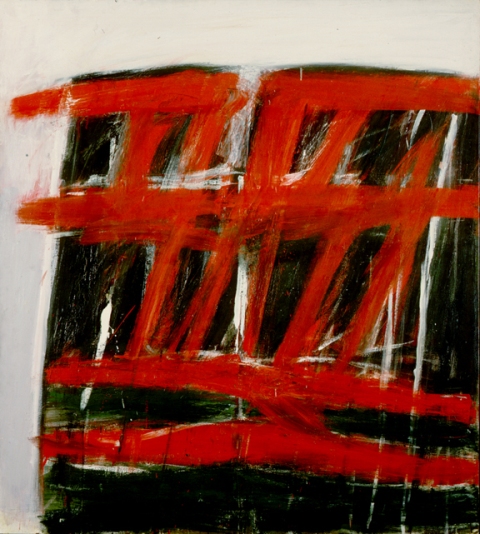
Gallery chronicle (September 2009)

  523TWRKV,Thursday1960
Jack Tworkov, Thursday (1960), courtesy Hirshhorn Museum and Sculpture Garden,
Smithsonian Institution, Washington, DC / Joseph H. Hirshhorn Purchase Fund

THE NEW CRITERION
September 2009

Gallery chronicle
by James Panero

We think of painting as a window, but for Jack Tworkov painting was a home. “My striving is not for the far-off or far-out landscape,” he once wrote, “but for the identification and naturalization of a home ground.” So he became the master contractor of Abstract Expressionism. In color and gesture he rarely dazzled. In the construction of work, however, he could be flawless. Rather than seek affection, he commanded admiration. His paintings do not seduce, they secure. They dig a foundation, erect four square walls, and put a roof over your head that is built to last.

In 1960 Tworkov complained that “I’ve been second-rated by every critic, large or small.” Two first-rate productions now allow us to reconsider this estimation. At no other moment, including 1964’s Whitney survey and 1987’s Pennsylvania retrospective, could this artist be so fully examined. At the UBS Art Gallery in midtown Manhattan, the curator Jason Andrew has assembled a must-see show called “Jack Tworkov: Against Extremes, Five Decades of Paintings.”[1] The exhibition presents numerous Tworkov drawings and twenty-nine major paintings, from Untitled (Still Life with Peaches and Magazine) (1929) to the large Compression and Expansion of the Square, completed just before the artist’s death in 1982. At the same time, Yale University Press has published the definitive collection of Tworkov’s writing in a book called The Extreme of the Middle, edited by Mira Schor.[2] This 480-page volume brings together Tworkov’s artist statements, published reviews, and correspondence, but most notably it unearths extensive selections from Tworkov’s diaries. In their philosophical and artistic introspection, these rigorous notations may just be the New York School’s answer to the journals of Delacroix.

Born in Biala, Poland, in 1900, Yakov Tworkovsky emigrated to the United States in 1913 with his mother and younger sister Janice, joining his father on the Lower East Side. The sister took the name of her Old World hometown to become a famous painter herself, a jet-setting Parisian ex-pat, and the common-law wife of Ford Madox Ford. Jack proved to be much less facile in putting down roots. He wrestled with the despair of alienation. “I have the perverse desire to be completely known as a Jew to non Jews but deny that fact to Jews,” he wrote of his religion in 1954. “My predicament is that I’m essentially a religious man—a religious man without a religion and so abstract art is perhaps the nirvana towards which I reach,” he reflected in the 1970s.

The order one can impose on painting became Tworkov’s support. “Geometrics or any systemic order gives me a space for meditation, adumbrates my alienation,” he wrote in a revealing letter to the painter Andrew Forge in 1981.

Tworkov studied at New York’s Stuyvesant High School and entered Columbia University to major in English Literature. He thought of becoming a poet. Then exposure to Cézanne and Matisse lured him to painting. Upon graduation in 1923, he enrolled in the National Academy of Design to study with Ivan Olinsky and Charles Hawthorne. He followed Janice to Provincetown and met Karl Knaths. At the Art Students League he trained with Guy Pène du Bois and Boardman Robinson.

Like many of the older members of the New York School, Tworkov took up painting with the Public Works Project. His genre work from this period, such as Afternoon Bridge (The Card Players) (c. 1935), is eminently forgettable, a fact he was quick to acknowledge. He became disillusioned with loaded political subject matter and stripped his work down to the bone. Tworkov may be known as the Abstract Expressionist who turned increasingly minimal in the 1960s, but the importance of structure is apparent from his early work. “I turned to still life as a release from subject and spectacular composition,” he wrote in 1947. His Untitled (Still Life with Blue Pitcher and Grapes) (1946) demonstrates an engineering hand, as line twists through space to connect elements into a unified whole. In 1948 he rented a studio next door to his friend Willem de Kooning. As a founding member of the Eighth Street Club, Tworkov then emerged alongside de Kooning during Abstract Expressionism’s rapid ascendency in the 1950s.

Some of Tworkov’s paintings from this period endure as masterpieces of post-war American art. House of the Sun (1952) ranks with de Kooning’s 1948 Painting in the MOMA collection as a supreme demonstration of gesture tied to form, here in primary colors. Watergame from 1955 is another example. Yet while Tworkov’s structure was always strong, often his color choice and brushwork lacked assurance. His painting could be stiff and overbuilt. Nausica (1952) is one instance where pastels produce a cartoonish riff on a de Kooning Woman.

The Dionysian expression that came to define Abstract Expressionism held little interest for Tworkov, and he gradually moved towards a more Apollonian center. “I would not be comfortable with a painting that was too aggressively stated or too sleek or too self-consciously simple, or too beautiful or too interesting,” he noted in 1973. “I am uncomfortable with extreme portrayals. I let reason examine disorder.” He recognized the uplifting quality in mid-century art: “The abstract-expressionist movement, although negative in its rejection of all tradition and especially of the French art of the first half of the century, did reflect this positive element, the postwar euphoria, the sudden feeling of strength both physically and spiritually.” Yet he turned against the violence of de Kooning: “We all dissent from de Kooning’s example of defacing, of painting out the painting, of throwing the defiled scrapings back on to the surface, in a gesture of contempt and hatred… . My attitude was to abandon the angry gesture, to wear in this respect a neutral face.”

Tworkov’s home life reflected his desire for order. He rejected the licentiousness of bohemia. He identified with middle-class America and lived accordingly. “Jack took care of everything—his car, his house, his lawn, his tools, his studio, his brushes, his family, himself,” noted the poet Stanley Kunitz. “Nobody could have led a more admirably moderate, regulated, or disciplined life.”

His diaries reveal a rigorous self-questioning that emerged from a revulsion with both Nazism and Communism. “The left has become the biggest cesspool,” he wrote in 1958. This sentiment matured into his identification with a patriotism that led not towards ideology but to freedom from ideology. “Only bourgeois society as we know it in America today gives me the freedom to join nothing, no organization and protects me from its vengeance,” he wrote in 1959. “We had and still have in this country the chance to take a new turn towards humanity and human society,” he continued, “Not Russia, not India, but America is the hope of the world.” He then proclaimed in 1960: “My Americanism amounts to a total conversion. I know myself to be Jewish, but my desire is for identification with those people and those forces that move towards making this country a reality of the Bill of Rights.” Tworkov saw the direction of his philosophy for what it was: “Rereading some of these notes I am struck by the conservatism of some of my views, how uncongenial they are to the prevailing intellectual point of view. However these notes are a response to the most serious self-questioning… . They represent not what I ought to believe, but what I know I believe.”

As Tworkov found his home in middle-class America, it meant an exit from artistic bohemia and the sacrifice of his own reputation. He despised Dada and its new formulations. (“A Jew is out of his head if he is for Dada,” he wrote in 1959, “like a hare running with the hounds.”) Yet rather than despair at his falling out, Tworkov found an additional spur. Many of his signature works emerged during this period. “I think the time has now arrived for me to do the best work of my life,” he wrote in his journal in 1960. He was right: Thursday (1960) is a standout of the UBS show. A red armature binds together the painting’s green and white forms, which come alive through an ambiguity of figure and ground. Although Tworkov says his dealer Leo Castelli once worried over them, one of Tworkov’s heraldic flag–type paintings, RWB #3, is also a triumph. “They are all in red, white and blue, and perhaps unconsciously an ironic comment on my growing patriotism.”

Tworkov moved to academia. In 1963 he became the chairman of the art department of Yale. He discovered a greater interest in mathematics and geometry. Unfortunately for an artist who once remarked that “all programs represent future sorrows,” much of the work from this period comes off as programmatic. Idling II (1970) might as well be the prototype for stain-concealing wallpaper. Even his writing seems increasingly formulaic. “The painting activity stands in ironic contrast to the measuring activity,” he noted at the time. “The brushing represents a purely random activity.”

The diagnosis of bone cancer around 1980 reawakened his human touch. Conventional wisdom dismisses all of Tworkov’s post-1960s work as bloodless noodling. Yet Compression and Expansion of the Square (1982) may just be the most assured painting in the show. In this three-panel work, structure becomes gesture. Tworkov built the animation of the piece into its form, not its brushstroke.

Tworkov could be a captive of his own intellect. “I had a revulsion against the intellectual in my own nature and in art,” he wrote in 1947. “I am a man condemned—behind bars—a prisoner,” he lamented in 1954. “I need desperately to be alone again—to stop the endless verbalizing of all my thinking, and to paint.” Yet he could also harness his intellectual pressures to build great structures in paint. “Reason chooses the ground where the play of feeling is set free. … It does not so much limit as it contains,” he remarked. While his paintings became marked by a greater sense of order, in fact he always exercised a high level of control, even in his more gestural work. “His paintings have a quality that other American-type non-objective paintings do not have,” Fairfield Porter rightly observed. “Though superficially just as broad and dashing, they are entirely conscious… . Tworkov’s power, which gives his paintings their lasting effectiveness, comes from his never letting go of awareness.” Tworkov believed in an “aesthetic morality,” and it began with the trueness of his line. “Art can become the true square and level of all things,” he wrote. Rather than a mere concern for structure and gesture, for Tworkov “trueness and pleasure add up to the most fundamental quality in a painting.”


Notes
Go to the top of the document.

    • “Jack Tworkov: Against Extremes, Five Decades of Paintings” opened at UBS Art Gallery, New York, on August 13 and remains on view through October 27, 2009. Go back to the text.
    • The Extreme of the Middle: Writings of Jack Tworkov, edited by Mira Schor; Yale University Press, 480 pages, $45. Go back to the text.

Special Report: The Pawnbroker

ART & ANTIQUES
September 2009

SPECIAL REPORT: The Pawnbroker
by James Panero

With the art lending business facing challenges, a startup tries an unconventional approach.

If the art of business has revolutionized the business of art in the past decade, Tony Barreiro and Ray Parker Gaylord are firmly in the vanguard. The San Francisco-based company ArtLoan, which they founded in 2004, lends money against the value of art collections owned by individuals and galleries. In this venture they join more established art financiers in New York. But unlike these large players, who lend only against big-ticket items, Barreiro and Gaylord say they want to change the way the world views even its smallest collectibles. Essentially, they aim to turn art and antiques at every level into ATMs.

Barreiro and Gaylord say they formed ArtLoan after a fateful visit to the local bank. They wanted a loan backed by a Picasso painting that Gaylord had inherited from his father, Charles, a dealer who specialized in antique mantelpieces. “We went to a major bank in San Francisco because they had extended credit to us based on real estate,” explains Barreiro, “but the idea of lending on a Picasso made no sense to them. They said that it had no value to them. We said, ‘There’s something wrong with this.’” The artwork, after all, could be appraised through auction results, just as real estate could be evaluated based on similar sales.

Eventually, they came to see the history of real estate as signaling an opportunity for the art market. “I remember the days where if you wanted to access money from your house, you had to sell your house,” Gaylord says. Home equity loans then made it possible to unlock the liquidity in real estate while still retaining ownership. The availability of money for equity fueled an unprecedented rise in home prices. This history, say Barreiro and Gaylord, shows that widespread access to an asset’s liquidity increases its value.

Asked whether the recently-imploded real estate market is the best model for lenders, Barreiro draws a distinction: “The real estate meltdown occured largely as a result of properties being overvalued and over-leveraged,” he says. “People were lending on 110, 120 percent of value. They were lending against future value, which is not how underwriting should work. We are not going to lend against what a Warhol is going to be worth five years from now.”

The ability to borrow against art is not altogether new. “Prior to the advent of modern banking and commerce,” Barreiro points out, “people borrowed against and bartered their personal property. Table silver, jewelry, furniture, porcelains and even rugs were used like cash. The business of art financing and lending can play an important role in making these objects readily liquid once again.” Even modern banking and finance gradually got back into the act. In 1979 Citibank formed an art advisory service, with two employees, out of its private banking division. The auction houses were not far behind, offering their own financial services in the form of bridge loans to sellers against consigned property and occasional financing to big-ticket buyers. Sotheby’s formed its Financial Services division in 1988. The year before, the auction house lent $27 million to Alan Bond, the Australian industrialist, to purchase Vincent van Gogh’s Irises. The purchase price of $53.9 million made it, at the time, the most expensive painting in the world, and the picture itself served as collateral for the loan.

Art prices, like real estate prices, have experienced their own recent rise and fall. Lending against equity has played a supporting role in this process by helping to drive auction returns. Even in 1987 some observers thought the Van Gogh purchase had been inflated by Sotheby’s loan.

During the past decade private equity firms, operating outside of banking regulations, have entered the business of art finance with headline-making deals that are turning expensive artworks into an ever more liquid commodity. For the first time art financing has come about not as an adjunct to other businesses but rather as an independent money-making venture.

“We are a private finance company, and not a bank” explains Ian Peck, who founded the New York-based Art Capital Group in 1999. “We are like a hedge fund.” In 2005 Andrew Rose, a former ACG director, started another private lending firm called Art Finance Partners, along with ACG’s comptroller Christopher Krecke. Since these firms operate outside of the FDIC regulations restricting bank-based lending, they could offer, for example, “non-recourse” loans—those backed only by art collateral for which the borrower is not personally liable (meaning that defaults have no effect on credit scores). The availability of such financing meant that art could be more than a luxury item. It could be a nontraditional asset in a diversified portfolio, with a suite of financial instruments at its service. In the fall of 2008 for example, the photographer Annie Leibovitz reportedly borrowed $24 million from ACG and a subsidiary against personal real estate and the reproduction rights for all her photographs.

Yet as art financing evolved over the past several years, only a small fraction of the collecting public could take advantage of it. “Our minimum loan amount is half a million dollars. Rarely do we do anything below that,” Peck explains. Since loans at ACG are made on 50 percent of the art’s value, he says, “to get to the half-million minimum you need to have artwork worth over a million,” or a combination of art and real estate with that value. Bank-based financing likewise serves only high-value art and high-net-worth individuals. Emigrant Bank Fine Art Finance, founded as Fine Art Capital by Andy Augenblick in 2004, advertises loan amounts between $1 million and $100 million on art and antiques.

“The competitors that are out there are primarily focused on very high-dollar artwork,” says Gaylord. “We realized that the market out there is not generally comprised of multimillion-dollar works of art. Most sales are $100,000 and under. And that means that dealers are not all buying multimillion-dollar Picassos and Warhols. They are buying stamp and coin collections, and their most valuable coin might be $25,000. Yet the ability to access cash from those collectibles is almost nonexistent because firms like Art Capital don’t want to deal with a $25,000 transaction.”

ArtLoan is still a startup. Barreiro and Gaylord will not discuss the volume of their business. They operate ArtLoan out of the same address as Charles Gaylord & Co., the company started by Ray’s father, where the two serve as dealer-partners. Yet they see their loan model as having the potential to change the art world. “There are people in New York who have been doing it longer than we’ve been doing it,” says Barreiro, “but they do it differently. We wanted to be the first to have a Web-based procedure, for it to be easy-no mystery, no 25-page contracts.” The two have taken out patents on several online business models. When financing becomes available, they plan to institute an auction financing system “as simple as Netflix,” says Barreiro. They also have a proposal to preapprove works sold at auction for loans, which could be activated by the buyer at any time after a sale.

Unlike other art lenders, ArtLoan is able to make small loans thanks to the particular regulatory structure Barreiro selected for their company—a structure that might surprise some in the art world. ArtLoan is a licensed pawnbroker. “Sadly, a lot of people have dim views of pawnbrokers,” says Barreiro. “They think they are going to take you to the cleaners or fence goods. But that’s not what we do here. I went to a pawnbroker’s convention in Sacramento and made the decision that this license makes so much more sense than any kind of banking license.”

Barreiro says the pawn license allows him to use simple contracts with low fees and no interest triggers. Once a work of art comes in for evaluation, ArtLoan bases its lending offers on the liquidation estimate of the collateral, minus the cost of storage, processing and depreciation. There is no court process on defaults. “There is a 10-day default grace period, and on the 11th day we vest in the property.” The pawn license also means that ArtLoan only makes non-recourse loans, in which the asset serves as the sole backing and approval requires only title and lien searches on the property and an in-house appraisal, not a credit search. “We don’t care whether the borrower is employed or whether they have paid their mortgage,” Barreiro says. Likewise, because these are nonrecourse loans, defaults do not adversely affect credit scores: “If you default on a loan from us, you are not a bad guy.” Finally, the license requires that all security must be sent to ArtLoan for safekeeping during the dura- tion of a loan.

According to Barreiro, the flexibility and simplicity of ArtLoan’s procedures make the firm attractive to his credit facilities (the companies that supply the cash) as well as to his borrowers. “When you borrow from a commercial bank,” he says, “you have to go through all the financial disclosures and credit-worthy tests, but many people cannot jump through those hoops.”

Barreiro believes that many lenders aim to encourage default through interest-rate hikes and fees hidden in their long contracts. “My bankers rub their hands like Shylock, hoping for default” in order to take possession of the art, he says, “but I don’t want our customers to default.”

Some high-end borrowers have run into trouble with their loans. In late July, The New York Times reported that ACG sued Leibovitz for allegedly refusing to cooperate with attempts to sell her houses and photographs to pay back her loan. Also accord- ing to the Times, the artist Julian Schnabel took out a loan from ACG in 2006 to help fund a real-estate venture and later sued the company over what saw as its “exorbitant fees.” ACG made a counterclaim against Schnabel for additional interest and fees because the artist did not disclose that there was an existing mortgage on his property.

Barreiro and Gaylord say they steer clear of such litigation. The real challenge for ArtLoan, as for all players in the art finance industry, is the current lack of availability of cash to make loans. “Cash is king, more than ever, and it seems to wear a big crown,” says Barreiro. “I would be lying if I said we are not challenged. Banks tell us they can get 15, 18 percent on their money all day long.” The retail rates for ArtLoan’s cash vendors mean that the company charges credit-card-like interest to its borrowers, with rates that can go as high as 24 percent.

Peck says ACG faces a similar cash crunch. “We have a lot of private equity, but our commercial lines are limited. As a result of the current market, where we used to have seven commercial banks, we now have one or two.” The cash crisis, says Peck, has recently forced many of his large competitors to shut their doors. “At the moment ACG is one of the few if not the only active lender in this space.” Christie’s officials say the auction house will still consider making loans against consigned artworks. Interview requests made to Emigrant Bank for this story were declined.

In the economic downturn, there could be an upside to ArtLoan’s small size. The multimillion-dollar loans made by the larger lenders were supported by the securitization markets and the ability to sell those loans into bond packages. That market is now largely closed. In addition, the pawnbroker license gives ArtLoan a great deal of latitude in its practices. “We are structured differently,” says Peck. “We are much more institutional.”

The art financing industry largely disappeared in the economic downturns of the 1980s and ’90s, only to rebound and grow. In the current climate the demand for art finance is offset only by the availability of cash to lend. The revolution that Barreiro and Gaylord anticipate in art-equity lending might come to pass in the next recov- ery. “There is a lot of house cleaning in the art and antiques world,” says Barreiro, “and this century is going to change the way that the antiques and fine arts business has always operated.”

Peck agrees, but advises caution about the road ahead: “Thirty years ago, only 5 percent of the buying public financed their cars; now that number is inverted. I am envisioning over time the same thing becoming true for the art market. People are going to use their collection as a margin account. Americans love to leverage their assets. Yet there has to be a balance with what the market says things are worth and the ampli- fier of financing. Real estate got out of control. There was such easy credit—you could borrow 100 percent of the purchase price for a home. There has to be a balance.”