A Beautiful Mind

Portraits of the mind

PROTO MAGAZINE
Winter 2011

A Beautiful Mind
by James Panero

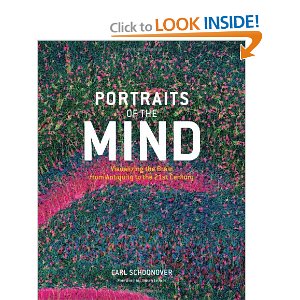
It was the hippocampus as no one had ever seen it, illuminated in radiant hues. The image is called, aptly, a Brainbow, the colors serving a scientific purpose by highlighting specific neural structures. Yet their choice also reflects an artistic bent; scientists display the brain not the way it is (an undifferentiated gray) but the way we want to see it, “painted” with bursts of fluorescent color.

This image, created in 2005, is one of many that Carl Schoon­over, a doctoral candidate in neurobiology and behavior at Columbia University, has collected in his recent Portraits of the Mind: Visualizing the Brain From Antiquity to the 21st Century (Abrams). As science has probed the brain’s structure and function, scientists have had to rely on art to translate their discoveries to visual form.

Leonardo da Vinci created a notable example around 1500, borrowing the techniques of statue casting to inject wax into the ventricles of a freshly killed ox. After the wax cooled, he carved the brain away to create an impression of the cavity, then sketched this casting of the void, rendering it from multiple angles.

The arrival of powerful optics during the mid-nineteenth century enabled scientists to penetrate the brain’s microscopic dimensions. Soon another Italian, Camillo Golgi, inaugurated modern neuroscience by successfully staining individual neurons. In his 1875 drawing of a dog’s olfactory bulb, Golgi records his observations while also somewhat imagining the process of smell, with bulbs in the shape of root vegetables penetrating a layer of neural connections, depicted in fanciful wavy lines.

Whereas Golgi mistook the brain for an uninterrupted web of cells, the Spaniard Santiago Ramón y Cajal correctly saw it as a network of discrete neurons. Cajal had an interest in the Eastern practice of composing ink on paper in a way that stressed negative space. Using this spare approach in a 1903 sketch, Cajal took note of synaptic boutons, which are partly responsible for intercellular communication.

Even after micrographs came into use, artistic intervention continued. In portraying the brain’s vascular system, scientists chose minimal white to create an image as haunting as snowbound woods, with detail conveyed through contrast rather than color values.

“Orientation Columns” (2006), meanwhile, is ruled by overlapping primary colors, as in op art. The piece was created by tracking the activity in a monkey’s visual cortex as the primate observed lines at different angles, each color denoting the angle that certain neuron groups “preferred.” The very act of seeing has created a compelling image.

Gallery chronicle (February 2011)

A_tree_grows_in_brooklyn
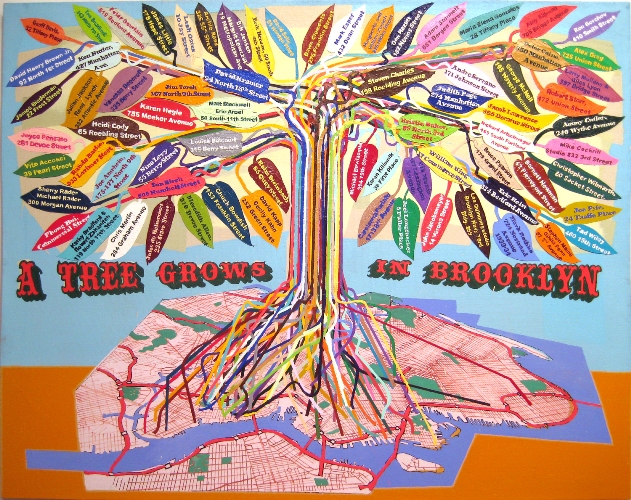
Loren Munk, A Tree Grows in Brooklyn (2006–10), courtesy of the artist


THE NEW CRITERION
February 2011

Gallery chronicle
by James Panero

On new media and the phenomenon of Loren Munk, whose work is on view at “New Year, New Work, New Faces” at Storefront Gallery, Brooklyn; “It’s All Good!!: Apocalypse Now” at Sideshow Gallery, Brooklyn; “Paper 2011” at Janet Kurnatowski Gallery; “I Like the Art World and the Art World Likes Me” at the Elizabeth Foundation for the Arts; and “#TheSocialGraph: An Evolving Exploration of Social Media Art” at Outpost gallery, Queens.


The art world that most people hear about is a dystopian one of auction headlines. It’s glossy features and gossip reporting. It’s the fast-food menu of celebrity artists arranged in starchitect-designed museum wings. It’s a world of power and money where taste gets issued by self-interested decree. And those are its better points. What makes this homogenized culture bad is how it obscures good art from public view.

A better art world revolves around nimble commercial galleries and non-profit spaces. Some of the best places for art are located in Chelsea, but many more are peripheral, alternative, and do-it-yourself (diy). Even if the art on display is sometimes bad, the vitality of this world is good, with its artist-packed openings and the chatter of conversation across a variety of styles.

The challenge for this world is how to broadcast and sustain itself with limited means in an environment that ignores it. A couple of issues back, I sounded a cautionary note about the intersection of criticism and new media. I was concerned about the messianism that accompanies new technology, especially when it’s employed by one of art’s most oxygen-depleting power brokers (see “My Jerry Saltz Problem,” December 2010).

That doesn’t mean we should disregard new media’s potential. The promise of new media is its ability to do an end-run around traditional networks of information. Facebook and Twitter have become essential tools for broadcasting shows and learning about art to see. Artists especially have benefited from becoming active online users, if only to take ownership and invest in their own representation.

For all of us, new media has elevated the issues of networking and connectivity from silent considerations into conscious actions. Thanks to Facebook, the word “Friend” is now a transitive verb. Those tools of social networking offer new ways to visualize our relationships while expanding our access to information.

Parallel to these developments, a school of art is now at work depicting the structures and connections of the art world in various graphic forms, while also using new media to draw attention to itself and the art of others.

I wrote about the paintings and video work of Loren Munk at the end of last month’s column, but they deserve further review. I am not the only one who thinks so. This is shaping up to be the Year of the Munk, as many more of us realize this quirky artist of strange diagrams and obsessive record-keeping is the prophet of a new art we are only starting to understand.

In addition to his exhibition at the gallery Minus Space, Munk has been invited to exhibit his paintings and videos in half-a-dozen recent group shows around New York. That list includes exhibitions at Storefront in Bushwick, Sideshow Gallery in Williamsburg, Janet Kurnatowski Gallery in Greenpoint, The Elizabeth Foundation in Midtown Manhattan, and an exhibition curated by the online editor Hrag Vartanian at Outpost gallery in Ridgewood, Queens, called “#TheSocialGraph: An Evolving Exploration of Social Media Art.”[1]

Munk creates his online videos of gallery openings and studio visits under the pseudonym James Kalm. If you take away anything from this column, search for his videos on YouTube under “JamesKalm” and “JamesKalmRoughCut” and subscribe to his feed. I predict this singular record of diy clips, most of them ten-minute windows on the art of today, will be more important to art history than almost anything being written about the contemporary scene.

I didn’t always think so. When I first heard about Munk’s video project several years ago—which he described as an expansion of his artistic practice—it sounded like an obsessive excuse to get out of the studio. Munk says he started filming around 2006, when he accidentally hit the video switch on his point-and-shoot camera. He has now made 500 or so videos, all filmed with similar low-tech equipment and a large memory card.

When I initially saw them, the look of the videos seemed as weird as the concept. Each report begins with Munk arriving at his gallery destination by bike (heavy breathing is a constant as he narrates what he encounters). His scenes combine observations of the people he sees with close-up views of art and thumbnail sketches of the artists. Since he films the gallery shows unannounced and often unauthorized, he holds his camera out as if taking a digital picture. Other times the camera dangles from a strap around his neck. The shooting style appeared rough back in 2006. Today it resonates with the amateur videos we all seem to be taking with our smart phones and flip cameras.

The amateur idiosyncrasies of these videos ultimately make them inviting. Munk records and overlays the performances of street musicians to get around the limitations of professional copyrights. He also thanks his wife Kate at the end of each clip. These are great touches. As opposed to most video art, which attempts to destabilize and confuse, his videos become more sensible with each view. Watch enough of them and it’s professional programming that starts to seem strange. Amateur videos have become the new normal.

Munk’s videos relate not only to new media (technically, he has created a video blog or “vlog”) but also to social networking and indeed his artistic project. The James Kalm Report connects the dots between artist, artwork, and viewer. It relates one show to the next. Through filming out-of-the-way galleries and non-headline personalities, his work documents an artistic network we might not otherwise see and broadcasts it to the greater public, without costing a dime (and without so far earning him a penny).

Munk came to New York to paint. When he’s not recording videos or writing about shows for The Brooklyn Rail, he is painting in his studio. He has been living and working in the same Red Hook loft since 1979. This history gets reflected in both his style in oil, which is heavily impastoed, rough, and rich in color, and in the connections he now depicts in his work.

Munk makes the case that personal connections matter and have always mattered in the world of art. Our links to the past matter as much as our connections to the present. So his paintings record the New York art scene in maps and lists from 1900 to today and document the inter-connectivity of a city’s artistic culture. For Munk, social media art, his videos, and his writing are all extensions of a reverential urbanism. (Hint: The City of New York could do worse than employ this urban historian for some grand artistic project.)

Munk’s best work highlights the connections of the artistic world he is invested in. Of his paintings now on view, the example up at Sideshow, Symbolic Clusters (STUDY) (2009–10), was my least favorite, because its analysis of the influences of contemporary British art seemed the most remote to Munk’s own world. In contrast, A Tree Grows in Brooklyn (2006–10) at the Elizabeth Foundation is iconic. Here, lines of color rise up from a map of Brooklyn to form the trunk of a tree, which then open into leaves that serve as labels for the location of artist studios—the flowering of an art scene in Munk’s own back yard.

As for their composition, these paintings, much like his videos, can seem strange, almost garish, but their weirdness becomes welcoming. Munk makes a conscious decision to connect with the history of painting not only in his work but also through his medium. His influences include the English Occultist Robert Fludd and the modernists Alfred Jensen and Ad Reinhardt. Hans Hofmann and Clement Greenberg hover in the background and sometimes feature in the diagrams themselves. The eccentricities that creep into Munk’s style also make his paintings instantly recognizable. The colors and typography borrow the visuals of signage to state their messages as boldly as possible. They are the exclamatory paintings of a reserved artist.

The Elizabeth Foundation show, curated by the artist Eric Doeringer, offers a survey of many of the younger artists working in modes related to Munk’s own. Art Basel Miami Beach Hooverville, by William Powhida and Jade Townsend, is already a modern classic. This hyper-detailed drawing depicts a fictional shanty-town of artists, critics, dealers, and collectors congregated outside the gates of the Miami Beach Convention Center, where arguably the country’s most important and most superficial art fair takes place each December. Friends and enemies are identified by name. Inside jokes are everywhere. Recently someone said the work resembled the centerfold of an old issue of Cracked magazine, a description that hints at the work’s punk humor mixed with a fantasy view of adult depravity and adolescent triumph. In the back of the image, beneath a plume of smoke, the artists depict their own “Siege Tower” made of “wood, rope, steel, iron will” directed at the front gate of the fair.

Through visual criticism, appropriation, and humor, the message here is that the good art world is coming to take on the bad. Powhida, along with the artist Jennifer Dalton and the alternative gallery owner Edward Winkleman, are leading this charge through artistic projects and webcast symposiums called #class and #rank (those #s are Twitter “hashtags” used for online organization). Powhida, a high school art teacher, has even developed a bratty alter ego for deep cover in the boozy-money world of celebrity art.

Munk’s project, though less confrontational, ultimately seems more subversive. Rather than take on the power and corruption of the bad art world, Munk strengthens the networks of the good. At the very least, he shows us the art world alternative. We should take note that on February 3, Munk, Powhida, Dalton, and Doeringer will meet at the Elizabeth Foundation to discuss their influences and try to arrive at a common term to describe their art (Munk likes “Informationism.”)

If the Elizabeth Foundation show brings together the criticisms of the mainstream, the group show now at Sideshow Gallery reveals the triumphs of the alternative network. The Brooklyn gallery’s owner, Richard Timperio, is not dissimilar from Munk in his attraction to the artists of his local scene. His annual group show brings together everyone he knows. With something like 500 works arranged floor to ceiling, this exhibition breaks every rule of gallery etiquette. In doing so it becomes a fantasy show of artistic friendships. The art of modern masters like Paul Resika, Thornton Willis, Nicolas Carone, Dan Christensen, Ronnie Landfield, Larry Poons, Peter Reginato, and Tadasky gets positioned next to the work of people (husbands of artists, other gallery owners) that you didn’t even realize made art. Then there are those under-represented artists here like Dana Gordon, Lori Ellison, and Tom Evans whom you would like to see much more often. Loren Munk used to be one of them. Now, through the vision of his art and a lot of pedaling, he’s everywhere.
 

[1] “New Year, New Work, New Faces” was on view at Storefront Gallery, Brooklyn, from January 1 through January 23, 2011; “It’s All Good!!: Apocalypse Now” opened at Sideshow Gallery, Brooklyn, on January 8 and remains on view through February 20, 2011; “Paper 2011” opened at Janet Kurnatowski Gallery on January 14 and remains on view through February 13, 2011; “I Like the Art World and the Art World Likes Me” opened at the Elizabeth Foundation for the Arts on January 14 and remains on view through March 5, 2011; “#TheSocialGraph: An Evolving Exploration of Social Media Art” was on view at Outpost gallery, Queens, from November 12 through November 27, 2010.

Oil on Canvas

RockefellerCenter
Rockefeller Center, John D's temple to technology, towering above Saint Patrick's Cathedral.

Philanthropy Magazine
January 2011

Oil on Canvas
by James Panero

The Rockefeller family has long been one of the nations most generous patrons of high culture. Suzanne Loebl assesses its legacy.

When antitrust laws broke up the ice floe of wealth accumulated in Standard Oil in 1911, John D. Rockefeller Sr. became the richest man in the history of the modern world. His fortune was estimated to reach into the hundreds of billions in today’s dollars.

A devout Baptist, Senior believed in giving his fortune away as zealously as he earned it. Following John Wesley’s evangelical economics—“gain all you can, save all you can, and give all you can”—Senior used his vast wealth to support initiatives in education and medicine. He provided funds to turn the University of Chicago and Rockefeller University into world-class institutions. His philanthropy supported Baptist schools throughout the country, most notably in the rural South. His wife, Laura (“Cettie”) Spelman Rockefeller, had been an ardent abolitionist, and after gifts from Rockefeller she became the namesake of Spelman College, a college in Atlanta for black women.

Senior imbued in his descendants his own sense of philanthropic obligation. As the family’s wealth began to pass into the hands of his only son, John D. Rockefeller Jr. carried on the religious tenor of his father’s giving, while widening the mission to include America’s great temples of culture. In America’s Medicis: The Rockefellers and Their Astonishing Cultural Legacy, Suzanne Loebl takes up the story with Junior and follows the family’s cultural philanthropy through Junior’s last surviving son, David Rockefeller. The youngest of five prominent brothers—John D. 3rd, Nelson, Laurance, and Winthrop—David, now 95 years old, inherited his grandfather’s longevity and continues the mission of his parents into the 21st century. Readers will have to wait for the sequel to this book to read about the philanthropy of the fourth generation of Rockefellers, following the elevation of David Jr. to chairman of the board of the Rockefeller Foundation this past November.

With hundreds of books already published on the Rockefeller family, the story Loebl tells may not be new, but it is told well. Her work is a breezy guide for how the Rockefellers supported the arts and how, today, we continue to enjoy their cultural largess. She not only recounts their achievements; she also seems to rejoice in their artistic successes, like Junior’s Rockefeller Center, that pagan temple to technology, and shows regret for those initiatives that fell short of their potential, like Nelson’s Empire State Plaza in Albany.

Loebl locates Junior’s philanthropic beginnings in his religious maturation at Brown University, where he became a protégé of its president, Elisha Benjamin Andrews, a Baptist minister. There, he modernized his world outlook while retaining his sense of piety. Understanding the Rockefellers’ progressive Protestantism is key to unlocking the family’s philanthropy. Loebl could have even done more with it. No family has given so much while deliberately courting so little prestige. At Brown, Junior met his future wife, Abby Greene Aldrich, the daughter of Rhode Island’s senior Senator. (He also smoothed out his awkward social manner—no more lengthy audits of dinner checks or salvaged postage stamps.) Later on, his faith would continue to inspire his giving, even (perhaps, especially) when applied to secular cultural causes.

As Junior settled back in New York after graduation and joined the family business, he took up teaching the Young Men’s Bible Class at the Fifth Avenue Baptist Church, which later relocated to Park Avenue. Inspired by the great Protestant modernist Harry Emerson Fosdick—the brother of an influential trustee of the Rockefeller Foundation—Junior undertook the creation of a new ecumenical cathedral in Morningside Heights, eventually donating $32 million to the project.

Junior laid the cornerstone for Riverside Church in 1927. Designed in the Gothic style of Chartres, the cathedral could accommodate 2,100 worshippers. It was completed in just three years, despite a massive fire during its construction. Included in the building’s elaborate ornamental program are carved likenesses of Albert Einstein and Charles Darwin, signaling the church’s (and Junior’s) progressive stance in the controversy between fundamentalism and theological modernism. The 22-story clarion, with 74 bronze bells, which includes the largest turned bell in the world, is named for Junior’s mother. Fosdick served as its first senior minister, and the church continues to broadcast Fosdick’s left-liberal worldview—sometimes to absurdity. In 2000, Fidel Castro delivered a four-hour-long diatribe from the Riverside pulpit, just one example of how politics sometimes obscure the beauty of the church’s towering architecture.

In the decades to follow, Rockefeller money spread through an ever widening circle of cultural enterprises. The successful ones were extensions of Junior’s ecumenical spirit, even when they were secular projects. Freed from a literal interpretation of the Bible, his advancement of science, art, and technology could take on its own religious fervor. Of these institutions, perhaps no other has been more influential and more closely associated with the Rockefeller family than the development of the Museum of Modern Art, built on the grounds of the one-time family compound.

MOMA is the Rockefeller temple to modernity, with a reverential solemnity that continues to define the institution to this day. Loebl dedicates a large section of her story to MOMA’s development and its principal founding patron, Abby Aldrich Rockefeller. Her husband, Junior, found little to like in modern art; his artistic passions were directed to sculpture, architecture, and Old World craftsmanship. Yet Abby saw her interest in modern art in Junior’s terms. “To me art is one of the great resources of my life,” she said. “I believe that it not only enriches the spiritual life, but that it makes one more sane and sympathetic, more observant and understanding, regardless of whatever ages it springs from or whatever subject it represents.”

The intricate dynamics of Rockefeller family giving could be comical at times, but they also served as lessons in how disparate tastes can play off each other to encourage greater developments. According to Loebl, Junior’s “dislike for some of modern art’s emotionally unrestrained, expressionistic spirit was such that the couple agreed that the art she acquired should be kept out of his sight.” At first Abby paid for her modest purchases, which formed a collection of thousands of modernist prints now in the MOMA collection, with Aldrich family money. In 1927, Junior increased her allowance of $50,000 for charitable gifts with another $25,000 for the art of her choosing. Abby sent her husband a formal thank-you letter, and Junior doubled the art budget the next year. Despite his aversion to its holdings, Junior proved to be MOMA’s single largest contributor by the time of his wife’s death in 1948. In addition to an initial $1.25 million, he donated another $4 million in her memory in the early 1950s. His sons, Nelson and David, later took up leadership roles at MOMA, donating artwork and millions more.

While Abby was founding MOMA in midtown, Junior went uptown, to the northern tip of Manhattan, for his greatest museum creation. As he did with his Riverside Church, which overlooks the Hudson River, Junior secured one of the most picturesque natural locations in the city for his creation—66 lofty acres around historic Fort Tryon, on a ridge north of the George Washington Bridge. He also bought up 700 acres of land along the Palisades in New Jersey to protect the viewshed across the Hudson.

The initial idea for bringing the fragments of disused ecclesiastic buildings from Europe to the United States belonged to George Grey Barnard, an eccentric sculptor. He imported columns and arches from four different cloisters, most notably the Benedictine abbey of Saint-Michel-de-Cuxa, before France tightened its laws on cultural exports. For a time he reassembled them as a small private museum on Fort Washington Avenue, not far from Rockefeller’s park property, which Junior donated to the city. Through Junior’s negotiations, the Metropolitan Museum was able to purchase Barnard’s architectural collection in 1925. Then with James Rorimer, the curator of the Met’s new Department of Medieval Art, and Charles Collens, the architect of Riverside Church, Junior reassembled the Cloister holdings into a unified building on a site reserved in northern Fort Tryon Park. The new Cloisters became the Met’s repository of medieval art, as well as one of the country’s great, unique architectural achievements. It also houses what was one of Junior’s most beloved possessions: the set of South Netherlandish Unicorn tapestries from 1495–1505.

Beyond these gems, few aspects of America’s cultural life have been bereft of Rockefeller largess. Loebl follows the story through the development of the Asia Society, Colonial Williamsburg, archeology museums, folk art collections, and the art of non-Western cultures. These have, of course, been a mere portion of the Rockefeller family’s entire philanthropic reach.

In the generation following Junior, the narrative of the Rockefellers’ cultural achievements gets harder to follow. There is an ever widening cast of characters. One also senses that the family’s ability to pull off great new cultural complexes gradually diminishes. Lincoln Center, John D. 3rd’s vital performing arts complex in Manhattan’s Upper West Side that includes spaces for the Metropolitan Opera, City Opera, the New York Philharmonic, the Juilliard School, and the New York City Ballet, is, architecturally, a brittle stepchild of Junior’s Rockefeller Center. Nelson’s redevelopment of downtown Albany into a massive governmental boondoggle, undertaken when he was Governor of New York, resembles nothing less than a fascistic parade ground cutting through the capital city.

Today the Rockefeller Foundation continues to support hundreds of cultural projects, but the heart of Rockefeller-style philanthropic fervor may have moved on to other causes. Maybe cultural philanthropy was but a generational stopover on the way to addressing more progressive political issues, ranging from global health to international relations and environmentalism. Politics also has a way of intruding in the arts. The Rockefellers found that out the hard way, when the family infamously commissioned Diego Rivera to paint a mural for Rockefeller Center. “Man at the Crossroads” ended up a paean to communism, featuring Vladimir Lenin, which Junior decided to remove. Fortunately, there are converts once the missionaries move on. With many hands now supporting them, the Rockefellers’ great cultural initiatives, from Rockefeller Center to MOMA to Lincoln Center, continue to thrive and enrich the life of the arts.