Gallery chronicle (March 2011)

Versailles_SV_with_info_panel+floorplan
Versailles with info panel from the Google Art Project

THE NEW CRITERION
March 2011

Gallery chronicle
by James Panero

On the VIP Art Fair, the Art Project powered by Google & "Angel Otero: Memento" at Lehmann Maupin, New York.

The “VIP” of the recent VIP Art Fair stood for Viewing in Private. Or maybe it was Viewing in Pajamas. The first international contemporary art fair designed to take place entirely online, VIP promised 138 galleries showing 2,200 artists, all delivered by the miracle of the internet to us in the comfort of home.[1] At its morning launch on Saturday, January 22, I doubt I was the only one throwing slippers at the computer screen. This adventure of art on the World Wide Web somehow went terribly wrong.

VIP had a glitzy, Chelsea feel. The co-founder of the fair was the mega-gallery owner James Cohan. VIP was his transliteration of a blue-chip fair to the web. There were booths to click and browse, galleries paying thousands of dollars to participate, and a business model that was lifted from Art Basel and Armory. Even the name VIP recalled the pecking-order hype that has
fueled fair culture over the past decade. The advanced publicity tried to add to that sense of urgency. In order to build up buyer pressure, VIP limited its run to a week. While browsing the fair was free, a “VIP Pass” was needed to gain “additional privileges, such as access to price ranges, chat, and the VIP Lounge”—“VIP,” here, meant in its original art-world sense. That Very Important ticket, by the way, cost $100 the first two days, and $20 for the stragglers starting on day three.

The problem with VIP was its decision to deliver art fair 2.0 with no worthwhile updates to version 1.0. In the real world, the sales gimmicks might have worked. In the decentralized culture of the internet, the engineered ostentation of VIP felt unwelcome, if not unseemly. Then there were the technical difficulties. Cohan & Co. may know art, but apparently they flunked computer science. As VIP’s servers became overloaded with traffic, the fair began kicking back error messages almost immediately upon launch. Due to repeated malfunctions, VIP had to discontinue its online chat facility for much of the run. On its homepage, the fair tried to spin the shortcomings as a product of its success. Really it was evidence of VIP’s failure to understand the medium.

Privacy proved to be another concern, an issue that quickly had Twitter a-tweeting with criticism. Somewhere buried in VIP’s user agreement was the disclaimer that “we share your name, email address, and your country of residence with the Exhibitors exhibiting artwork that you click on, unless you have opted out of this type of sharing.” In other words, for the privilege of paying up to $100 a ticket, a user’s personal information would be sent to participating galleries with each click-through. “Viewing in Private”? More like a data-mining scam.

Yet it was the experience of seeing art at VIP that proved to be the greatest disappointment. An engagement with art may be personal, but even when viewed in private, the interaction is never airless. VIP somehow managed to deliver an art fair that might as well have been in the vacuum of outer space. The fair failed to mimic, or even recognize, the attractions of its real-life counterparts. Art fairs succeed not by displaying a succession of merchandise. Fairs work because they simulate the landscape of the street, right down to the grid of display booths. Fairs are nomadic, condensed art-world cities where each building houses a gallery. How we experience these fairs depends on the ways we navigate them, the art we get to see, and the society of people we encounter. Watching and talking to people viewing an abundance of art work—the relationship of art and people—makes a fair worthwhile. Cohan and his VIP Art Fair attempted to do away with these interactions in order to deliver his collectors most efficiently to a point of sale. The approach missed the point entirely.

Of course, there was also the inherent limitation of displaying art in electronic reproduction. The problem with VIP was not with the computer images themselves, but with the fact that these pictures had no connections to real things. Considering that this fair was populated by brick-and-mortar galleries, the disconnection was inexplicable. Traditional art fairs concentrate the art represented by far-flung galleries in one place. In doing so they bring disparate people together as well. VIP had its galleries and art work stay put. The art existed somewhere in the real world, yet the fair made no effort, by way of maps or gallery hours, to send viewers out to see it in person.

Fortunately, just two days after VIP closed, art on the internet got an unexpected reprieve. On February 1, with little advanced fanfare—or at least fanfare directed towards me—Google launched its “art project.”[2] First developed by a Google engineer named Amit Sood as his “20% project,” what the company calls its percentage for experimental work, the Art Project brought two Google technologies to bear on the world of art: Street View and gigapixel photography. The company began by partnering with an initial round of seventeen museums in eleven cities and nine countries, including the Metropolitan Museum, MOMA, Tate Britain, the State Hermitage Museum, and the Uffizi. Leaving the curatorial decisions to the institutions, Google wheeled a modified version of its 360-degree Street View camera around whichever rooms the museums opened for imaging. Then at each institution, Google took a digital photograph of one work with a super high-definition camera. This device recorded the art in approximately seven gigapixels of information—that is, with 1,000 times more definition than a standard digital camera.

All of this visual data has now been incorporated into a new user interface. Google’s special website, www.googleartproject.com, is free to use, providing floor plans and visitor information about each museum paired to the newly recorded information. It ties the 360-degree indoor panoramas directly into the existing architecture of Google Maps and Street View—to the point where, if you take one extra step past a back wall at MOMA, you end up on 54th Street. It also tabs the gigapixel scans into the gallery views, along with 1,000 or so other existing images of museum holdings in various lower resolutions (the giga-pictures have a “plus” sign in the frame icons, the others do not). When clicked through, all of these images launch in their own window.

Did Google succeed where VIP failed? The answer is yes, because the Art Project attempts to supplement, rather than substitute, the viewing of art in person. Like Street View and Google Maps, the Art Project offers an invaluable digital record, here of art and museology, to anyone with a computer and an internet connection. I found the specter of Google’s cameras reflected in the Hall of Mirrors at Versailles a fitting image for the project’s singular mash-up of the beauty of innovation, old and new.

Like the zoom feature of Maps’s Satellite View, Gigapixel also offers a chance to see and appreciate the landscape of an art work’s surface in ways that were before unavailable outside of the conservation lab. Seen up close, the precision of Holbein can be as astonishing as the virtuoso brush marks of van Gogh. Google even allows users to clip and share zoomed images—potentially leading to new conversations and discoveries about key works. It says something about the genius of Google that everyone, from expert to amateur, can find something new in the Art Project. That’s because the project does not try to be a replacement for art, but instead offers a revolutionary new road map for exploring art in person. The exciting part is what happens as millions of people log in to see what they can discover for themselves.

My next discovery was made not behind a computer screen but through the low-tech conversation of a dinner party. Angel Otero is a young artist whose inaugural New York show opens at Lehmann Maupin gallery a day after this issue goes to press.[3] In January, we met sitting across from each other following the opening of a show of Joe Zucker’s latest work at Mary Boone (beat that, VIP Art Fair). A painter’s painter, Zucker can attract a heady following, so perhaps it was not surprising that I became interested in the artistic practice of one of his guests. The day after the dinner, Otero invited me up to his studio in Ridgewood/Bushwick for a visit and an advance look at his forthcoming show.

Born in San Juan, Puerto Rico in 1981, at age twenty-four Otero left a job as an insurance agent, along with his studies at the University of Puerto Rico, to earn an mfa at the Art Institute of Chicago. Here, while studying on a scholarship, he became something of a stand-out, attracting the attention of established painters and critics alike, including Zucker—who saw a kinship in the way Otero popped the hood on the process of painting.

Certainly it also helped that Otero has an unusual background. In a recent interview, he recounted how soon after arriving in Chicago, a professor asked the class which contemporary artists they liked to follow. Otero said Jackson Pollock and Willem de Kooning, because those were the painters he knew and liked. The answer drew laughs from his more sophisticated peers. Yet this innocence has now left Otero with his unburdened relationship to paint, a willingness to experiment with his medium—and a healthy dose of wide-eyed charm.

At the Art Institute, and now in his large studio overlooking the skyline of Manhattan, Otero developed a technique that turns oil paint into a “skin,” which he then peels and applies to canvas and other armatures. Otero may not be the first to manipulate paint in this way, but his gift for handling materials turns process into an art form. For his inaugural New York show, he painted images and stenciled words onto large sheets of plexiglass. Once the top layer of oil dried into a gummy mass, he used a large scraper to separate the more liquid paint beneath from the glass. He then attached these large sheets, of what one might call oil on oil, to canvas in reverse, with the wet underside now on top. The results might have been all thumbs, but instead the work became elegiac, with the shadows of painted imagery folding and melting off the picture planes.

With his first show at a top-shelf gallery, Otero now finds himself in the barrel of art’s spring-loaded career cannon. The position may be enviable for the great majority of artists who never experience their day on the launch pad. It also comes with the unenviable pressure of ceding some control over development to the people investing in your future. Otero now faces a burden of where to take his talent and opportunity—especially in his choice of imagery, which moves among literary allusion, personal mythology, and pure abstraction. He may develop into the Puerto Rican Anselm Kiefer, forever confronting island stories. I would prefer he continue his experiments in process to create a body of work that evokes the memory of paint itself. In either case, his feel for paint must remain personal—something we can only sense when viewing his work in person.
 

[1] The VIP Art Fair was on view at www . vipartfair . com from January 22 through January 30, 2011.

[2] Art Project, Powered by Google opened at www.googleartproject.com on February 1, 2011.

[3] “Angel Otero: Memento” opened at Lehmann Maupin gallery on February 17 and remains on view through April 17, 2011.

A Beautiful Mind

Portraits of the mind

PROTO MAGAZINE
Winter 2011

A Beautiful Mind
by James Panero

It was the hippocampus as no one had ever seen it, illuminated in radiant hues. The image is called, aptly, a Brainbow, the colors serving a scientific purpose by highlighting specific neural structures. Yet their choice also reflects an artistic bent; scientists display the brain not the way it is (an undifferentiated gray) but the way we want to see it, “painted” with bursts of fluorescent color.

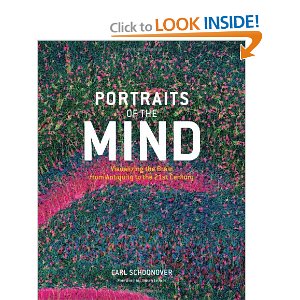
This image, created in 2005, is one of many that Carl Schoon­over, a doctoral candidate in neurobiology and behavior at Columbia University, has collected in his recent Portraits of the Mind: Visualizing the Brain From Antiquity to the 21st Century (Abrams). As science has probed the brain’s structure and function, scientists have had to rely on art to translate their discoveries to visual form.

Leonardo da Vinci created a notable example around 1500, borrowing the techniques of statue casting to inject wax into the ventricles of a freshly killed ox. After the wax cooled, he carved the brain away to create an impression of the cavity, then sketched this casting of the void, rendering it from multiple angles.

The arrival of powerful optics during the mid-nineteenth century enabled scientists to penetrate the brain’s microscopic dimensions. Soon another Italian, Camillo Golgi, inaugurated modern neuroscience by successfully staining individual neurons. In his 1875 drawing of a dog’s olfactory bulb, Golgi records his observations while also somewhat imagining the process of smell, with bulbs in the shape of root vegetables penetrating a layer of neural connections, depicted in fanciful wavy lines.

Whereas Golgi mistook the brain for an uninterrupted web of cells, the Spaniard Santiago Ramón y Cajal correctly saw it as a network of discrete neurons. Cajal had an interest in the Eastern practice of composing ink on paper in a way that stressed negative space. Using this spare approach in a 1903 sketch, Cajal took note of synaptic boutons, which are partly responsible for intercellular communication.

Even after micrographs came into use, artistic intervention continued. In portraying the brain’s vascular system, scientists chose minimal white to create an image as haunting as snowbound woods, with detail conveyed through contrast rather than color values.

“Orientation Columns” (2006), meanwhile, is ruled by overlapping primary colors, as in op art. The piece was created by tracking the activity in a monkey’s visual cortex as the primate observed lines at different angles, each color denoting the angle that certain neuron groups “preferred.” The very act of seeing has created a compelling image.

Gallery chronicle (February 2011)

A_tree_grows_in_brooklyn
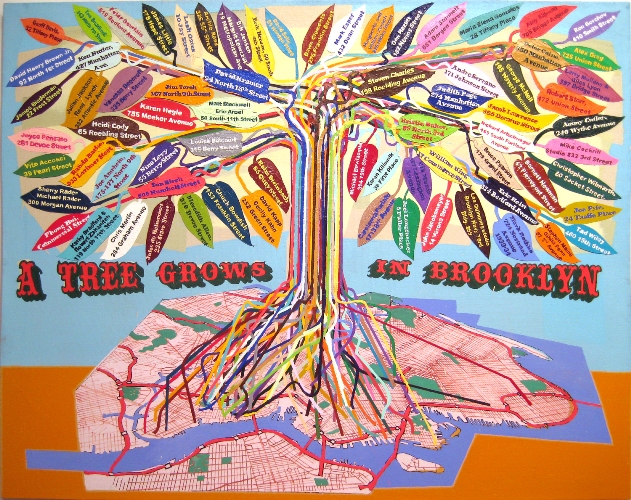
Loren Munk, A Tree Grows in Brooklyn (2006–10), courtesy of the artist


THE NEW CRITERION
February 2011

Gallery chronicle
by James Panero

On new media and the phenomenon of Loren Munk, whose work is on view at “New Year, New Work, New Faces” at Storefront Gallery, Brooklyn; “It’s All Good!!: Apocalypse Now” at Sideshow Gallery, Brooklyn; “Paper 2011” at Janet Kurnatowski Gallery; “I Like the Art World and the Art World Likes Me” at the Elizabeth Foundation for the Arts; and “#TheSocialGraph: An Evolving Exploration of Social Media Art” at Outpost gallery, Queens.


The art world that most people hear about is a dystopian one of auction headlines. It’s glossy features and gossip reporting. It’s the fast-food menu of celebrity artists arranged in starchitect-designed museum wings. It’s a world of power and money where taste gets issued by self-interested decree. And those are its better points. What makes this homogenized culture bad is how it obscures good art from public view.

A better art world revolves around nimble commercial galleries and non-profit spaces. Some of the best places for art are located in Chelsea, but many more are peripheral, alternative, and do-it-yourself (diy). Even if the art on display is sometimes bad, the vitality of this world is good, with its artist-packed openings and the chatter of conversation across a variety of styles.

The challenge for this world is how to broadcast and sustain itself with limited means in an environment that ignores it. A couple of issues back, I sounded a cautionary note about the intersection of criticism and new media. I was concerned about the messianism that accompanies new technology, especially when it’s employed by one of art’s most oxygen-depleting power brokers (see “My Jerry Saltz Problem,” December 2010).

That doesn’t mean we should disregard new media’s potential. The promise of new media is its ability to do an end-run around traditional networks of information. Facebook and Twitter have become essential tools for broadcasting shows and learning about art to see. Artists especially have benefited from becoming active online users, if only to take ownership and invest in their own representation.

For all of us, new media has elevated the issues of networking and connectivity from silent considerations into conscious actions. Thanks to Facebook, the word “Friend” is now a transitive verb. Those tools of social networking offer new ways to visualize our relationships while expanding our access to information.

Parallel to these developments, a school of art is now at work depicting the structures and connections of the art world in various graphic forms, while also using new media to draw attention to itself and the art of others.

I wrote about the paintings and video work of Loren Munk at the end of last month’s column, but they deserve further review. I am not the only one who thinks so. This is shaping up to be the Year of the Munk, as many more of us realize this quirky artist of strange diagrams and obsessive record-keeping is the prophet of a new art we are only starting to understand.

In addition to his exhibition at the gallery Minus Space, Munk has been invited to exhibit his paintings and videos in half-a-dozen recent group shows around New York. That list includes exhibitions at Storefront in Bushwick, Sideshow Gallery in Williamsburg, Janet Kurnatowski Gallery in Greenpoint, The Elizabeth Foundation in Midtown Manhattan, and an exhibition curated by the online editor Hrag Vartanian at Outpost gallery in Ridgewood, Queens, called “#TheSocialGraph: An Evolving Exploration of Social Media Art.”[1]

Munk creates his online videos of gallery openings and studio visits under the pseudonym James Kalm. If you take away anything from this column, search for his videos on YouTube under “JamesKalm” and “JamesKalmRoughCut” and subscribe to his feed. I predict this singular record of diy clips, most of them ten-minute windows on the art of today, will be more important to art history than almost anything being written about the contemporary scene.

I didn’t always think so. When I first heard about Munk’s video project several years ago—which he described as an expansion of his artistic practice—it sounded like an obsessive excuse to get out of the studio. Munk says he started filming around 2006, when he accidentally hit the video switch on his point-and-shoot camera. He has now made 500 or so videos, all filmed with similar low-tech equipment and a large memory card.

When I initially saw them, the look of the videos seemed as weird as the concept. Each report begins with Munk arriving at his gallery destination by bike (heavy breathing is a constant as he narrates what he encounters). His scenes combine observations of the people he sees with close-up views of art and thumbnail sketches of the artists. Since he films the gallery shows unannounced and often unauthorized, he holds his camera out as if taking a digital picture. Other times the camera dangles from a strap around his neck. The shooting style appeared rough back in 2006. Today it resonates with the amateur videos we all seem to be taking with our smart phones and flip cameras.

The amateur idiosyncrasies of these videos ultimately make them inviting. Munk records and overlays the performances of street musicians to get around the limitations of professional copyrights. He also thanks his wife Kate at the end of each clip. These are great touches. As opposed to most video art, which attempts to destabilize and confuse, his videos become more sensible with each view. Watch enough of them and it’s professional programming that starts to seem strange. Amateur videos have become the new normal.

Munk’s videos relate not only to new media (technically, he has created a video blog or “vlog”) but also to social networking and indeed his artistic project. The James Kalm Report connects the dots between artist, artwork, and viewer. It relates one show to the next. Through filming out-of-the-way galleries and non-headline personalities, his work documents an artistic network we might not otherwise see and broadcasts it to the greater public, without costing a dime (and without so far earning him a penny).

Munk came to New York to paint. When he’s not recording videos or writing about shows for The Brooklyn Rail, he is painting in his studio. He has been living and working in the same Red Hook loft since 1979. This history gets reflected in both his style in oil, which is heavily impastoed, rough, and rich in color, and in the connections he now depicts in his work.

Munk makes the case that personal connections matter and have always mattered in the world of art. Our links to the past matter as much as our connections to the present. So his paintings record the New York art scene in maps and lists from 1900 to today and document the inter-connectivity of a city’s artistic culture. For Munk, social media art, his videos, and his writing are all extensions of a reverential urbanism. (Hint: The City of New York could do worse than employ this urban historian for some grand artistic project.)

Munk’s best work highlights the connections of the artistic world he is invested in. Of his paintings now on view, the example up at Sideshow, Symbolic Clusters (STUDY) (2009–10), was my least favorite, because its analysis of the influences of contemporary British art seemed the most remote to Munk’s own world. In contrast, A Tree Grows in Brooklyn (2006–10) at the Elizabeth Foundation is iconic. Here, lines of color rise up from a map of Brooklyn to form the trunk of a tree, which then open into leaves that serve as labels for the location of artist studios—the flowering of an art scene in Munk’s own back yard.

As for their composition, these paintings, much like his videos, can seem strange, almost garish, but their weirdness becomes welcoming. Munk makes a conscious decision to connect with the history of painting not only in his work but also through his medium. His influences include the English Occultist Robert Fludd and the modernists Alfred Jensen and Ad Reinhardt. Hans Hofmann and Clement Greenberg hover in the background and sometimes feature in the diagrams themselves. The eccentricities that creep into Munk’s style also make his paintings instantly recognizable. The colors and typography borrow the visuals of signage to state their messages as boldly as possible. They are the exclamatory paintings of a reserved artist.

The Elizabeth Foundation show, curated by the artist Eric Doeringer, offers a survey of many of the younger artists working in modes related to Munk’s own. Art Basel Miami Beach Hooverville, by William Powhida and Jade Townsend, is already a modern classic. This hyper-detailed drawing depicts a fictional shanty-town of artists, critics, dealers, and collectors congregated outside the gates of the Miami Beach Convention Center, where arguably the country’s most important and most superficial art fair takes place each December. Friends and enemies are identified by name. Inside jokes are everywhere. Recently someone said the work resembled the centerfold of an old issue of Cracked magazine, a description that hints at the work’s punk humor mixed with a fantasy view of adult depravity and adolescent triumph. In the back of the image, beneath a plume of smoke, the artists depict their own “Siege Tower” made of “wood, rope, steel, iron will” directed at the front gate of the fair.

Through visual criticism, appropriation, and humor, the message here is that the good art world is coming to take on the bad. Powhida, along with the artist Jennifer Dalton and the alternative gallery owner Edward Winkleman, are leading this charge through artistic projects and webcast symposiums called #class and #rank (those #s are Twitter “hashtags” used for online organization). Powhida, a high school art teacher, has even developed a bratty alter ego for deep cover in the boozy-money world of celebrity art.

Munk’s project, though less confrontational, ultimately seems more subversive. Rather than take on the power and corruption of the bad art world, Munk strengthens the networks of the good. At the very least, he shows us the art world alternative. We should take note that on February 3, Munk, Powhida, Dalton, and Doeringer will meet at the Elizabeth Foundation to discuss their influences and try to arrive at a common term to describe their art (Munk likes “Informationism.”)

If the Elizabeth Foundation show brings together the criticisms of the mainstream, the group show now at Sideshow Gallery reveals the triumphs of the alternative network. The Brooklyn gallery’s owner, Richard Timperio, is not dissimilar from Munk in his attraction to the artists of his local scene. His annual group show brings together everyone he knows. With something like 500 works arranged floor to ceiling, this exhibition breaks every rule of gallery etiquette. In doing so it becomes a fantasy show of artistic friendships. The art of modern masters like Paul Resika, Thornton Willis, Nicolas Carone, Dan Christensen, Ronnie Landfield, Larry Poons, Peter Reginato, and Tadasky gets positioned next to the work of people (husbands of artists, other gallery owners) that you didn’t even realize made art. Then there are those under-represented artists here like Dana Gordon, Lori Ellison, and Tom Evans whom you would like to see much more often. Loren Munk used to be one of them. Now, through the vision of his art and a lot of pedaling, he’s everywhere.


[1] “New Year, New Work, New Faces” was on view at Storefront Gallery, Brooklyn, from January 1 through January 23, 2011; “It’s All Good!!: Apocalypse Now” opened at Sideshow Gallery, Brooklyn, on January 8 and remains on view through February 20, 2011; “Paper 2011” opened at Janet Kurnatowski Gallery on January 14 and remains on view through February 13, 2011; “I Like the Art World and the Art World Likes Me” opened at the Elizabeth Foundation for the Arts on January 14 and remains on view through March 5, 2011; “#TheSocialGraph: An Evolving Exploration of Social Media Art” was on view at Outpost gallery, Queens, from November 12 through November 27, 2010.