Gallery Chronicle (October 2012)

Schonebeck

Ohne Titel/Untited by Eugen Schönebeck (pen on paper, 60.9x42.9cm, 1963)

THE NEW CRITERION
October 2012

Gallery Chronicle
by James Panero

On “Line and Plane” at McKenzie Fine Art, “Fred Gutzeit: SigNature” at Sideshow Gallery, “Heroes” at Small Black Door, “Jon Schueler: The Mallaig Years, 1970–75” at David Findlay Jr. Gallery & “Eugen Schönebeck: Paintings and Drawings, 1957–1966” at David Nolan Gallery.

The start of the New York art season can seem like going back to school. The furious few weeks of openings following Labor Day serve as student orientation. Everyone’s on campus, classes begin, and you get a good sense of what the semester will bring.

In the galleries, all early indications suggest this will be a very good year. I found strong inaugural exhibitions across every gallery neighborhood I visited. And for all the ones I saw, there were others I wanted to catch but just couldn’t before press time. These include the early photographs of Ai Weiwei at Carolina Nitsch; Thomas Micchelli’s figure drawings at Centotto; “Land Escape” at Parallel Art Space; Chuck Bowdish’s paintings, drawings, and collages at Steven Harvey; and “To Be a Lady: An Exhibition of Forty-five Women in the Arts,” curated by Jason Andrew at the former UBS Art Gallery in Midtown. There’s more good art to see than could possibly meet the eye.

This solid start is in contrast with what’s happening at New York’s museums. Over dinner, an independent curator explained to me that she would now rather organize an exhibition at a respected gallery than at The New Museum. With its hacked-up walls, its self-dealing, and its parade of second-rate shows, The New Museum has become such a pariah that (as an artist recently confirmed to me) to exhibit there is to blow your shot at a real New York museum show.

But then, what’s become of the real museums? Over a weekend in September, the Brooklyn Museum awoke from its slumber to engage with art made in its own backyard, which it had, up to that point, all but ignored. Yet the museum’s initiative, “Go Brooklyn,” a “community-curated open studio project,” amounted to little more than a social-media marketing gimmick. After suggesting that artists open their studios across Brooklyn, the museum turned them into unpaid contestants competing for studio “check-ins,” where the “ten artists with the most voter nominations will receive visits from Brooklyn Museum curators.” Sure, it was possible to see some great work, but it would have been far better (and truly generous) if the Brooklyn Museum had put its muscle behind each neighborhood’s existing open-studio weekends rather than leverage its own art crawl.

Since the Brooklyn Museum was a partner in the canceled reality-TV show “Work of Art,” the institution may now assume that connoisseurship is little more than a contest. Do I need to suggest that curators shouldn’t need a popular vote to visit studios? Or that artists shouldn’t be the pawns in a museum’s marketing campaign? Until now, the artists of Brooklyn have thrived without the help of the Brooklyn Museum. “Go Brooklyn” suggests the borough was better off without it.

Fortunately, unlike the Brooklyn Museum, we still have the Metropolitan Museum, where scholarship . . . oh wait. Since the retirement of Philippe de Montebello in 2008, we’ve all been wondering whether this institution, under the directorship of Thomas Campbell, would continue to be a stalwart for serious art or fall prey to the temptations of populism that defined Thomas Hoving, de Montebello’s predecessor.

Hoving described his promotion of blockbuster exhibitions—such as his late-1970s circus act from the tomb of King Tut—as “making the mummies dance.” In contrast, de Montebello repeatedly demonstrated that a great exhibition needed little fanfare to attract an audience. Admission statistics alone were no measure of importance, and an inverse relationship appeared to exist between an exhibition’s promotional budget and its artistic merit.

Now following its recent blockbuster costume show for the designer Alexander McQueen, the Metropolitan has again begun touting its turnstile numbers as a sign of success, not to mention a source of revenue. With advertisements plastered across town, events sponsored by the Campbell’s Soup Company, and Hollywood celebrities shilling in its marketing campaign, the Met suddenly seems to be everywhere except where it needs to be—as the example of an institution that takes itself seriously. With “Regarding Warhol, Fifty Years, Sixty Artists,” Tom Campbell’s soupy show might make Hoving dance, but it appears to be little more than a dumbed-down spectacle designed to juke the stats at the ticket counter.

This all goes to show how fortunate we are for the life of art that exists outside museums. Consider this interesting dynamic. The non-profit museums promote themselves; the commercial galleries promote the art. One enriches an administrative class through tax breaks, ticket returns, and government subvention, all while claiming to fulfill an educational mission; the other largely lives off sweat equity, charges no admission, and actually educates the public by displaying a great breadth of art without any guarantee of financial return.

At the galleries, the season began with openings across the Lower East Side. Many of the galleries here are descendants of the smart, smaller venues that once lined the upper floors of buildings in Soho, Chelsea, and the Upper East Side. My tour began with Matthew Miller’s haunting self-portraits at Pocket Utopia (I covered Miller’s paintings at length in my column of June 2011). It continued with Sandi Slone’s pearlescent abstractions at Allegra LaViola Gallery, Drew Shiflett’s paper constructions at Lesley Heller Workspace, and Charles Hinman’s canvas sculptures at Marc Straus.

A standout among many was the group show “Line and Plane.”1 McKenzie Fine Art is the latest LES arrival, leaving an upstairs venue in Chelsea for a large storefront on Orchard Street. The gallery specializes in geometric abstraction, and these strengths were all on display in a group show with several artists I have praised in these pages, including Don Voisine, Halsey Hathaway, Gary Petersen, Rob de Oude, and Lauren Seiden.

In Williamsburg, Fred Gutzeit has put his signature on “SigNature” at Sideshow Gallery.2 Through photographs, watercolors, and computer manipulation, Gutzeit transforms street graffiti into op-art abstraction. Atop eye-popping patterns, he signs his paintings in a script of taffy swirls. While the underlying patterns can interfere with the energy of the writing, Yijing sig. 5 has such flourish it calls to mind (to my mind, at least) Suleiman the Magnificent, the Ottoman Sultan with one of history’s great tags.

Further out in the outer boroughs, several openings in Ridgewood, Queens had me riding the M train in what was a personal first. This lovely, middle-class neighborhood that borders Bushwick, Brooklyn, features some of the city’s more interesting apartment galleries, such as Valentine, now with a smart group-painting show. The nearby venue Small Black Door is a basement space true to its name. Currently behind its tiny entrance is an excellent survey of local artists. Organized by the painter Julie Torres, one of the neighborhood’s art evangelists, “Heroes” brings together twenty-four artists who have in some way contributed to the community beyond their own work.3

Several here have organized their own gallery spaces and art events (Liz Atzberger, John Avelluto, Deborah Brown, Kevin Curran, Joy Curtis, Paul D’Agostino, Rob de Oude, Lacey Fekishazy, Enrico Gomez, Chris Harding, Lars Kremer, Ellen Letcher, Amy Lincoln, Matthew Mahler, Mike Olin, James Prez, Kevin Regan, Jonathan Terranova, and Austin Thomas). Others have been writing about them for blogs and newspapers (Brett Baker, Paul Behnke, Sharon Butler, Katarina Hybenova, and Loren Munk). With work that can be as engaging as their advocacy, all of these “heroes” speak to the vitality of art on the periphery.

In midtown, David Findlay Jr. Gallery presented “Jon Schueler: The Mallaig Years.”4 Visiting the Sound of Sleat off the western coast of Scotland, Schueler (1916–1992) captured the energy of the sky in Wagnerian tones. A B-17 navigator based in England during World War II, Schueler spent his war years inside a plexiglas nose cone “as though suspended in the sky,” he later said. His paintings are infused with “red thoughts” and the “red of rage,” with glowing clouds parting on an unknown skyscape. With thin coats of pigment, Schueler combined the lessons of his teacher Clyfford Still with the fury of Turner. He took on Ab-Ex scale to produce work that occupies a middle ground between Mark Rothko and Milton Avery—part abstract, part representational, and fully ominous.

Among several strong shows in Chelsea, including Carolanna Parlato at Elizabeth Harris and Katherine Taylor at Skoto Gallery, David Nolan has mounted one of the best of them, with an historical exhibition of the greatest post-war German artist you’ve never heard of.

Coming from the Communist East, moving to the West, and struggling to find a voice outside of Cold War ideology, Eugen Schönebeck in many ways mirrored Georg Baselitz, his now better-known contemporary.5 Yet unlike Baselitz, Schönebeck never found a middle ground between the misplaced idealism of the East and the demands of the West. By 1967, his non-conformism caught up with him. He gave up art altogether.

This show—Schönebeck’s first solo exhibition in the United States—testifies to the abilities of an artist who channeled the spirit of the age into macabre paintings and drawings of singular dexterity and imagination. Abandoning the Soviet Realism of the East, Schönebeck first worked through Tachisme, Western Europe’s cooler answer to American Abstract Expressionism. In the early 1960s, these drips and drabs coalesced into nightmarish figures. He aimed “to let a certain tenor rise to the surface . . . a consciousness of crisis, pervasive sadness, gruesomeness, and even perverseness—that I found missing in the work of my colleagues.” With Baselitz, his fellow student, he wrote a pair of stream-of-consciousness manifestos called “Pandemonium” seeking to “point the way unerringly to the true meaning of freedom. / Flowers in the undergrowth. / The crematorium.”

Curated by Pamela Kort, the Nolan show follows this trajectory and focuses on the grotesque figure drawings of 1962 and 1963. The show is less than a survey. There is only one example, Mayakovsky (1966), from his late series of deadpan portraits dedicated (ironically?) to the icons of socialism. Schönebeck’s political evolution therefore remains unexamined, as do his reasons for leaving the world of art. Still, the dyspeptic mood he enunciated remains as current today as it did in the 1960s. One cannot but hope that this visionary, now living in Berlin, may once again put pen to paper and brush to canvas.


1 “Line and Plane” opened at McKenzie Fine Art, New York, on September 5 and remains on view through October 28, 2012.

2 “Fred Gutzeit: SigNature” opened at Sideshow Gallery, Brooklyn, on September 8 and remains on view through October 7, 2012.

3 “Heroes” opened at Small Black Door, Queens, on September 14 and remains on view through October 14, 2012.

4 “Jon Schueler: The Mallaig Years, 1970–75” was on view at David Findlay Jr Gallery, New York, from September 5 through September 29, 2012.

5 “Eugen Schönebeck: Paintings and Drawings, 1957–1966” opened at David Nolan Gallery, New York, on September 13 and remains on view through November 3, 2012.
A Monumental Problem

IMAG0955

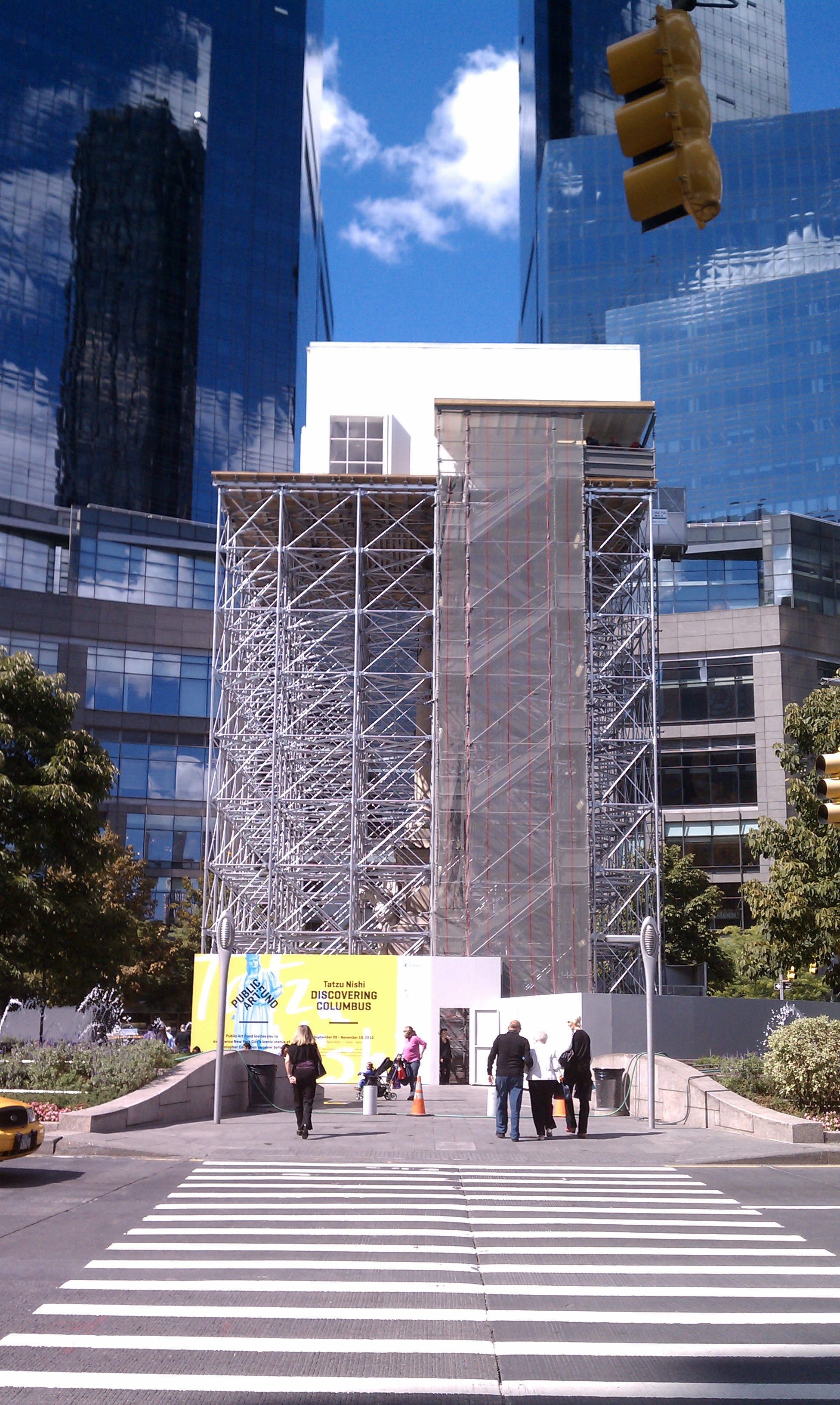
"Discovering Columbus," an installation by Tatzu Nishi featuring the 1892 Columbus Circle statue by Gaetano Russo. (All photographs by James Panero)


THE WALL STREET JOURNAL
September 25, 2012

A Monumental Problem
by James Panero

Through late November, visitors to the southwest corner of Central Park will have to say "Goodbye, Columbus." That's because Gaetano Russo's 1892 statue of the explorer, usually visible for miles around, will be covered in scaffolding that all but removes the monument from public view.

IMAG0968
The Columbus Circle monument covered by "Discovering Columbus"

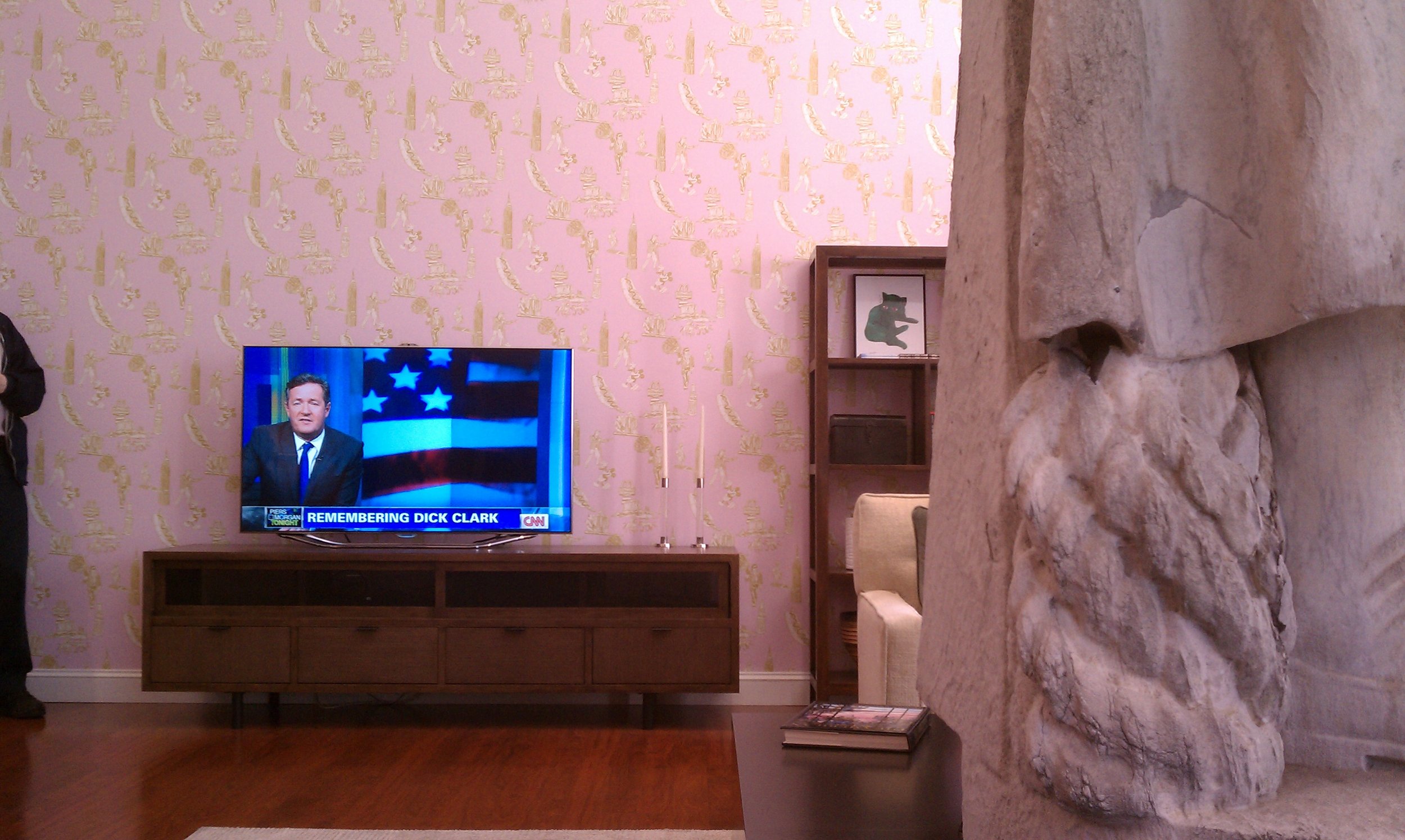
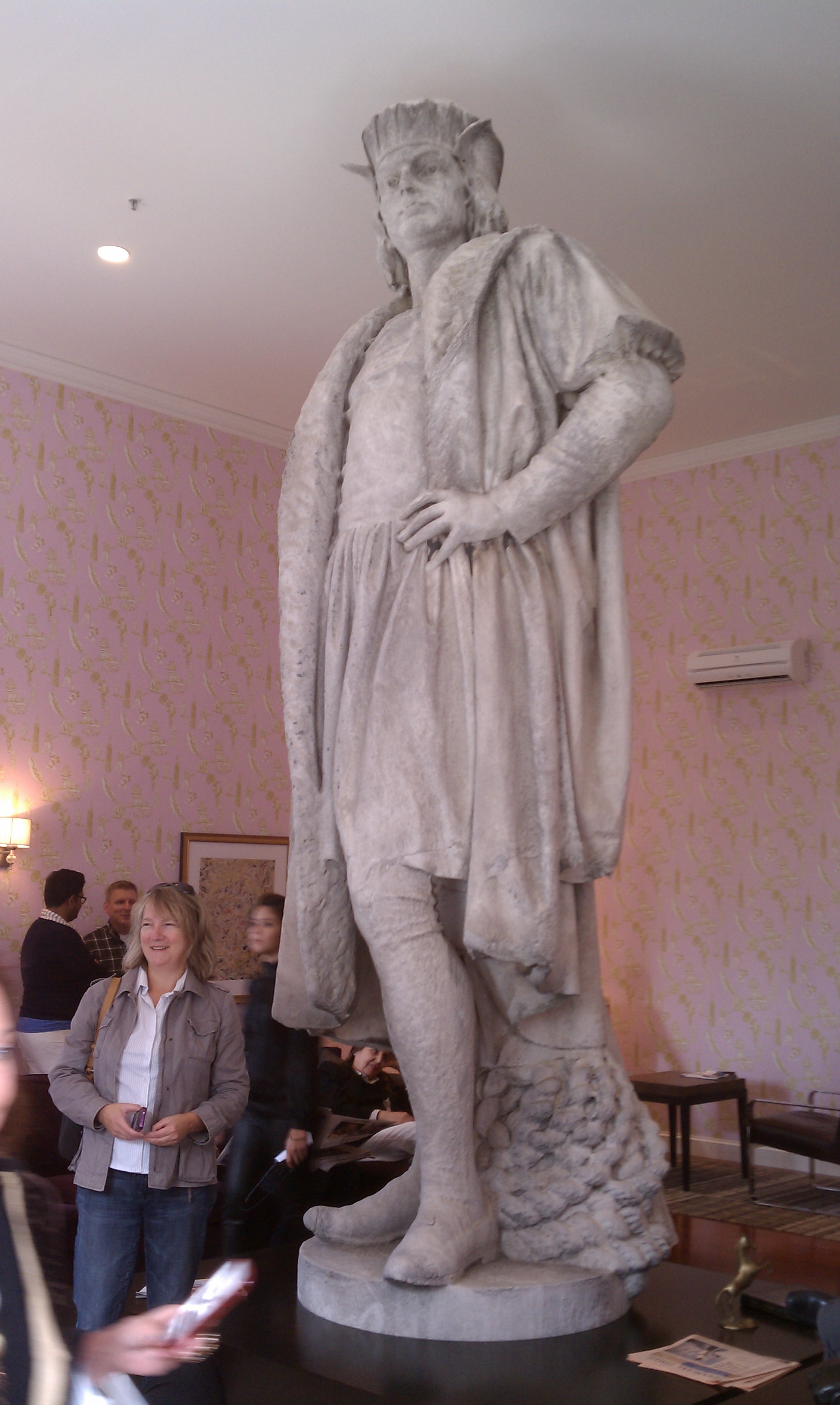
What looks like restoration work is really much more: A Japanese artist, Tatzu Nishi, has been commissioned to decorate an elevated shed enclosing the statue so that, instead of looking out over Columbus Circle atop a 60-foot column, Columbus now appears to be standing on a coffee table, surrounded by couches, lamps, a television set, red window curtains and pink-and-gold wallpaper printed with pictures of Marilyn Monroe, Mickey Mouse and Michael Jackson. Admission to this spectacle is by a free timed ticket, with at most 25 people at once allowed inside the 800-square-foot space.'Discovering Columbus' encloses the explorer's statue at Columbus Circle in an 800-square-foot living room.

IMAG0953
Marilyn Monroe, Mickey Mouse and Michael Jackson: custom wallpaper covers the "living room" of "Discovering Columbus"

The installation, "Discovering Columbus," has been produced by the Public Art Fund, a nonprofit championed by Mayor Michael Bloomberg. Dedicated to offering the public "powerful experiences with art and the urban environment," the fund's other projects have included bringing Jeff Koons's topiary-puppy sculpture to Rockefeller Center and Rob Pruitt's statue of Andy Warhol to Union Square.

Like much of what the Public Art Fund promotes, "Discovering Columbus" can seem like campy fun—a million-dollar confection brought to you by the city's billionaire mayor. Yet the hijinks of "Discovering Columbus" come at the expense of the Columbus Circle monument itself, which must be kidnapped to take part in the party. The offer of the organizers to restore the monument at the end of the show—with Parks Department funds—implicitly acknowledges the disservice done during the run.

IMAG0965
A television inside "Discovering Columbus" is tuned to CNN

The temporary hijacking of Columbus Circle is but the latest chapter of a monumental problem. Part of this story is the unease, bordering on contempt, with which cultural progressives regard traditional monuments. Outmoded in both form and content, Columbus Circle was ripe for ridicule. Even if most New Yorkers find little fault with it, this classical monument to a questionable figure in our history has become embarrassing to the city's cultural establishment. "Discovering Columbus" therefore appropriates and recasts it at the exact time of year when it is valued most. This Columbus Day, the Italian-American groups that traditionally lay a wreath at the base of the monument can lean it against a purple sofa in Mr. Nishi's ersatz living room.

Columbus_Circle,_New_York_c1907_LC-DIG-ppmsca-05881
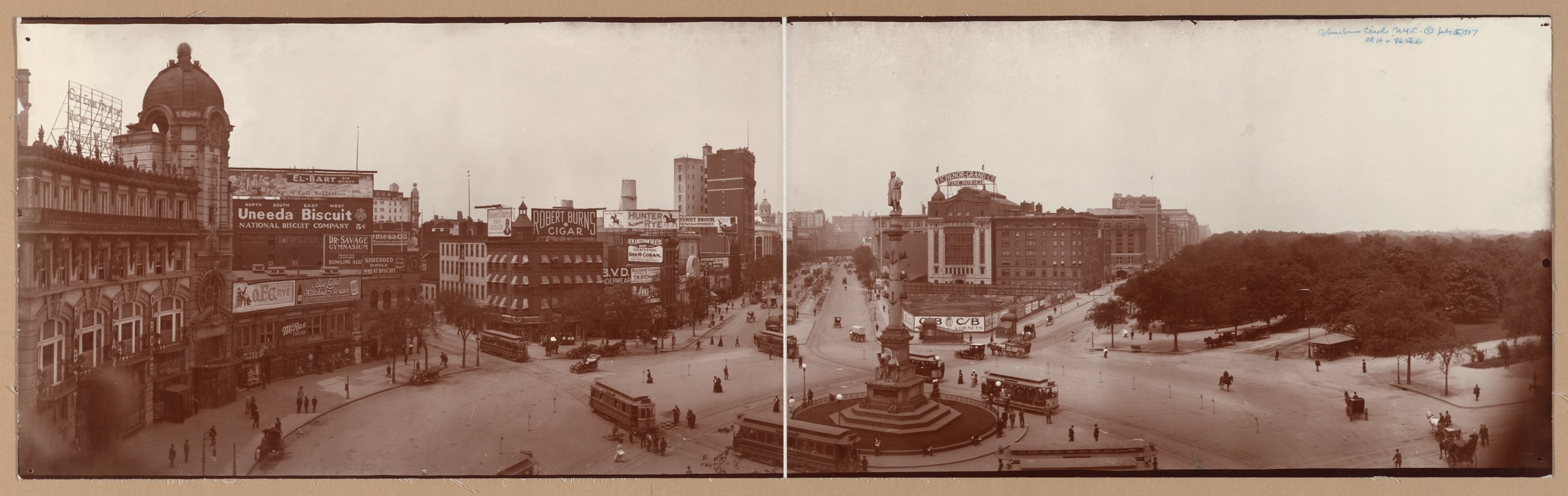
Columbus Circle, ca. 1907

As power changes and the memorialized fall out of favor, the forces of history have destroyed monuments almost as fast as they go up. The cultural war on monuments, however, only officially began in 1871. That was the year Gustave Courbet, the celebrated Realist painter then in his early 50s, found himself at the center of a 72-day utopian experiment known as the Paris Commune. This failed attempt at autonomous rule became the model for many later idealist uprisings, from Soviet Communism to the student riots of 1968 to Occupy Wall Street. "For Courbet, the Commune was, all too briefly, the fulfillment of his dreams of a government without oppressive, domineering institutions, the Proudhonian Utopia of social justice come true," explains the art historian Linda Nochlin in her book "Courbet."

Napoleons-column-history-removing-taking-down-grand-tour-souvenir-replica-bronz-building-miniature-Column-of-Austerlitz
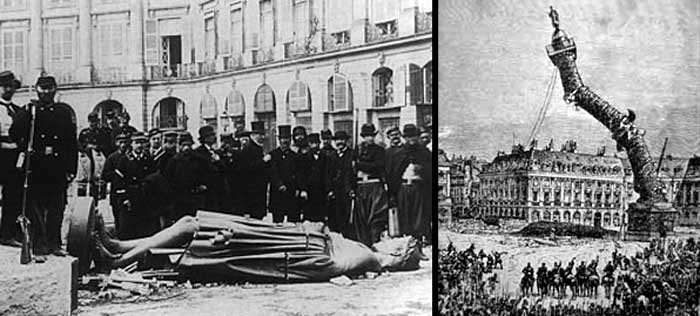
Paris Communards pull down the Vendome Column, 1871

As head of the Commune's Federation of Artists, Courbet quickly suppressed the city's traditional art schools: the Academy, the École des Beaux-Arts, and the Schools of Rome and of Athens. He then turned his attention to the Vendôme Column, a monument modeled after Trajan's Column in Rome that Napoleon had erected at the center of Paris to memorialize the French victory at Austerlitz. Courbet derided it as a "mass of melted cannon that perpetuates the tradition of conquest, of looting, and of murder." The Commune agreed and set about undermining its foundation and pulling it down with cables. As a band performed for an assembled crowd, the column came crashing to the street, breaking into several pieces. Three years later, after the collapse of the progressive Commune and the restoration of a traditionalist government, the French courts fined Courbet in exile to pay for the column's restoration. As his assets were seized and sold at auction, Courbet drank himself to death.

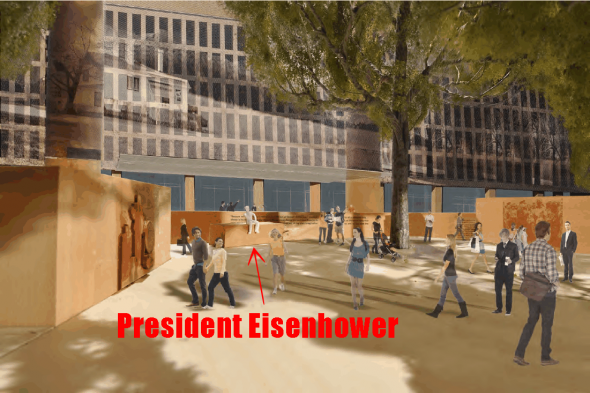
Following Courbet, the monumental fight between progressives and traditionalists hasn't gone much better. In the case of the Dwight D. Eisenhower Memorial, now planned for Washington, a progressive design has faced a traditionalist backlash. In what critics have called a closed selection process, the Department of the Interior, working through the General Services Administration, chose the architect Frank Gehry to undertake the design for a 4-acre site on Independence Avenue. Rather than a classical design in line with the Jefferson and Lincoln memorials, Gehry proposed a progressive design that he said would seize on Eisenhower's modesty. It would feature a small statue of the president as a young boy sitting under 8-story-tall wire screens painted to resemble pictures of his childhood home in Abilene, Kan.

Eisenhower_Memorial_barefoot_boy_statue
Frank Gehry's initial design for the Dwight D. Eisenhower Memorial

A traditionalist group called the National Civic Art Society has led a campaign to scrap the plan. Its Chairman, Justin Shubow, has testified before Congress against it. Léon Krier, a traditionalist architect and leading critic, has called Mr. Gehry's plan "An anti-monument if there can be such a thing." The antimonumentality of the design is no accident. Writing in the Washington Post, the architecture critic Philip Kennicott defended Mr. Gehry's design for inverting "several of the sacred hierarchies of the classical memorial, emphasizing ideas of domesticity and interiority rather than masculine power and external display." But he goes further, praising Mr. Gehry for having "'re-gendered' the vocabulary of memorialization, giving it new life and vitality just at the moment when the old, exhausted 'masculine' memorial threatened to make the entire project of remembering great people in the public square seem obsolete." Ridiculous as this may sound, Mr. Kennicott's essay nonetheless serves a useful purpose in laying out the postmodern perspective on memorials. In his view, the purpose of the contemporary monument is antiheroic: to debunk, diminish and ensure that equal time is given to the subjects' more mundane qualities.

Progressives want monuments to be radical. Traditionalists want monuments to be classical, arguing that anything newer becomes a monument to radicalism and its designer rather than the people who are memorialized. Unfortunately, most of us get caught in the middle. We don't care about "regendering" our supreme allied commander in Europe and 34th president. At the same time, we may find the neoclassical design of the National World War II Memorial by the Austrian-born Friedrich St. Florian, or the new memorial to Martin Luther King Jr by the Chinese artist Lei Yixin, uninspiring.

Monuments give form to memory. They allow us to reflect upon our history, values and experience. Unfortunately, we no longer share a consensus on what that history, those values and that experience should be. We barely agree on what we should remember rather than forget, and we share no common understanding of what form our memories should take. That all helps explain why neither the progressives nor the traditionalists excel at monument design on their own—and why the bad designs and the ridicule of monuments seem bound to continue.

A version of this article appeared September 25, 2012, on page D5 in the U.S. edition of The Wall Street Journal, with the headline: A Monumental Problem.

American Punk's Unheralded Impact

Studies in perspective
Ai Weiwei, Study of Perspective - Tiananmen Square (1995-2003) 

THE WALL STREET JOURNAL
September 6, 2012

American Punk's Unheralded Impact
by James Panero

Political art is usually terrible—rotten in message and form—or good but with a beauty that misleads. "The Death of Marat," Jacques-Louis David's 1793 painting of the French revolutionary murdered in his bathtub by Charlotte Corday, may be his masterpiece, but its politics led to the guillotine. Reproduced by the Jacobins, "Marat" became an image used to incite The Terror.

Following David's example, political art has mainly meant the seduction of art by the state. In the 20th century, Communism and Fascism each used art to destroy art. The Italian Futurists, the Mexican Muralists and the Russian Suprematists advanced regimes that sought to oppress the freedoms that had given rise to their artistic champions.

Meanwhile in the free world, with a few notable exceptions, art that has been "politically engaged" has most often been directed against those who defend freedom while either ignoring or praising those who oppose it. The 2011 Venice Biennale offered one recent example. There the artistic duo Allora and Calzadilla instructed an athlete to run on a treadmill atop an overturned allied tank as a parody of U.S. power. This installation, mockingly called "Gloria," was sponsored by our own State Department. Or politics has been used as a selling point, offering art with the illusion of controversy while merely reiterating the assumptions of the buying public. Consider the spray-can polemics of Shepard Fairey, who, through a political publicist, designed the "Hope" and "Progress" posters for candidate Obama in 2007 and 2008.

The latest wave of political art has proved the exception to the rule. With charged political works, the Chinese conceptual artist Ai Weiwei and the Russian performance artists of Pussy Riot are bad for good reasons. By broadcasting the abuses of the authoritarian states in which they live with work that can be aggressive and crude, they have shown that political art can be more than just another form of propaganda. It can act against propaganda to become the conscience of reform. The objects of this art may not be masterpieces, but the freedom of this art can be a leading edge advancing the freedom of others.

What connects these artists and distinguishes them from earlier generations is the underrecognized influence of American punk.

The son of Chinese dissidents, Mr. Ai moved to New York in 1981 and enrolled in Parsons School of Design. He primarily lived near East Seventh Street and Second Avenue, where his basement apartment became a hub for Chinese artists plugging into the burgeoning East Village art scene. Mr. Ai spent more than a decade in New York before returning to Beijing in 1993. While his artistic output during this period was modest, it was a formative moment in his career.

Modern history has often been shaped by foreigners absorbing the intellectual culture of the cities of the West. Mr. Ai was fortunate to find himself not in the Marxist circles of Paris but in the alternative punk scene of New York, where he immersed himself in the neighborhood's culture. Through thousands of photographs he took during his stay, many of which were on exhibit at New York's Asia Society a year ago, he documented and studied the city's punk and alternative spirit: from concerts at CBGB's and the Pyramid Club to the East Village's colorful street life and the social unrest of a gentrifying neighborhood.

Back home, Mr. Ai directed against the Chinese Communist Party the punk tactics that he saw protesters employ in the Tompkins Square Park riots of 1988—where the New York Police Department overreacted while (justifiably) enforcing a curfew on an Occupy Wall Street-like encampment. As he criticized a government ungoverned by the rule of law—"Kafka's castle," he calls today's China—he used the freedom of art to get his message out while also insulating himself from state reprisal. The avant-garde neighborhood that first attracted him was nicknamed Beijing East Village.

Mr. Ai's artful criticism of the Communist Party has employed every medium at his disposal—from sculpture to Twitter to video to his own body. After a Chinese policeman assaulted him in 2009, an attack that left him with a life-threatening brain injury, Mr. Ai turned the images of his convalescence into a symbol of state brutality—a "Marat" of our own day, but one designed to criticize rather than incite.

Pussy-riot-court

Nadezhda Tolokonnikova and Maria Alyokhina of Pussy Riot in the cell in a Moscow courtroom. Photo by Maxim Shemetov

This example is now closely followed by the punk-inspired act Pussy Riot, which was modeled on the feminist punk bands that emerged in the Pacific Northwest during the 1990s, such as the Olympia, Wash.-based band Bikini Kill. Performing in unorthodox—or, rather, ultraorthodox—venues, Pussy Riot has used aggressive lyrics, brash presentation and bold-colored balaclavas to broadcast its dissent.

As is by now widely known, in February three of its performers—Nadezhda Tolokonnikova, Maria Alyokhina and Yekaterina Samutsevich—briefly performed a "punk prayer" in front of the altar at Moscow's Cathedral of Christ the Saviour. With a song that appealed to the Virgin Mary to "cast Putin out," the women, documented on video, protested the co-opting of the church by the Russian state. After a show trial this summer, they were each sentenced last month to two years in prison. The images of them imprisoned in a glass cage during their trial, broadcast to the world, have now become icons illuminating the corruption of the Orthodox Church and the thugocracy of Vladimir Putin.

Punk is politically antidoctrinaire. While many who follow punk hew to the left, Johnny Ramone, one of the founders of the seminal punk band The Ramones, called Ronald Reagan the "best President of my lifetime." What they all share is an art of provocation, an antiauthoritarian philosophy and the energy to put their skepticism to the test.

While at times misused within Western culture, the mixture when employed against oppressive regimes can be potent. In 2011, after the Chinese government apprehended Mr. Ai and held him for 81 days in two secret locations, the Communist Party charged him with everything from tax evasion to harboring pornography. "You criticized the government," his jailers told him, "so we are going to let all society know that you're an obscene person, you evaded taxes, you have two wives, we want to shame you."

Yet as Ai Weiwei and Pussy Riot have demonstrated, the art of individuals can also shame entire states. Their work has brought international attention to oppression and become a rallying point for internal dissent. And for that we should all say a prayer for punk.

A version of this article appeared September 6, 2012, on page D6 in the U.S. edition of The Wall Street Journal, with the headline: American Punk's Unheralded Impact. This essay is adapted from a longer article in The New Criterion's September issue.