Escape Vehicle

SPECTATOR USA, November 2020

Escape Vehicle

The automobile’s artifice is its art, but it is still an art of artifice: A review of “Detroit Style: Car Design in the Motor City, 1950-2020” at the Detroit Institute of Arts from November 15, 2020 through June 27, 2021.

One of the more unusual works in the family art collection is a concept drawing of an automobile from 1937. The car, identified by the angular writing on its nose, is the LaSalle.

To call this a drawing of just a car does a disservice to the concept behind it. With its shimmering grilles and Futurist forms, the vehicle might as well be an open-cockpit fighter plane about to strafe a runway. Automobile enthusiasts, as I recently learned, consider the drawing to present one of the first known examples of a ‘ripple-disk single-bar flipper hubcap’. Clearly, here is a machine meant to do more than just deliver you from point A to point B. It is a vehicle for transporting desire, for mowing down all obstacles in your path, for getting you wherever you want to go with whatever means it takes.

My grandfather, James Ross Shipley, created this concept drawing when he was a young art-school graduate working in Harley Earl’s Art and Color Section at General Motors. The fanciful sketch reveals much about the creative origins of car design. The man behind it — behind the way we even think about ‘the car’ — was Earl, my grandfather’s boss and the industrial designer who made Detroit.

The bones of the automobile have changed little in over a century. Even the electric-car revolution, so far, has not altered the basic construction of an engine on a frame with four wheels. And before Earl, a car was little more than just that. You bought your vehicle unfinished and sent it to a coachbuilder for body fabrication. Earl began his career customizing the early cars of Hollywood in this way, but he also gave them something more than just a hood, a trunk, a windshield and some seats. When he arrived in Detroit, his genius was to turn the car body into an object of love, to convey more than mere conveyance, to make it all something on an industrial scale that we would want to acquire, occupy and control. He also expected us to trade it in when the new ‘model year’ came out — built-in obsolescence being another one of his great innovations.

Detroit Style: Car Design in the Motor City, 1950-2020, a new exhibition organized by the Detroit Institute of Arts, reveals the driving influence of American car design over the post-war period. As a constellation of car companies consolidated into the Big Three — GM, Ford and Chrysler — their design teams competed to capture the evolving American spirit in mobile form.

The exhibition tells this tale through ten vehicles, displayed along with the story of their designs, side-by-side with concept drawings and related automobile-inspired art. The exhibition begins with GM’s 1951 Le Sabre, a convertible of tapered nose and heavy chrome that resembles a fighter plane. With its wing-like hoodline and jetlike intake and exhaust grilles, the Le Sabre speaks to the power look of Earl’s GM. Glittering ornamentation is built right into its curving forms. Earl wrote in a 1955 brochure that he intended to make ‘these useful things beautiful, not in the sense of applying superficial ornamentation, but in developing a form of beauty exactly suited to the purpose’. ‘People like something new and exciting in an automobile as well as in a Broadway show,’ he added. ‘They like visual entertainment, and that’s what we stylists give them.’

There is power in Le Sabre’s bulging forms and cut lines, but the overall massing is also heavyweight and over-the-top — all muscle, no brains. Compare this to the next model on display: Chrysler’s 300C of 1957. Rather than roaring through the air, here is a car that looks like it could float on water. In the 300C, Chrysler’s design team, led by Virgil Exner, championed a ‘Forward Look’. With reduced chrome and a single grille, the car’s bulk is now ‘concentrated toward the rear, crowned by the upsweep of the tail,’ Exner explained. ‘Big racing boats take the same general form.’ The Chrysler’s tail is not a wing so much as a line of wake. You could imagine this elegant vehicle motoring through the canals of Venice, with headlamps like lashy eyes beckoning you on.

As the jet age became the space age, Earl set his sights higher. For his Firebird III concept car, he wanted ‘what you would expect the astronauts to drive to the launch pad on their way to the moon’. The result was the apotheosis of fin, as much Batmobile as automobile. This Firebird’s abstracted forms continued to influence 1960s car design even after its wings were clipped.

The Sixties proved there was more to car design than flying forms. Some cars took on natural shapes. The 1959 Corvette Stingray Racer, a stunningly attractive concept car from GM’s new head of design Bill Mitchell, conveys the teardrop shape of a sea creature. Meanwhile the 1967 Mustang, Ford’s wildly successful ‘pony car’, references the smoothness of a saddle mounted atop a galloping heart (made all the more apparent in the iconic equine grillework).

Fin de siècle: Dave Cummins’s ‘1960 Chrysler’ design, 1956 (Detroit Institute of Arts/Collection of Brett Snyder)

Fin de siècle: Dave Cummins’s ‘1960 Chrysler’ design, 1956 (Detroit Institute of Arts/Collection of Brett Snyder)

In the 1970s, Detroit doubled down on power. The 1970 Chrysler Plymouth Barracuda borrowed lessons from such cars as the 1966 GM Oldsmobile Toronado to represent strength in brutalist, hard-edged form. A straight beltline ties the body together from headlight to tail. A flat front end presents a menacing blackened maw with a hood scoop of simian nostrils.

A decade later, after an oil embargo or two, Detroit was ready to repent. With its chastened forms, the 1983 Ford Probe IV puts the car in an exercise leotard. Aerobics and aerodynamics now came to represent Detroit’s supposed new efficiency. Computers and wind tunnels, as much as the clay model, came to define car design. The 1987 Chrysler Portofino, a concept car designed by Sergio Coggiola at his Carrozzeria Coggiola near Turin, also shows the growing influence of European styling over Detroit. Here torsional forms replace lines of lateral speed. In a surprising Futurist move, the doors, hood, and trunk all rotate up to reveal an entirely open cabin.

By the 1990s, Detroit looked to the past as much as the future. Nostalgic designs appealed to the same car buyers who coveted the Detroit designs of decades before. As its name suggests, the 1998 Chrysler Chronos is a time machine back to the 300C and Exner’s Forward Look. In the Ford GT Concept of 2002 and the 2017 Ford GT, the final two cars of the exhibition, the end results are back to the future. The forward styling of the past now informs designs that are still to come.

I never got to ask my grandfather about his car-designing days. As he went on to become a professor of industrial design, all I heard of his time in Earl’s shop was that it was long hours for little pay. ‘Automobiles are hollow, rolling sculpture,’ said Arthur Drexler, MoMA’s curator of architecture, at mid-century. The automobile’s artifice is its art, but it is still an art of artifice — one designed, in the end, merely to sell you a new car.
Like a Rock

James Panero reads “Like a Rock,” his Letter from Plymouth in the November 2020 issue of The New Criterion.

THE NEW CRITERION, November 2020

Like a rock

On the four-hundredth anniversary of the Pilgrims’ landing at Plymouth Rock.

There is nothing particularly impressive about Plymouth Rock. As far as famous rocks go, the seaside boulder on which the Pilgrims may have first set foot in the New World is notably underwhelming. It has not helped that this ten-ton glacial errant, an Ice Age deposit of granite on the morainal coastline of Cape Cod Bay, has been moved and abused, venerated and desecrated many times since the storied passengers of Mayflower set down roots here four hundred years ago, in December 1620. And yet it is precisely the Rock’s humble appearance that can still evoke the greatest awe. The pilgrims’ arrival at Plymouth proved to be the moonshot of the seventeenth century—odds-breaking, death-defying, and ultimately world-shattering. The Rock remains the manifestation of the first step of these spiritual wanderers, not just from ship to shore but also heaven to earth. For the nation’s celestial origins, Plymouth Rock is our moonstone.

It took over a century for the Rock to be recognized for its historical relevance, after a Plymouth elder recalled a folktale of the landing. Its importance then grew alongside a burgeoning sense of the central role of the Pilgrims in our national story. In the War of Independence, the stone came to symbolize the endurance of the Pilgrims’ separatist faith crystallized in the cause of national liberty. In 1775, the people of Plymouth joined Colonel Theophilus Cotton to “consecrate the rock . . . to the shrine of liberty.” In attempting to move the stone from the shoreline, however, the townspeople split it in two, a portent of the coming Revolutionary break. Leaving one half behind in the sand, they relocated the other to “liberty pole square” by the Plymouth meetinghouse. On July 4, 1834, that part of the rock was moved again, this time to the front of Plymouth Hall. Other pieces went farther astray. Two chunks came to reside in Brooklyn, one at the abolitionist Plymouth Church of the Pilgrims and the other at the Brooklyn Historical Society. Smaller fragments went the way of the souvenir hunters. Meanwhile the original seaside stone came to be buried in sand and port development.

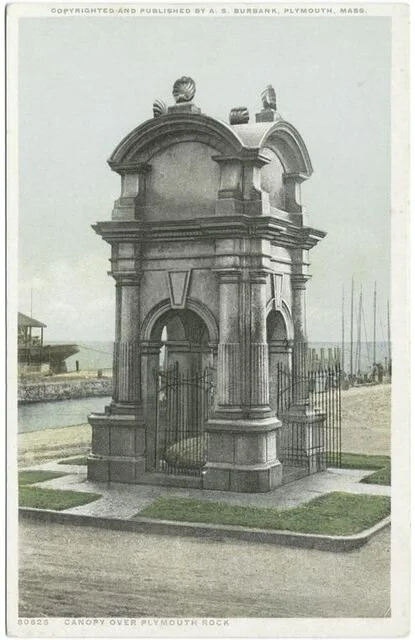
Hammat Billings’s baldachin, which housed Plymouth Rock from 1867–1920.

Hammat Billings’s baldachin, which housed Plymouth Rock from 1867–1920.

In 1867, an elegant Beaux-Arts baldachin designed by Hammatt Billings resurrected the beach half, which was soon rejoined by the other Plymouth rock of Plymouth Rock as “1620” was etched in the stone. Finally, in 1920, for the tercentenary of the Pilgrims’ landing, McKim, Mead & White designed the portico that stands over Plymouth Rock today. The understated design, built into an esplanade and replacing the Billings monument, invites viewers to look down onto the Rock, now again on the sandy beach. At spring tide, through iron grilles in the pavilion’s open foundation, the waters of the cold Atlantic can once again lap over the worn stone.

The present portico over Plymouth Rock, built by McKim, Mead & White in 1920.

The present portico over Plymouth Rock, built by McKim, Mead & White in 1920.

The treatment of Plymouth Rock has reflected the ebbs and flows of our own national conscience. In 1820, at the bicentennial of the Pilgrim landing, Daniel Webster proclaimed, “We have come to this Rock to record here our homage for our Pilgrim Fathers; our sympathy in their sufferings; our gratitude for their labors; our admiration of their virtues; our veneration for their piety; and our attachment to those principles of civil and religious liberty.” Pledging “upon the Rock of Plymouth,” he also called on Americans to “extirpate and destroy” the slave trade.

By 1835, Tocqueville came to observe how “this Rock has become an object of veneration in the United States. I have seen bits of it carefully preserved in several towns of the Union. Does not this sufficiently show that all human power and greatness is in the soul of man? Here is a stone which the feet of a few outcasts pressed for an instant, and this stone becomes famous; it is treasured by a great nation, its very dust is shared as a relic.”

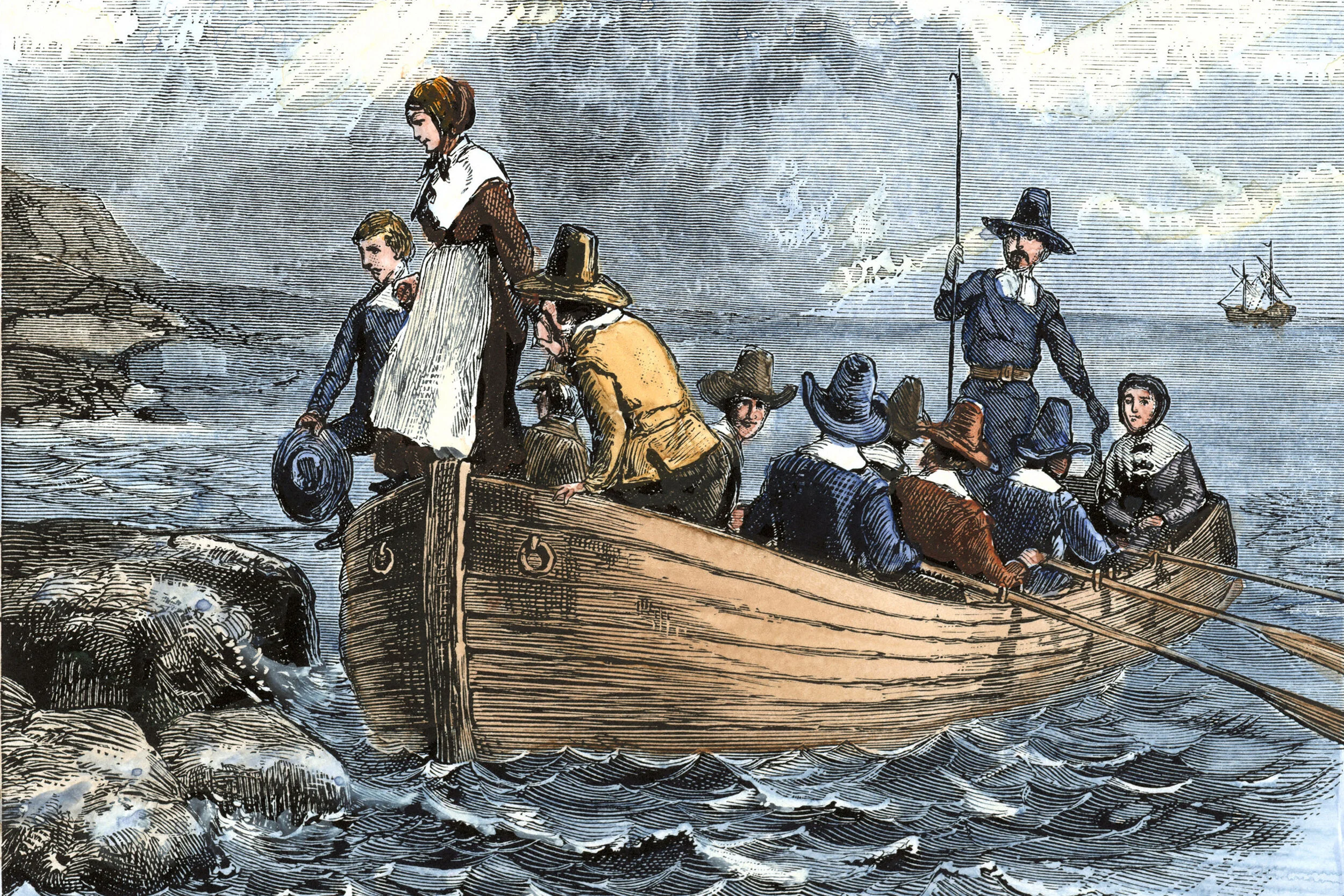
The pilgrims John Alden and Mary Chilton landing at Plymouth.

The pilgrims John Alden and Mary Chilton landing at Plymouth.

This year’s quadricentenary of the Pilgrim landing has not been so felicitous for Plymouth or its Rock. The pandemic has destroyed the town’s tourist trade and canceled many festivities on what should have been its most eventful year. A million visitors a year usually come to Plymouth Rock. This year that number may be less than half. Chinese, British, and German tourists, all precluded from international travel, are otherwise particularly drawn to the attraction. As I am told, the Chinese come for the American history, the British for the English, and the Germans for the indigenous. In other years, faith-based visitors are also regulars here, making their own pilgrimage to a site of America’s Christian origins. This year, even at the height of tourist season, the glasses at the Pillory Pub are half empty, the John Alden curio shop is in want of the curious, and the on-street parking is abundant.

Beyond just the closures, the Pilgrims’ progress, like the American project itself, has been cast in doubt. For most of our history, the Pilgrims’ first Thanksgiving meal of 1621 has represented the Providence of America and the amity of its native peoples—after Samoset, Tisquantum (Squanto), and Massasoit’s tribe of Wampanoag saved the new arrivals from starvation. In giving thanks for their salvation, George Washington codified the Pilgrims’ holiday into civic religion.

Until recently, the story of this first Thanksgiving was central to our civic education, from elementary-school assemblies to Peanuts television specials. Now, a “National Day of Mourning,” a protest march against Thanksgiving first organized by Native American activists, can draw crowds larger than the Mayflower Society’s own Pilgrim Progress procession held in town the same day. The Plymouth Rock monument has also been the site of attacks and desecrations. So far this year, the Rock has been splattered and sprayed with paint on two separate occasions. Meanwhile, the Pilgrims have been castigated along with Christopher Columbus for the usurpation of native lands and the murder of native peoples. If children are now taught anything about the Pilgrims, the settlers are more than likely to be denounced as a colonizing force—one that never really originated Thanksgiving, never conveyed the spirit of liberty as represented in their “Mayflower Compact,” and never even landed at Plymouth Rock.

The evidence at Plymouth suggests a more nuanced understanding. In Europe, the Pilgrims had drifted around as the backwash of the Reformation. Since taxation also meant supporting the ministers to a false faith, the Pilgrims’ separatist beliefs put them at odds with the monarch and the inseparable church of England. “The king is a mortal man, and not God,” declared the Puritan Thomas Helwys in his challenge to King James I, and “therefore hath no power over the immortal souls of his subjects.” Like others, Helwys was imprisoned and died for his beliefs. From England to Amsterdam, and then to Leiden, the Pilgrims attempted to resettle. In Holland, they found the labors unforgiving and the temptations undermining. Here was a faith that knew more what it stood against than for. A group of Pilgrims struck a deal with the London Company to resettle their families around what became New York. They eventually hired Mayflower, a reconfigured merchant ship, for the late fall passage. Their decision to leave the land of Rembrandt—who was then a student just a block from their Leiden church—for lands unknown was propelled by a desperation for religious liberty. “England hath seen her best days,” Thomas Hooker, the Puritan founder of Connecticut, later preached, “and now evil days are befalling us: God is packing up his gospel.”

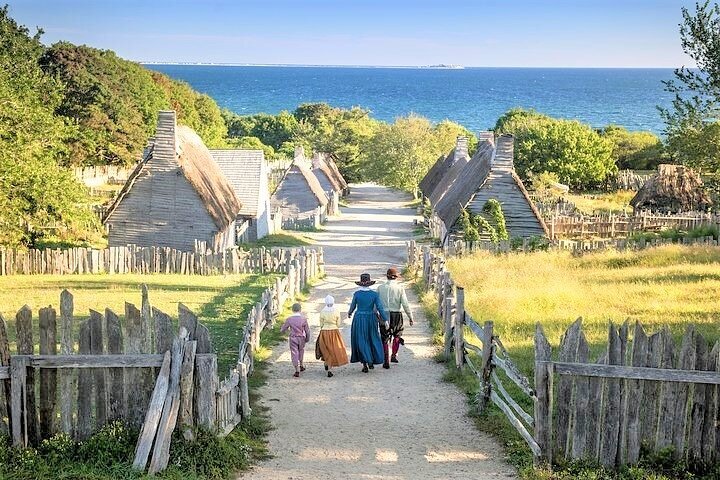
Plimoth Plantation today.

Plimoth Plantation today.

“Founding a colony was just about the most foolish thing a congregation or any other group of Europeans could do.” So writes John G. Turner in They Knew They Were Pilgrims, his new history of Plymouth.1 What powered these early settlers, especially through the misery of their first winter, was their separatist conviction. “They knew they were pilgrims . . . and quieted their spirits,” explained Plymouth’s Governor William Bradford. Blown off course, and after exploring the area of what became Provincetown (where there is now another Pilgrim monument), the settlers arrived in the protected natural harbor of Plymouth Bay. Regardless of where they took their first actual steps, the Pilgrims “walked into a disaster,” Turner writes. “The poor nutrition during the crossing left their health fragile, and they lacked sufficient food for the months ahead. Exposure to bitter-cold weather and wading in water did not help matters.” Barely half of Mayflower’s passengers survived the crossing and the first winter. “The living were scarce able to bury the dead,” Bradford wrote the next fall.

Just down the road from Plymouth Rock, Plimoth Plantation recreates some of these privations. In the 1940s, the museum’s founder, a gentleman archaeologist named Henry (Harry) Hornblower II, announced that “we had by-passed the era of putting a fence and canopy above a rock or some artifacts in a glass case . . . my idea was to create a living museum.” He tore down his family’s estate and converted it into a life-size diorama of the Pilgrims’ first village. Later on, the staff in period costume began to take on period roles. Now as soon as you set foot out of the reconstructed fort and walk down the village road, the Plantation offers its visitors an immersive experience. This year as you come upon Governor Bradford reading English law in his home with Mistress Winslow, the face masks are the only concessions to our present moment.

Yet even this quaint settlement does not fully convey the true extremis of the Pilgrims’ first year, as husbands lost wives and mothers lost children. The Plantation’s research and reconstruction of historic Patuxet, an equally fascinating section of the living museum, goes further in explaining how these privations were overcome. Then as now, a disease had reduced the population passing through Plymouth. An “extraordinary plague,” Samoset informed the new arrivals, had recently killed the people who had lived there. The Pilgrims arrived in the land of the Wampanoag just as the weakened tribe faced off against the neighboring and untouched Narragansetts. By the 1620s, Europeans were no strangers to American Indians. Traders had been sailing the New England waters for a century. What was new was the arrival of European families. In the early years, the Pilgrim and native populations gave thanks together for their mutual support. Twice as many Wampanoags as Pilgrims joined the first Thanksgiving dinner. Recent excavations have also suggested that the two peoples chose to live and trade next to each other.

This summer, after completing a three-year rebuilding at Connecticut’s Mystic Seaport, Mayflower II, a faithful 1956 replica of the Pilgrims’ faith-conveying ship, returned to Plymouth under her own sail power. Plimoth Plantation is once again scheduling tours of the ship, tied up within sight of Plymouth Rock. Four hundred years after the original landing, the craft speaks to the hardships, endurance, and desperation of the settlers who have defined America in myth and memory. Entering the open hold of this tiny replica vessel, where 102 passengers would have endured the Atlantic passage together, reveals much about the death and disease they encountered that first winter in Cape Cod Bay.

The Monument to the Forefathers in Plymouth, completed in 1889.

The Monument to the Forefathers in Plymouth, completed in 1889.

Just up the hill from Plymouth Rock, now buried among the trees and residential development, the Monument to the Forefathers offers a final statement on the combination of forces that came to the Pilgrims’ salvation. Hammatt Billings began designing this eight-story-tall granite carving in the 1850s. His brother, Joseph, working with local carvers, completed it in 1889. The monumental site, which now also includes scalloped fragments from Billings’s original Plymouth Rock pavilion, might appear grandiloquent did it not commemorate such an extraordinary event. In addition to relief images from Pilgrim history, the monument is buttressed by the personifications of Morality, Law, Education, and Liberty. Rising above them, facing England to the east, is the colossus of Faith. “Erected by a grateful people,” reads the front inscription, “in remembrance of their labors, sacrifices and sufferings for the cause of civil and religious liberty.” Stone by stone, the monument recalls the Providence of Plymouth Rock. Through sacrifices and sufferings, its blessings continue to land on the country the Pilgrims helped define.

1They Knew They Were Pilgrims: Plymouth Colony and the Contest for American Liberty, by John G. Turner; Yale University Press, 464 pages, $30.

Flowing Color, Billowing Canvas

THE WALL STREET JOURNAL, August 20, 2020

Flowing Color, Billowing Canvas

Sam Gilliam’s innovative, loosely draped work is a light and luminous addition to the galleries at Dia Beacon.

Beacon, N.Y.

It’s not always easy to see the light at Dia Beacon. This 240,000-square-foot cathedral of Minimalism, Conceptualism and related art movements of the 1960s and ’70s has next to no artificial lighting, which can make it hard to come to grips with the works on display. Instead the sprawling museum in a repurposed Nabisco box-printing plant relies on factory windows and 34,000 square feet of skylights for illumination. So the mood of the museum, a little over an hour’s car or train ride up the Hudson River from New York City, is muted and indirect. The seasons, the weather, and the time of day all color and shade what you see and feel.

And about that feeling: puzzling, contemplative, perhaps at times reverential, but, until recently, not necessarily uplifting. Minimalist art, of rusted metal and broken glass, can be menacing. Conceptual art, of dry ideas and arid humor, can be deadening. The heady art of the 1960s and ’70s takes itself seriously—perhaps too seriously. All that weight is meant to be profound.

Which is why Sam Gilliam’s light and luminous addition to this display is so welcome. A color-rich, spirit-filled installation of two of his sculptural canvas works—the draping, loose “Double Merge” (1968) and the tightly fitted “Spread” (1973)—arrived here last fall on long-term loan. With the museum newly reopened by appointment, finally this assembly returns to view.

Sam Gilliam’s ‘Spread’ (1973) PHOTO: SAM GILLIAM/ARTISTS RIGHTS SOCIETY/ BILL JACOBSON (PHOTO)

Sam Gilliam’s ‘Spread’ (1973) PHOTO: SAM GILLIAM/ARTISTS RIGHTS SOCIETY/ BILL JACOBSON (PHOTO)

Taken together, these works feel like the baldachin and tabernacle in the heart of the gothic gloom. Although Mr. Gilliam appeared in the American Pavilion of the 1972 Venice Biennale—the first Black American to receive the honor—the 86-year-old artist has been often considered peripheral to the movements of the 1960s and ’70s. Now he is right where he should be, in dialogue with his contemporaries and front and center in his own time and place.

A Washington-based artist born in Tupelo, Miss., Mr. Gilliam has a way of absorbing diverse influences and folding them into his own innovative work. Abstract Expressionism, Japanese tie-dying, Titian-esque color, and his own history as the son of a seamstress all spread and merge in a deeply felt sense for paint’s interaction with a canvas’s warp and weft.

In the 1960s, Mr. Gilliam followed other artists of the so-called Washington Color School, such as Morris Louis and Kenneth Noland, who had been inspired by Helen Frankenthaler to develop new approaches to abstraction. They experimented with new materials and techniques by staining unprimed canvas, unstretched and on the floor, with poured acrylic paints. Mr. Gilliam began adding aluminum powders, fluorescent paints, and resisting agents to his expanding palette. He also tucked and folded his wet canvases on the floor to create patterns in his free-flowing compositions.

He then went a step further. Working with ever-lengthening rolls of canvas, Mr. Gilliam developed new ways of presenting his widening work: hanging from the ceiling, nailed to the wall, draped over sawhorses, or tacked onto his own bevelled stretchers—pushing the boundaries of painting and sculpture.

Now at Dia Beacon, “Spread”—the first, smaller work on display (though still nearly six feet tall by 10 feet wide)—is a master-class in the art of the in-between. Abstract forms appear and reappear out of the folding of the canvas. Lines of white add structure, bringing the design to the surface, while symmetries of yellow and red created out of the folds hint at illusion and depth. Mr. Gilliam has long understood how his process of folding and unfurling creates a Rorschach test of abstract forms. Framing these dynamics, the canvas’s thick bevelled stretcher bars push the painting to the edge of sculpture while echoing the smoothed-out facets of its jewel-like composition.

After this taut introduction, ”Double Merge” appears all the more free-flowing. A combination of two huge works from 1968, both titled “Carousel II,” “Double Merge” is a new site-specific installation created by the artist of these two canvases, 66 and 71 feet wide, suspended from the ceiling and tacked to the wall.

Sam Gilliam’s ‘Double Merge’ (1968)PHOTO: SAM GILLIAM/ARTISTS RIGHTS SOCIETY/BILL JACOBSON (PHOTO)

Sam Gilliam’s ‘Double Merge’ (1968)PHOTO: SAM GILLIAM/ARTISTS RIGHTS SOCIETY/BILL JACOBSON (PHOTO)

Mr. Gilliam has attributed his suspensions or “drapes” to the vision of wash drying on the line. Flags, bunting, carousel rides, and the big top all come to mind. The two parts of “Double Merge” interact like a ballet pas de deux dancing off the wall. Despite their casual, even provisional appearance, the works are architectural studies in curves, masses and forces in space, coming within inches of the ground. Mr. Gilliam has described his affinity for banners arcing in the paintings of Albrecht Dürer. As he bundles and pins his canvases into catenary curves, “Double Merge” turns this appeal on its head. Painting itself becomes the banner.

Here the draping folds play off the folding that went into painting these compositions. In certain passages, Mr. Gilliam can overwork his studio sorcery. Elsewhere, his absorbing designs come together in celestial revelation. It’s as though the serendipity of soaking and folding can reveal heavenly clouds or the gas storms of Jupiter.

Daydream beside “Double Merge” and see for yourself. Once again, the work is ready to sway and inspire wonder as we come upon it. Like clothes on a line, these once-wet canvases hang loose in the light of a new day.