No Place Like Home

James Panero discusses the architectural virtues and vices of the American home, and culls a few examples of past styles from the city of Portland, Maine.

THE NEW CRITERION, December 2019

No place like home

On American architectural style.

I like to go “housing” the way many people go birding. What I mean is, I like to classify and call out house styles as I come upon them in the wild. Granted, my hobby is not too popular with my family, who could do without my outbursts of architectural enthusiasm, but our country is fertile ground for good house-watching. Fine examples, of just about any style of any period, abound. What stories they tell if only we listened to their calls.

Take the Colonial, with its simple shapes and rustic materials. These tiny dwellings still betray the bare necessities of early settler life, all flattened into a landscape of rectangles and triangles and parallelograms. Or consider the Georgian, with its proud symmetries square-shouldered to the door. These stoic structures imposed classical order on the new republic and the nascent Federal style. Or how about the Greek Revival, the subsequent divination that seemed to sweep through every New England farm: its delicate upward lines, pedimented white gable fronts, and off-centered doors rotated the house a quarter turn like an altered state. As the country grew, so did its worldview, and later styles looked in ever more head-turning directions: to the Italianate and the Second Empire, on to the Queen Anne, the Romanesque, and the Exotic Eclectic, on to the Beaux-Arts and the Chateauesque, on to their many blends and crossbreeds.

Like unusual plumage, the subtle details in each of these styles give the greatest delight: the lace-like vergeboard dripping off the projecting gables of a steeply pitched Gothic Revival; the glowing belvedere—from the Italian for “beautiful view”—popping out the top of some bejeweled Italianate box; the sunbursts and spindlework woven into the turrets and trusses of the Queen Anne. Among these happy sightings, my favorite of all is that rara avis: the Stick style, with its toothpick-like details, so named after the fact by Vincent Scully, that came and went in a flash in the later nineteenth century.

I find the tidy styles of the twentieth century, both revival and modern, often lacking the same free spirit: “Stockbroker Tudor” I could do without; the Craftsman and Foursquare can be clunky and junky; the much-touted Prairie style I regard as oppressively flat and dark. Standardized housing plans and mail-order designs led to stylistic over-breeding, which the moderns tried much to exterminate. Yet ultimately, what resulted was not some ascetic paradise but rather a post-apocalyptic landscape of surviving flora and fauna, including those irradiated forms known as McMansions, all jostling for space among what remains of our grand architectural menagerie.

Like a birder, the “houser” must be equipped with a taxonomic dictionary. Like the “Sibley,” the “Peterson,” or the “Kaufman” birding guides, everyone has a preference. Virginia Savage McAlester’s Field Guide to American Houses, revised and expanded in 2015, may be the gold standard for housing typology. In addition to offering hundreds of thumbnail examples of just about every form of American home, the guide presents pictorial keys and glossaries to help identify the style of any house found in the bush. The book also dilates in interesting ways over housing stocks I rarely consider, such as manufactured mobile homes, which for reasons of climate are found in the greatest numbers in the South and West. Today one in ten American homes is prefabricated. In many warmer areas, more than 20 percent of dwellings are now factory-made and highway-delivered—even though the end result, such as the “decorated double-wide with extensions,” little resembles what we think of as a “mobile home.”

For picture pleasure, I enjoy William Morgan’s accessible Abrams Guide to American House Styles (2008). American homes tell a story behind their styles. Morgan captures this with a light touch and colorful photography. “A temple in Vermont marked the success of a sheep farmer,” he writes of the Greek Revival, while such a house “in Ohio’s Western Reserve showed that the new settlers were planning to set down roots for the ages.” Morgan also rightly notes that “one of those rich ironies in which American architecture abounds is that, in reaching deeper and more seriously into the classical and medieval past for inspiration, our houses became more particularly American.” The American-ness of these historical forms is what the International Style found most “dishonest.” Nevertheless, American architecture continued to “revive” its historical styles, because “so many in search of the American dream were willing to have it interpreted by Colonial Williamsburg, Sears, or a shelter magazine, but not by a European-trained professor.”

For the story of style, John Milnes Baker says it best in American House Styles: A Concise Guide, updated in a new edition last year. Supplemented by his own elegant elevation drawings, Baker reveals how American homes adapted the treasure trove of Old World influence to the climate and resources of the New. With an abundance of forests, timber often replaced brick and stone in domestic construction. Meanwhile the harsher American climate, intemperate to both extremes, introduced covered porches, shingled rooflines, and breezier, more convertible floor plans compared to our European prototypes. Baker’s book pays homage to our architectural inheritance in the same way our best buildings do: “Our houses have been shaped by their architectural forebears as much as we as individuals are shaped by our genetic and cultural backgrounds.”

In the summer of 1877, Charles Follen McKim, William Rutherford Mead, and Stanford White embarked on a now-celebrated sketching tour of coastal New England north of Boston. Their observations of buildings in Salem, Marblehead, Newburyport, and Portsmouth fueled the Colonial Revival and forged their own architectural partnership two years later. The New England coast has always offered promising house-watching grounds. This is especially true as Victorian-era summer homes came to roost among the older vernacular styles. Here, warm-weather feathering could be in greatest display apart from the concerns of year-round shelter. My summer haunt of Block Island, Rhode Island, still abounds in fine examples of Gothic Revival and Queen Anne houses—not to mention some of my favorite Stick- and Shingle-style buildings. These are all mixed in among Second Empire hotels and the many Colonial and Greek Revival forms dotting the landscape.

This past summer, I ventured farther afield by following the stylistic flyways north, to Portland, Maine. I have a theory that historical houses are often best preserved in cycles of boom and bust. Too much continuous growth and history gets wiped away. Too little and houses fall apart or never aspire. But success followed by stagnation followed by renewed prosperity can preserve interesting houses in amber just long enough for them to be rediscovered and restored.

The 1801 McLellan House in Portland, Maine, which has stood the test of time. Photo: Portland Museum of Art.

The 1801 McLellan House in Portland, Maine, which has stood the test of time. Photo: Portland Museum of Art.

So it has been for Portland more than once. As the northernmost Atlantic port navigable in winter, the city offered early year-round access to the Canadian interior. Its landscape was then shaped by four cataclysmic fires, the last of which was caused by fireworks set off on Independence Day, 1866. The fire leveled the city’s commercial center, destroying 1,800 buildings and displacing 10,000 residents. Meanwhile, the city’s shipping, industrial, and tourist economies have come and gone and come back several times. Today the city is again experiencing a cultural renaissance, in particular one centered around its cuisine. This renewal now finds root and flowers among the city’s many historic houses.

A good place to start house-watching in Portland is at the corner of High and Spring Streets. That’s just what I did when I signed up for a walking tour offered by Greater Portland Landmarks, dedicated to the preservation of the city since 1964. The organization’s motto is “this place matters.” Standing at High and Spring, you can see why this advocacy is important. Just to the northeast, a wave of “urban renewal” marched up Spring Street almost to where we stood—part of an ill-fated scheme to run an arterial road through the heart of the old city. With consequences far worse than the 1866 fire, in the 1970s the urban planners laid waste to this historic neighborhood and left a landscape of reinforced concrete, parking garages, and a Holiday Inn.

Yet their march stopped just short of this key intersection, which still maintains some of the finest buildings from Portland’s successive architectural eras. To the north, at 111 High Street, is the McLellan House of 1801. In this three-story brick building, the delicacy of the Federal style is revealed in abundance, with the organization of the Georgian style flattened and refined. For comparison, the 1755 Tate House, a few miles away and now a house museum, offers a far more rustic Georgian interpretation. Constructed for the senior mast agent for the British Royal Navy, who oversaw the cutting and shipping of Maine white pines to England, the unpainted clapboard Tate House sports unusual but picturesque subsumed dormers in its gambrel roof.

The 1755 Tate House in Portland, Maine.

The 1755 Tate House in Portland, Maine.

Compared to the stout massing of the Tate House, the McLellan House offers delicacy at every turn. A second-story Palladian window balances above a semi-circular portico of slender Doric columns leading up from sandstone steps. A gently tapered balustrade topped with tiny urns around a low-hipped roof completes the ordered composition. Designed by John Kimball, Sr., of Ipswich, Massachusetts, the home was built for the shipping magnate Hugh McLellan. In the later nineteenth century, the McLellan House was purchased by the wonderfully named Lorenzo De Medici Sweat, a U.S. Representative from Maine. In 1908, his widow bequeathed the brick home to the Portland Society of Art, which added a memorial gallery that evolved into the Portland Museum of Art, now fronting Free Street. So while it takes some internal navigation to get there, the house is now open simply with a ticket to the museum, which recently restored the mansion’s Federal details. Touring its interior completes the picture, since the house’s order outside mirrors its order within. Centered on the front door and its Palladian window is a free-standing staircase that seems to levitate from the first floor to the second. Light, and lightness, is everything here.

Just to the east of the McLellan House, at 97 Spring Street, is the Charles Q. Clapp House of 1832. The house was likely designed by its eponymous first owner. Clapp was so committed to Greek Revival that he created a free-standing Corinthian colonnade to run along the two sides of his home, curiously narrowing his living quarters beneath a gabled pediment. The front entrance, not just pushed to the side but around a corner, lends a masonic mystery to this latter-day temple. I hope this building, now under the ownership of the Portland Museum of Art like the McLellan House but used for storage, might one day be opened to the public.

Across the street, at 93 High Street, the Safford House of 1858 offers a later example of Portland high style, this time in the Italianate. The building is now both the headquarters of Portland Landmarks and one of its restoration projects, offering exhibitions on the preservation of the city. I wouldn’t necessarily have expected them in New England, but Portland offers an abundance of Italianate buildings, all at one time built as private homes but having served and suffered a multitude of uses since. The Morse-Libby House, known as Victoria Mansion, is the finest and open to the public.

The Morse-Libby House, also known as Victoria Mansion, built ca. 1859. It still stands today.

The Morse-Libby House, also known as Victoria Mansion, built ca. 1859. It still stands today.

There are now eighty historic landmarks in Portland. In addition to offering walking tours, the Landmarks society hosts an interactive online map documenting them all. But there are still more houses of note than merely the eighty. Although not advertised as such, my boutique Italianate hotel on Congress Street in Portland’s reviving West End, built in 1881 for Mellen E. Bolster, served most of its life not as a gentleman’s residence but as a funeral parlor.

While the city now shows remarkable signs of life, there remain those symbols of misuse and decay, especially in the population of vagrants—pickled, salted, and sauced—who still tumble through its historic streets. The revival of this city from wholesale destitution is very much a testament to its historic architecture, which is buoying it up from the depths.

Just what will endure from today’s house styles remains a point of contention. What became known as the Millennium Boom introduced speculative specimens into barren deserts and fallow farmlands and leveled historic lots in existing neighborhoods. Not the austere modernism of the elite, nor even the jokey post-modernism of the effete, these houses were often designed for maximal square footage and maximum “curb appeal” through a minimum of stylistic felicity, unironically deploying historical style—sometimes, seemingly every style compressed into one building. Called McMansions for their cheap ingredients and unavoidable ubiquity, these houses have marked out a new American style that is now already in eclipse (giving way, I understand, to more refined “McModerns”).

I like to call the McMansion style “Queen And.” These buildings are driven by the extensive list of demands placed on their interior spaces: private wine cellars and media rooms and art rooms and workout rooms and family rooms and man caves and fire pits and utility kitchens and Peloton rooms must all exist side-by-side a full set of more formal, but unused, spaces. In response to the low ceilings of a previous generation of modern houses, these homes feature overly high ceilings and double-height entryways leading on from two-story-tall porticos, one of the hallmarks of the style. The houses are pushed from the inside to the breaking point. Architects and builders conceal the girth under a multi-layered drapery of false, historic-esque façades.

The “Queen And” has justifiably gone in for a beating. I laugh along with most everybody else at the putdowns offered by McMansion Hell, the website created by Kate Wagner that revels in all the “lawyer foyers,” roofline “nubs,” and cast-styrofoam details. The style guidebooks can be as equally damning of these frankenhomes. “Does adding a Palladian window to the balloon-frame house covered in polyvinyl siding make it a Georgian house?,” asks William Morgan. “Does mixing several styles in a single house cloud the lessons the past style might have to teach us? . . . McMansion developments are like Potemkin villages: all façade, designed to impress.”
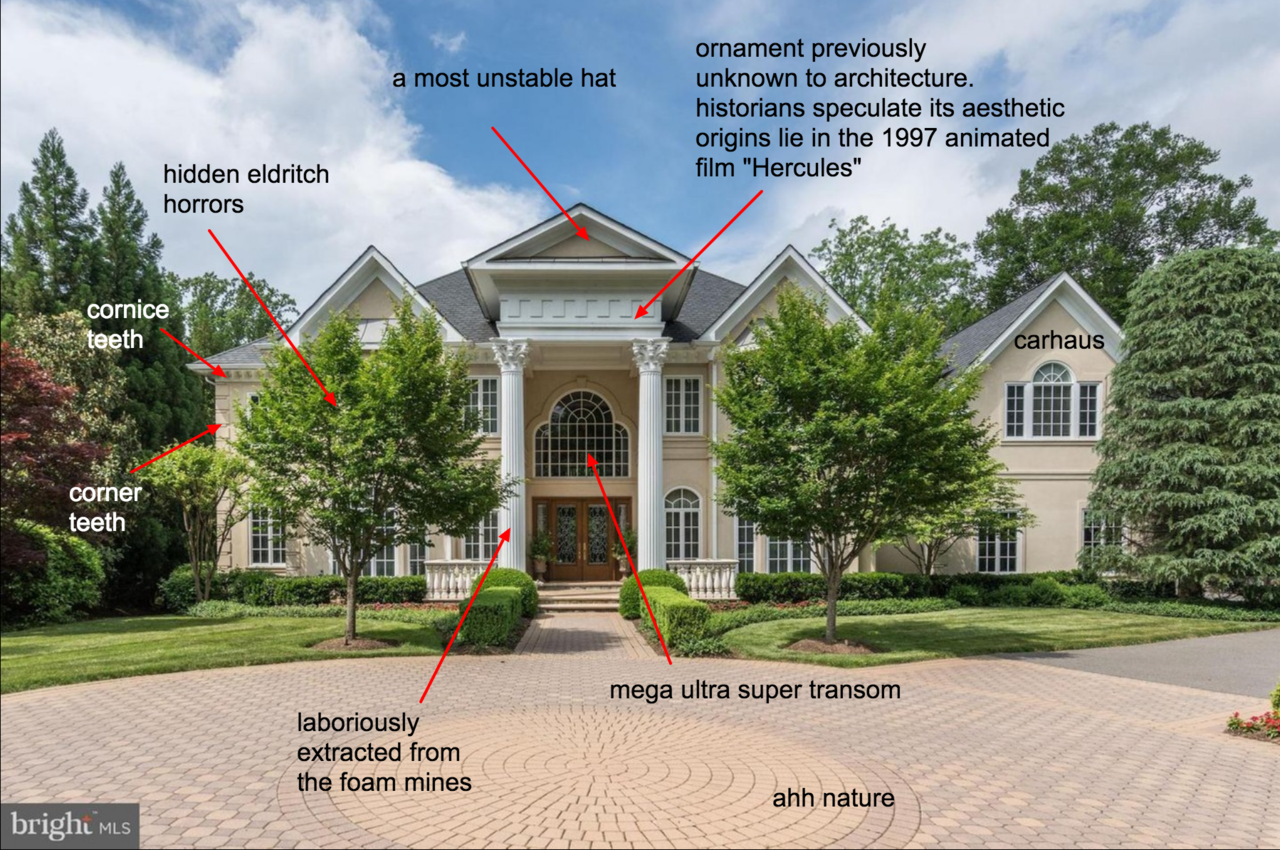
A variety of McMansion local to Fairfax County, Virginia, as documented by the architectural critic Kate Wagner. Courtesy McMansion Hell.

A variety of McMansion local to Fairfax County, Virginia, as documented by the architectural critic Kate Wagner. Courtesy McMansion Hell.

And yet, I see some hope in these architectural jumbles. “Queen And” houses may speak gibberish, and in them the mockers see much bourgeois striving, but such homes nevertheless reveal a yearning for a lost language. I am reminded of the history of the Temple of Saturn in the Roman Forum. First built in 497 B.C., the temple was resurrected several times, most recently after a fire in 360 A.D. But that final restoration, done in the waning days of pagan revivalism, went a little wrong at every turn, with bits borrowed from prior buildings and column heights and widths all inconsistent with ancient classical order.

The McMansion is likewise built for a population that might still recognize the ancient sounds of architecture but not its language and certainly not its style. John Milnes Baker likens good architectural style to good writing. The proper guide can instruct in each, in ways that go beyond mere style: “Houses should have more substance than style,” he writes—

Let’s not worry so much about what particular style our houses are; let’s trust that they will simply have style—an inherent, intrinsic style that derives from the nature of the materials used and an expression of the spaces defined. . . . Throughout our history, our best houses have derived elegance from simplicity, dignity from restraint, and richness from subtle diversity.

The challenge for the future of the home is therefore not just a revival of style but also a revival of substance. Historic orders require an ordering of the lives contained therein. But done right, the chaos of an open-plan, open-access, hyper-connected world may be partitioned and controlled through classical proportion and domestic order. Beyond mere style, our architectural forebears understood these attributes of the home. Their examples still sing to us from the wild. We should listen to their calls.

Two If by Sea

James Panero recounts a recent trip to Mystic, Connecticut, and offers his thoughts on “J. M. W. Turner: Watercolors from Tate” and other developments at the Mystic Seaport Museum.

THE NEW CRITERION, November 2019

Two If by Sea

On “J. M. W. Turner: Watercolors from Tate” at the Mystic Seaport Museum, Mystic, Connecticut.

Sailing to Mystic Seaport is one of those prehistoric memories of my childhood that still inspires limbic delight. How primitive it all now seems: no cell phones or GPS, my father and I dead reckoning on our small cutter-rig Cape Dory. Down in the cabin, I measured the paper charts with a plexiglass navigational plotter. I turned the directional dials on the LORAN radio. Finally we reached the mouth of the Mystic River. We circled and honked our airhorn until the railroad and highway bridges rotated and lifted to let us through. When we tied up at the historic Seaport, a maritime town of preserved boats and buildings, the facility was just closing for the day. That was the best part about it. As transients staying overnight at the marina, we alone could still wander the Seaport village at all hours, past the cooperage, the ropewalk, the church, the tiny school, and the George H. Stone & Co. General Store, like Ishmael on his way to the Spouter-Inn. On my Walkman, I played a cassette tape of sea shanties. Here was the Age of Sail. We were living it.

From the Age of Sail—or at least its recreational variant—to the Age of Screen, the subsequent decades have not been altogether kind to Mystic Seaport. History has gone out of fashion, if you haven’t already heard. So has the sort of immersive history offered by institutions like the Seaport, founded in 1929, where reenactors forge iron, craft barrels, and caulk hulls in its historic structures. In our virtual present, real experience itself has grown suspect, foreign, even dangerous. As a teacher recently explained to me, many children today do not know what to do when their feet get wet. They really don’t know what to do when close-hauled in wine-dark seas. The sport of sailing has suffered. A large outdoor institution dedicated to our seafaring past has suffered especially.

Enter the “reimagined” Seaport. Since the turn of the millennium, the historic institution has proclaimed at least two “Strategic Plans.” The Seaport must be “repositioned.” It must “appeal to new audiences.” It must be “evolving and embracing contemporary culture.” It must be “rebranded.” It must be “relevant.” It all sounded, to me at least, quite alarming.

The Charles W. Morgan (middle), the last remaining American wooden whaling vessel, on the docks of Mystic Seaport. Photo: Mystic Seaport Museum.

The Charles W. Morgan (middle), the last remaining American wooden whaling vessel, on the docks of Mystic Seaport. Photo: Mystic Seaport Museum.

Yet the distress calls have been a boon to the consultants, architects, and planners who now school around foundering institutions. One consequence has been the renaming of the Seaport, as it seems every “library” and “collection” and “institute” must be renamed these days, into a “museum.” And so we now have the “Mystic Seaport Museum.” Another consequence has been the construction of a new gallery, the Thompson Exhibition Building, to serve as a Kunsthalle for traveling shows and commissioned installations.

The proliferation of white-box galleries has largely become a blight on our cultural landscape. I suspect we will one day regret most of them, much like the benighted highways that slice through our urban centers, which are similarly designed for maximum throughput but have only invited further congestion. Contemporary art puts greater and greater impositions on its housing and display. Bigger galleries are built to contain it. Then new forms of art develop to overfill these gargantuan spaces.

Often this new art comes in the form of commissions designed to provoke commentary and commotion around some aspect of contemporaneity. At the Seaport we might soon see installations about swirling gyres, or modern-day pirates, or the rising seas. Or what about the history of the salt trade through large salt sculptures? That’s coming next year. You can almost figure it out yourself. The Seaport even brought in the impresario Nicholas R. Bell as its new curatorial director to crank up the institution’s popular reach, as he did at the Renwick in Washington, D.C., with immersive shows where “photography is encouraged.”

Museum leaders rarely lament these modern intrusions on their historic missions, buildings, and collections. Far from it—the “need” turns their hamster wheels. New buildings spur new fundraising that pays for more buildings and so on. What results are new brick-and-mortar (and glass-and-steel) billboards of perpetual presentness. I will never forget the director of one famous collection who proclaimed that her new Renzo Piano addition would finally let people know her institution was a museum. Of course, several generations of patrons managed to find their way there without Renzo. And of course, they still go there for the historic institution, not its mock-industrial appurtenance.

The Thompson Exhibition Building at the Mystic Seaport Museum. Photo: Mystic Seaport Museum.

The Thompson Exhibition Building at the Mystic Seaport Museum. Photo: Mystic Seaport Museum.

Back at Mystic Seaport, maybe it’s the case of a stopped clock being right twice a day. Or maybe a favorable wind still blows over my beloved institution. Despite my dire predictions, through storm-tossed seas the Seaport has remarkably reached safe harbor. With a major exhibition of Turner watercolors on loan from the Tate, which opened here last month and remains on view through February, I might even say the institution has discovered a triumphant new world.1

Designed by Centerbrook Architects and Planners, the 14,000-square-foot Thompson Exhibition Building, which opened in 2016, is better than feared, even as it nevertheless presents a “distinct departure from the Museum’s traditional architecture.” Wood-framed in the shape of a hollow wave, the building references the Seaport’s collection of ship hulls in its fittings—although with its oversized patio and cavernous interior, the structure most resembles a mountaintop ski lodge. Stephen C. White, the Seaport’s president, says he wanted a building that would say, “Something’s happening here. Things are moving forward.” Such pathetic pleas aside, the museum sought a building that would be “good enough for Turner.” And here is Turner. There are also plans afoot to open up the Seaport’s extensive watercraft collection, with some eighty-seven boat designs, to public view. If this building boom ultimately leads to more open storage and more Turner, the results would be welcome indeed.

There is nothing quite like seeing a Turner, such as A Shipwreck in a Stormy Sea (ca. 1823–26), after just witnessing a reenactment of a nautical rescue by “breeches buoy,” as I did on my recent visit to the Seaport. The former United States Life-Saving Service, one of our government’s smartest creations, patrolled beaches day and night to rescue shipwrecked sailors. The breeches buoy was an ingenious system of ropes and pulleys that could be fired from a small cannon hauled down the beach from the lifesaving stations (which were themselves beautifully designed). Attached to the mast of a ship run aground, the buoy had a pair of shorts sewn to it that held passengers in place as they were hoisted ashore. Tens of thousands of lives were saved this way.

J. M. W. Turner, Whalers (Boiling Blubber) Entangled in Flaw Ice, Endeavouring to Extricate Themselves, 1846, Oil on canvas, Tate.

J. M. W. Turner, Whalers (Boiling Blubber) Entangled in Flaw Ice, Endeavouring to Extricate Themselves, 1846, Oil on canvas, Tate.

Through its artifacts and displays, the Seaport reveals the true challenges and terror of life at sea. Whaling ships like the Seaport’s prized Charles W. Morgan, the last remaining American wooden whaling vessel, were closer in experience to today’s floating oil rigs than to the romantic visions they might now inspire. They were factories at sea. American ships like the Morgan were the first to be able to harvest, process, and store whale oil, all without touching land, due to their set of shipboard try pots, which could render blubber while underway. “Voyaging in the Wake of the Whalers,” an ongoing and must-see exhibition at the Seaport, explains it all while matching a historic film of whaling with passages from Moby-DickWhalers (Boiling Blubber) Entangled in Flow Ice, Endeavouring to Extricate Themselves (1846), a stunning Turner painting at the center of this exhibition of watercolors, likewise shows those boilers firing away even as their ships sit stranded. Like a real-world Ahab, the American whaler was always determined.

While the watercolor exhibition is centered around a selection of maritime images, this is more than a “Turner and the Sea” show. The exhibition brings to America close to one hundred works from the Tate’s 1856 Turner Bequest, which ended up conveying just about everything the artist left behind, hook, line, and sinker, into Britain’s public trust. Selected out of some thirty thousand watercolors and sketches by the Tate’s David Blayney Brown, the exhibition presents the full arc of Turner’s astonishing fecundity. The artist began as a precise draftsman in such works as View of the Avon Gorge (1791), Durham Cathedral: The Interior, Looking East along the South Aisle (1797–98), and Holy Island Cathedral (ca. 1806–07). He ended up the atmospheric dreamer we famously know in such meditations as Venice: Looking across the Lagoon at Sunset (1840), Rain Falling over the Sea near Boulogne (1845), and Stormy Sea with Dolphins (ca. 1835–40).

J. M. W. Turner, Venice: Looking across the Lagoon at Sunset, 1840, Watercolor on paper, Tate.

J. M. W. Turner, Venice: Looking across the Lagoon at Sunset, 1840, Watercolor on paper, Tate.

The exhibition makes the compelling case that watercolor was the medium in which Turner developed and tested these stylistic innovations. An accompanying catalogue of revealing essays and interviews assembled by Bell (who will soon be leaving the Seaport) looks at how Turner began his career as a painter-like watercolorist and ended up a watercolorist-like painter. In resplendent works such as Venice: San Giorgio Maggiore—Early Morning (1819), we can see how Turner’s uncanny sense for luminosity on canvas first developed in the white ground of watercolor, as did his gauzy building-up of scrims and layers.

Water gives and it takes. In his 1950 book The Enchafèd Flood: or, The Romantic Iconography of the Sea, W. H. Auden writes that the sea represents “that state of barbaric vagueness and disorder out of which civilization has emerged and into which, unless saved by the effort of gods and men, it is always liable to relapse.” In his watercolors, Turner likewise mixed the waters of content and medium for his own deep dive into compositional disorder.

J. M. W. Turner, Arundel Castle, on the River Arun, ca. 1824, Watercolor on paper, Tate.

J. M. W. Turner, Arundel Castle, on the River Arun, ca. 1824, Watercolor on paper, Tate.

But Turner was not a pure abstractionist, despite the claims made by “Turner: Imagination and Reality,” Lawrence Gowing’s 1966 exhibition at the Museum of Modern Art that has long left us with an unfair retrospective view of Turner’s achievements. Nor was Turner a proto-Impressionist, an ultra-Romanticist, an anti-Industrialist, or whatever other school or cause he has been attached to. Turner began as an empiricist. As his compositions dissolved into formless shapes and blinding light, he became even more so, capturing a fuller vision of nineteenth-century life at the outer reaches of experience.

Born into the lower classes, through his own hard-driving career Turner maintained a respect for industry and the experiences of those who build, forge, sail, and render. His sense for awe reflected the real lives of hardworking people of the kind we still see at Mystic Seaport, which you can still reach by land or by sea.

1 “J. M. W. Turner: Watercolors from Tate” opened at Mystic Seaport Museum, Mystic, Connecticut, on October 5, 2019, and remains on view through February 23, 2020.

Venice's Last Judgment

James Panero on the beginning and end of the Most Serene Republic, occasioned by "Venice's last judgment" from the September 2019 issue.

THE NEW CRITERION, September 2019

Venice’s Last Judgment

On the beginning and end of the Most Serene Republic.

The Venice Biennale, that strange pageant of contemporary fashions, offers the opportunity, if not the necessity, to explore the real art of La Serenissima. At the furthest extreme from the latest forms on display in the Biennale’s Giardini are the ancient mosaics of the Church of Santa Maria Assunta, on the distant lagoon island of Torcello. I brought my family to Torcello’s desolate piazza on what proved to be the hottest morning of a hot Italian summer. Torcello is an hour by vaporetto water bus from the Fondamente Nove, on the northern edge of Venice’s sestiere of Cannaregio. We cut the time in half by water taxi and sped past the islands of Murano, Burano, and Mazzorbo before idling up to Torcello’s Ponte del Diavolo, where the narrow canal becomes too shallow for navigation.

Since we arrived early, we had to wait for the church lady to unlock the doors of the basilica. We fed the languid fish schooling by the abandoned quay of a nearby channel. Then we huddled in what shade we could find on this barren deposit of alluvial silt. Torcello’s tiny Locanda Cipriani, the fabled retreat where Hemingway wrote Across the River and into the Trees, was closed for the day, so the negronis would have to wait. At one point, we begged someone inside the island’s archaeological museum for some shelter from the sun. Mi dispiace, he said, closing the shutters on us. Our water supply started running low, as did my party’s patience. In the Italian custom, the attendant for Torcello’s lavish municipal bathroom had overslept and missed his ferry, and no one else had the key.

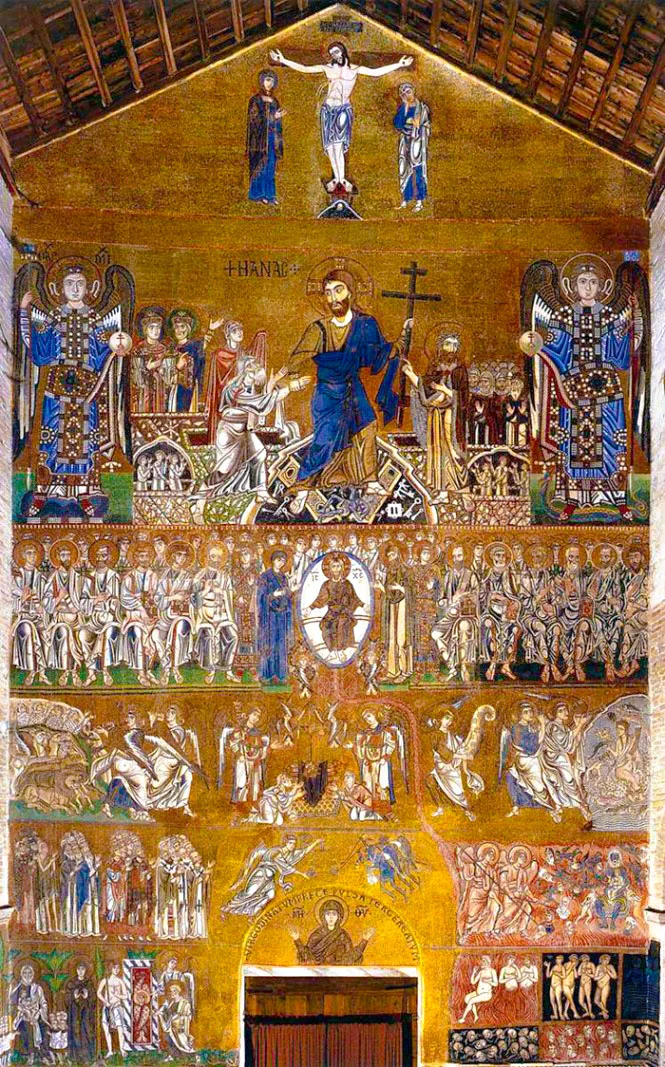
The privations no doubt made the sight of Santa Maria Assunta, once we were let inside, all the more thrilling. On its western wall, the golden vision of its “Last Judgment,” which received a full cleaning and restoration in February, is as profound as any art in Venice. With six vertical registers, the mosaic is filled with an awe-inspiring amount of visual information: scenes of the crucifixion, anastasis (resurrection), deesis (Christ with Mary and John the Baptist), and psychostasis (the weighing of souls) all rest on vignettes of heaven and hell divided in the lowest registers.

The Last Judgment, ca. twelfth century, Gold and glass mosaic.

The Last Judgment, ca. twelfth century, Gold and glass mosaic.

The decorative splendor of this mosaic barely holds its dynamic forces together. In the upper registers, an expressive Christ pulls the souls of the Old Testament up from limbo to heaven by their wrists. Below, a snaking line of judicial plumbing leads down to increasingly explicit visions of hell. Two demons try to tip the scales of Saint Michael with their pitchforks while pouring out sins from bottles and bags. Meanwhile the damned are subdivided among the lustful, gluttonous, wrathful, envious, avaricious, and slothful, where they endure fiery and icy torments, when not being eaten by worms.

Today Torcello is an overlooked shoal in the northern lagoon, but at one time the island nurtured the first seeds of what became the great Republic of Venice. Torcello flowered as the original center of activity in the Veneto, before its channels silted up and its inhabitants relocated to the nearby islands of Burano, Murano, and the high ground of the Rialto. A millennium ago, at its apex, there were some ten thousand inhabitants on Torcello. Today, only about a dozen remain. Torcello’s “Last Judgment” therefore offers genuine revelation. The end times here have already come.

There was a period when Torcello was the crucible of Venice’s unexpected beginnings. In the final days of the Western Roman Empire, barbarian hordes descended on the old Roman towns still clinging to the shores of the northern Adriatic. As Attila the Hun surrounded the town of Altinum in 452, its residents fled to the sandbars of the nearby lagoon. These Roman holdouts and refugees from the other Veneti towns became lagoon dwellers, incolae lacunae, just three miles south of Altinum on the shifting delta sands of the River Sile.

Today the view from Torcello’s campanile does not look all that different from what those settlers first saw fifteen hundred years ago. In The Stones of Venice, John Ruskin called the sight “one of the most notable scenes in this wide world of ours. As far as the eye can reach, a waste of wild sea moor, of a lurid ashen gray; . . . lifeless, the color of sackcloth, with corrupted sea-water soaking through the roots of its acrid weeds, and gleaming hither and thither through its snaky channels.”

A close-up of “the Envious,” The Last Judgment, ca. twelfth century, Gold and glass mosaic.

A close-up of “the Envious,” The Last Judgment, ca. twelfth century, Gold and glass mosaic.

The Venetian lagoon has always been an alien landscape, but its separation from the mainland provided essential protection from Italy’s drawn-out period of Germanic incursions and the collapse of the Byzantine Empire. In their exodus, the settlers built houses on pilings of hardwood driven into the mud flats. All of Venice was built this way. It is said that the baroque church of Santa Maria della Salute, the towering domed memorial to the devastating plague of 1630 by the Punta della Dogana, rests on a million wooden piles. The Venetians also organized their new community along Roman republican lines. Rather than be ruled by an emperor or king, they elected their leader—dux in Latin, duke in English, doge in Italian. In this way the Veneti of the lagoon formed their mighty maritime republic that endured for over a thousand years. In the Republic’s final days, before its destruction by Napoleon, the Venetians even counseled the architects of the United States on the secrets of their Republic’s endurance.

The foundation stone of the Torcello basilica was laid in 639, a year after the town’s bishop had a vision that his flock should abandon what remained of Altinum. As Torcello rose in importance, its basilica became a prominent cathedral. The nearby channel, now little more than a shoaled-up estuary that harbors those languid fish, was once Torcello’s bustling Grand Canal. The relics of Saint Heliodorus, the Altinum bishop who accompanied Saint Jerome and was martyred in 390, were carried off from his Roman town and laid to rest beneath the basilica’s altar. His golden reliquary can still be seen there today. Since the Torcello basilica predates the construction of even the first cathedral of San Marco in Venice by some two centuries, one legend maintains that the body of Saint Mark was first interred here, perhaps in the crypt’s Roman sarcophagus, after two Venetian merchants alighted with the Evangelist’s remains from Alexandria, Egypt, which was then under the dominion of the Abbasid Caliphate.

About the time of the height of Torcello’s predominance in 1100, the interior of the basilica received its cycle of golden mosaics, which includes a sorrow-filled image of the Virgin and Child in the main apse above a swirling, tessellated marble floor. Byzantine in form, the selection of a Last Judgment scene for the opposite towering western wall, through which congregants once entered and exited, is said to have been a particularly Venetian touch.

Torcello reveals Venice in its true provisional strangeness, where art gives vision to immanence and relics buoy the faithful to the final days. The great works of Venice have always conveyed these contingent qualities—as a world between worlds. Rather than gaze up to some idealized beyond, the art of Venice looks out to proximate, felt, rough-and-tumble revelation.

A close-up of “the Gluttonous and Avaricious,” The Last Judgment, ca. twelfth century, Gold and glass mosaic.

A close-up of “the Gluttonous and Avaricious,” The Last Judgment, ca. twelfth century, Gold and glass mosaic.

Art has always played a central role in connecting the Venetian experience to the cosmic story. The particular hardships endured by the disease-prone city can be seen through its adoration of the “plague saints”: San Rocco, in whose scuola and church, in the sestiere of San Polo, Tintoretto painted one of the world’s greatest cycles of Christian image-making; and San Sebastiano, in whose church, on the site of a medieval hospice in the sestiere of Dorsoduro, Veronese painted some of his own masterpieces. For the Scuola Grande di San Marco, which now serves as the entrance to Venice’s hospital, in the sestiere of Castello, Tintoretto painted his breakthrough Miracle of the Slave (1548), along with his famous depictions of how the body of Mark came to Venice (and its miraculous rediscovery after the Evangelist was, for a time, temporarily misplaced).

Art holds a particular power over the city, just as the city conveys a particular power to art. Undoubtedly this is the reason why many contemporary artists come to congest Venice’s art-filled walls: to claim the city’s revelations, even if what they themselves purport to reveal may be facile and false. Of course, the science-fiction didacticism of the group show in this year’s Biennale, full of blinking lights and spinning whirligigs, speaks little to the art of Venice’s resonant past. In our secular age, so enraptured with the present moment, how could it? Yet sometimes connections can still be made: in the United States Pavilion, the sculptures of Martin Puryear, which draw together the classicism of many sculptural traditions, are fraught with memory; an exhibition on “The Nature of Arp” at the Peggy Guggenheim Collection speaks to the aquatic forms of the lagoon; “Pittura/Panorama: Paintings by Helen Frankenthaler, 1952–1992,” at the Palazzo Grimani, returns the great modernist to Venice some fifty years after she dazzled in the United States Pavilion with her aqueous compositions; and at Ca’ Pesaro, “Arshile Gorky, 1904–1948” reveals the tragic vision of the American abstractionist who lost his family in the Armenian genocide.

Through plague and pestilence, rising sea waters and sinking salt marshes, in Venice the end has never seemed all that far off. Today the flood that troubles Venetians most is the tourists pouring out of grandi navi, the massive cruise ships that wreak havoc on the Giudecca Canal and may soon be banned, not the city’s frequent inundations of acqua alta, which locals take in watery stride. Last November, when I was previously in Venice for the Tintoretto exhibitions at the Palazzo Ducale and Accademia museums, the high-water siren sounded at daybreak. The sirene allertamento acqua altanow broadcast from twenty-two points across the historical center and islands of Venice. From my window overlooking the Accademia, I listened as the signal broke the morning spell from the alarm atop San Trovaso. As my water taxi motored up the Grand Canal, the flood waters compounded with the morning rain and washed over the calliaround the Ponte di Rialto.

Thirty-five years ago Venice installed its first flood alarm on the campanile of San Marco. A new alarm developed by the Centro Previsioni e Segnalazioni Maree now uses a wireless network and digital signals of various tones to indicate the height of the rising tide. Venetians also sign up for emergency notices by text message, giving them a few extra minutes to slide in the low metal barriers at the bottom of their doorways to hold back the headwaters. In the months of fall, as the sirocco southern wind, the full moon, and other hydrological effects converge on the Adriatic to push water into the lagoon, many Venetians now simply leave the barriers in place.

The waters of the lagoon have always offered protection and destruction in equal measure. With its canals framing an architecture of exquisite lace, the city’s liquid light gives evanescent form to the miraculous story of survival that began, and ended, on humble Torcello. “Without making this excursion you can hardly pretend to know Venice,” Henry James said of his own visit to that island. “It is impossible to imagine a more penetrating case of unheeded collapse. Torcello was the mother-city of Venice, and she lies there now, a mere mouldering vestige, like a group of weather-bleached parental bones left impiously unburied.”