Bruni Out of Tune

Dara writes:

Just when I was feeling badly I had not yet posted on the recent development in the world of New York Times' chief restaurant critic Frank Bruni, Bruni lets loose another gust of bad wind that makes me kind of glad I waited.

To begin: the ranting letter written against him by restaurateur Jeffrey Chodorow. Chodorow has opened several successful restaurants, including China Grill and Asia de Cuba, and several disastrous ones, such as Rocco's, the demise of which television chronicled. Chodorow's $40,000 Times' ad opposite Bruni's column responded to Bruni's no-star review of Chodorow's latest venture, Kobe Club. In his rant, Chodorow recoils not from the negativity per se, but from what he considers Bruni's ad hominem attack. Chodorow complains that the "unfair" review hurts not him, as he is battle-worn and tough, but his servers and kitchen staff.

As Mimi Sheraton, former New York Times' chief restaurant critic, brilliantly asserts on Slate, Chodorow is in fact the one hurt--by his own letter. Now, all those unaware of the negative review will be aware of it. Moreover, by attesting to the critic's influence, Chodorow merely served to increase Bruni's power.

Too bad, because I have really started to dislike Bruni. While I may not agree with Chodorow's view--many other critics also panned Kobe Club--I do agree that Bruni tends toward the ad hominem, as I have already made abundantly clear on this very blog. Now, just today, we see that Bruni is also capable of agressing ad feminam.

Witness today's NYT review of the steakhouse inside the Penthouse Executive Club.

“Foxy,” I began, then stopped myself, wondering if I was being too familiar. “Are you and I on a first-name basis, or should I address you as Ms. Foxy?”

“You can call me Dr. Foxy,” she said.

“Is that an M.D. or a Ph.D.?”

“Yes,” she answered.

Now, this rudeness has already been addressed on Gastroporn, but I have to second that blogger's comment assailing Bruni for being so condescending to this Penthouse worker. On the NYT website, a "multimedia" show accompanies Bruni's article, on which you can relish such photo captions as:

Look at that meat. On the plate, I mean.

It's not so much that I think Bruni is demeaning women, as much as I think he is being awkward and dumb. Gridskipper has reported that Mr. Bruni is gay; maybe his being in a straight strip joint made him profoundly uncomfortable and he acted out. Unfortunately, his writing bore the brunt of whatever psychic burden being around nude women loaded on his shoulders. To wit:

You can find bliss in the soulless cradle of a strip mall. Why not the topless clutch of a strip club?

Get it? Get the parallels? I used to like Bruni's puns, but now I find he is precious and annoying when trying to make so many cute literary twists.

I am curious to see Bruni's next move. Many others are now also tuned in, including, my favorite post on the Strip Snafu, Feminist Law Professors.
What's in a name?

Davidandjames
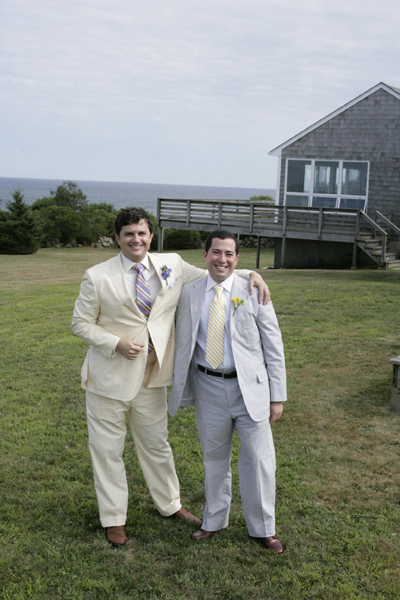
This morning I received a message from my Best Man, David Spitz. He's in London for the year and writing a great travel weblog called... well, that's the thing. David's looking for a new name. So what should it be? Check out the link and see what you think. Here are David's suggestions (my fav is 'Overseas Mail'):

The focus is on travel and cultural experiences (food, arts, theater, etc). The original title, A Year in London, did not really fit because much of the narrative takes place outside of London, not to mention outside of the year.

The new candidates are:

Digital Postcard (current working title of http://davidspitz.wordpress.com) or Overseas Mail (has a nice symbolic ring, but does it fit?) or Overseas Wire (or Wires?) or Wire Transfers (with Overseas Wires and Digital Postcards as categories) or Other (you choose!)

Any clever thoughts, suggestions?

-david

'A Diorama's Moving Story'

056_mtngorilla034

Mountain Gorilla
Akeley Hall of African Mammals
American Museum of Natural History, New York

THE WALL STREET JOURNAL
February 17-18, 2007

'A Diorama's Moving Story'

Masterpiece: Anatomy of a classic
Carl Akeley never lived to see his most lasting achievement

by James Panero

A silverback gorilla stands proudly before his family. Wild celery and Ruwenzori blackberry, Cusso and Tutsan trees fill the foreground. The volcanic Kivu range smolders in the view beyond. All on the Upper West Side of Manhattan.

New York’s cathedral to the natural world, the American Museum of Natural History, is built on the belief that one’s betterment through education will lead to the betterment of all. The museum’s mountain gorilla diorama is an expression of this faith. Through the transformation of stones and bones into an art without artifice, we feel empathy for an unseen world.

The master of the habitat diorama was a larger-than-life figure named Carl Akeley. He was an artist who genuinely suffered for his art. Over two expeditions to Africa in the 1920s, he faced down charging elephants and strangled an attacking leopard with his bare hands. With a genius for invention and a polymath’s interest in science, naturalism and art, he took museum education into the 20th century with his affecting tableaux of plants and animals. His legacy of diorama art is finally getting its due.

Akeley built the first diorama for science education—a muskrat habitat, still on display at the Milwaukee Public Museum, in 1889. He also created a culture of taxidermists, foreground sculptors and background painters at the American Museum that elevated his craft into an art form.

On the museum’s 1926 Akeley-Eastman-Pomeroy Expedition to Africa, artists joined scientists in the field. Shoebox-size mockups were ported from camp to camp. Armed guards kept watch over the painters for fear of animal attacks.

Akeley was there preparing material for a two-tiered hall of dioramas dedicated to African mammals, which he envisioned would include a herd of elephants as its centerpiece and the mountain gorilla display as its cornerstone.

Each diorama scene would be a precise reproduction of the flora and fauna of an exact time and place. Each display would require extensive on-site analysis. Each animal specimen would be sculpted in clay prior to mounting (before Akeley, taxidermists stuffed hide with straw).

When the Hall of African Mammals opened 10 years later, it become Akeley’s most lasting achievement. He never lived to see it.

In 1926, Akeley died of dysentery and malaria on the slopes of Mount Mikeno in Africa’s Belgian Congo. He is buried just beyond view of the site now depicted in the museum’s mountain gorilla diorama. Using scientific information gathered from his 1926 expedition, along with gorilla specimens Akeley had collected and prepared in 1921, Akeley’s colleagues completed this diorama in 1936.

It was a fitting tribute. Thanks to Akeley’s efforts on behalf of gorilla conservation, Belgium’s Leopold II established Parc Nationale Albert, Africa’s first national park and research facility, in 1925. The park now spans three countries, including the area around Mount Mikeno. Today, the forest depicted in this diorama would undoubtedly be gone, and the mountain gorilla would most likely be extinct, were it not for Akeley. (Dian Fossey, a naturalist who walked in Akeley’s footsteps, was killed near Mikeno in 1985 protecting Akeley’s “amiable giants” from poachers; her story became the subject of “Gorillas in the Mist.”)

After Akeley’s death, such background artists as James Perry Wilson, foreground sculptors as Raymond DeLucia, and taxidermists as Robert Rockwell went on to exceed Akeley’s artistic achievements. By mid-century, individual dioramas had taken on theatrical story lines. The diorama artist attacked the challenges of dusk, variable weather conditions, and animals in motion. The Hall of North American Mammals, one floor below Akeley Hall and born from the spirit of Akeley’s mountain gorilla display, contains many of these examples.

“All of the talents, all of the staff and techniques and methods and tricks of the trade that were utilized in the Akeley years were then brought to bear on the North American mammals groups,” says Stephen Christopher Quinn. As the heir to Akeley’s exhibition department at the museum, Mr. Quinn published “Windows on Nature,” the definitive, illustrated guide to the dioramas, last year.

As a kid, I remember becoming attached to the small winter scene of a Canadian Lynx creeping up on a Snowshoe Hare along a rime-encrusted ridgeline. I imagine I wasn’t the only one with feelings for the lynx’s prey crouching beneath a balsam fir. A similar emotion swept over Akeley upon encountering the mountain gorilla. “I envy that chap his funeral pyre,” Akeley wrote in his journal of 1921.

Theodore Roosevelt spent his own boyhood in this museum; his father was influential in its founding in 1869, and the original charter for the museum was signed in his family’s home. The Theodore Roosevelt rotunda, the museum’s entrance hall designed by John Russell Pope, has for generations served as the institution’s lofty shrine to our conservation-minded president.

Affixed to the wall of this hall is the following Roosevelt pronouncement: “There are no words that can tell the hidden spirit of the wilderness, that can reveal its mystery, its melancholy and its charm.” With his own form of virtual reality, Carl Akeley developed a way to reveal nature’s hidden spirit without words.

Next time you are at the American Museum of Natural History, step out of the lobby into the Akeley Hall of African Mammals, make a left at the Mountain Gorilla diorama, and you will find a masterpiece of diorama art that is as profound as anything in the museum.

Mr. Panero is the managing editor of the New Criterion.