In the high alpine zone: Labor Day weekend in New Hampshire

James writes:

Dara and I joined friends Lauren and Nick over Labor Day weekend for a three day hike through two of the 'huts' of the Appalacian Mountain Club: Galehead and Greenleaf. Our pictures just recently came back from the print shop (yes, Lauren used a 35 mm camera, which is one reason the images came out great). It was a beautiful weekend and the long hike from Galehead to Greenleaf on day two especially rewarding (I had hiked the entire 'hut chain' a few years back and remembered that this traverse, which summits Mount Garfield and Mount Lafayette, always takes longer than you might expect (in our case, over eight hours).

'The Picture of Lucian Freud'

THE NEW YORK SUN

'The Picture of Lucian Freud'
BY JAMES PANERO
November 7, 2007

66038_main_large

Isn't it ironic that postwar art has traded one Freud for another. The very influence that Sigmund once exerted in the 1950s, his grandson Lucian, now in his mid-80s, might claim today. John Currin, Elizabeth Peyton, Lisa Yuskavage, Tracy Emin: All are among the younger artists who look to Lucian's analysis of the body just as many Abstract Expressionists once drew on Sigmund's dissection of the mind.

In his new monograph on the artist, "Lucian Freud" (Rizzoli, 488 pages, $135), billed by the publisher as the most comprehensive survey of Lucian to date, William Feaver writes, "There's an easy assumption that, metaphorically speaking if not by actual bequest, Lu the Painter inherited the couch of his renowned grandfather." An easy assumption, yes, but an overworked one. Mr. Feaver, a British art critic and painter who has organized several Freud exhibitions, fortunately knows better than to spend much time on the Sigmund-Lucian comparison. Instead, his book hints at more interesting terrain. Although it is not an argument made explicitly in the book (a somewhat tongue-tied, soft appreciation), Mr. Feaver offers up nearly 400 reproductions, four interviews with the artist, and an introductory essay that suggests a different conclusion: The secret of Lucian's success may not be his Sigmundness. It may instead be his Englishness.

Born to Jewish parents in Berlin in 1922, Lucian escaped with his family to England in 1933. He did not look back. He never dilated on the Jewish identity that first sent him abroad — "Being Jewish?" Mr. Freud remarked to Leigh Bowery, the corpulent performance artist who became one of his favorite subjects, "I never think about it, yet it's a part of me" — he gave up on Germany — "Hitler's attitude to the Jews persuaded my father to bring us to London, the place I prefer in every way to anywhere I've been" — and, finally, he wanted little to do with Sigmund: "I think [psychoanalysis is] unsuited to the lifespan," he told Mr. Feaver, somewhat elliptically. "I feel very guarded about it but I'm fairly ignorant about it."

What replaced all this was an adopted national canon. Sure, boiling things down to national style may be reductive, but Mr. Freud clearly set about performing that reduction himself. The process began in boarding school, where Lucian worked to rid himself of Teutonic mannerisms. "When I came to England first I could only do German Gothic handwriting," says Mr. Freud. Mr. Feaver continues: "The spikiness lapsed and he developed a rounded, laboured, but not inelegant script of his own, each word treated as a novelty, written as though drawn."

The same transition can be seen through his early artwork. Despite little formal training, Lucian displayed an immense talent for draftsmanship. Although less well known than his paintings, his etchings remain a high point of his oeuvre (a subject that will be examined in an exhibition at the Museum of Modern Art starting in December). Ink drawings, such as "Loch Ness from Drumnadrochit" (1943), likewise became crystalline interpretations of the visible world.

Yet his paintings through the 1940s still shout "Weimar." The bug-eyed portraits of the period, though accomplished, betray an expressionist manner. Mr. Feaver writes how this led to the "assumption (he took it as an accusation) that he was a Germanic sort of artist, carrying on willy-nilly in prewar, pre-Hitler, 'Neue Sachlichkeit' style."

Well, up to a point, he was. In the mid-1950s, however, the manner matured. Suddenly we see the signature style, the splotchy red-yellow-green brushwork that he would apply, for the rest of his career, to his analysis of human flesh.

The 19th-century British painter Benjamin Haydon once remarked:

The explanation of the propensity of the English people to portrait painting is to be found in their relish for a Fact. Let a man do the grandest things . . . yet the English people would prefer his portrait to a painting of the great deed.

The likeness they can judge of; his existence is a Fact. But the truth of the picture of his deeds they cannot judge of, for they have no imagination.

If Mr. Freud was not born with English sensibility, he developed one in paint. And he found ready success in the "honesty" of these fleshy facts. It comes as no surprise that one of Mr. Feaver's interviews with Mr. Freud concerns Lucian's appreciation of John Constable. This interest began when Mr. Freud was "living in Dedham, in the Constable country. I'd seen the little painting of the tree trunk, close-up, in the V&A, and I thought what a good idea." Mr. Freud continues: "I mean, this is so English isn't it?"

But of course, beyond the interest in fact, Mr. Freud's most famous paintings are English for more tabloid reasons, too. Oscar Wilde once said, "The English public, as a mass, takes no interest in a work of art until it is told that the work in question is immoral." As is underscored by Mr. Feaver's book, Mr. Freud's shortcoming is that he can abandon English fact for mere English sensationalism.

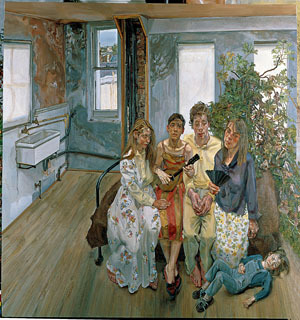
In 1964, Mr. Freud was dismissed from a teaching job for assigning his students to paint naked self-portraits that would be "something really shameless, you know." Thereafter, the subject in his own work became evermore shameless and grotesque. Enter Leigh Bowery and "Big Sue," Mr. Freud's obese painter's models. Enter taboo. For one painting he positioned his half-naked, pre-pubescent daughter Isobel on the floor beside a houseplant ("Large Interior, Paddington," 1968-69). He also featured a man, the photographer David Dawson, breastfeeding a baby as Francis Wyndham reads Flaubert's letters ("Large Interior, Notting Hill," 1998).

The slow rise of British art, which tracked the demise of the New York School and the dying influence of the French avant-garde, has privileged Mr. Freud as the embodiment of English style. Unfortunately, he inhabits the best and worst attributes of what England can offer up in paint. His champions point to John Constable. But Mr. Freud is rather more Dorian Gray.
'Art's New Financial Landscape'

JeffKoonsBlueDiamnod ART AND ANTIQUES
November, 2007

Critic’s Notebook: Art’s New Financial Landscape
by James Panero

A frequent response to the sticker shock of postwar and contemporary art is to claim that the market is inflated, that we are experiencing a bubble. But does this term, usually reserved for stock and real estate prices, apply? The art market exhibits few if any of the traditional indicators of speculation or other instabilities in pricing. Unlike real estate, most art is purchased with cash in hand. There are no sub-prime mortgages propping up the purchasing of art, no unstable supports to come crashing down in periods of price correction. One explanation of the rise of art prices might be found in the rapid growth of global wealth, and this liquidity shows no sign of drying up. Art may simply be a luxury good with limited supply and growing demand.

But market skeptics are really saying something more. Underlying their concerns is the sense that art is suffering from a bubble in taste. It is difficult not to feel that disproportionate amounts of money are being lavished on certain artists, but does this necessarily mean that the market is overdue for some kind of aesthetic correction? Perhaps the art world has simply become more tasteless and will stay that way.

It is said that a rising tide lifts all boats, but even as art prices have risen across the board, they have not risen in equal measure to one another. Postwar and contemporary art has come to occupy a place in the market that never existed for it in the past, while prices for French, Italian, and other European art from the 16th through mid-19th centuries have experienced little uplift. Everywhere we can see the evidence of this sea change, from the very introduction of contemporary art auctions to the rise of the international contemporary art fair to the so-called deaccessioning of museum collections to fund contemporary acquisitions. Of course, older does not always equal better, but as the dealer Richard L. Feigen recently wondered in The Art Newspaper, should a Damien Hirst sculpture really carry a price tag comparable to that of the Halifax Titian, one of the world’s last Titian portraits in private hands (and still on the market)?

Maybe contemporary collectors just don’t realize how far their money will go in the arts of earlier periods. Lawrence Salander of Salander-O’Reilly Galleries has bet the bank that he can educate them. This fall and winter, in cooperation with the London dealer Clovis Whitfield, Salander is mounting an ambitious exhibition of Renaissance and Baroque masterpieces, including works by El Greco, Parmigianino, and Pontormo, with price tags that are a fraction of what you’ll pay for a Warhol. To top it off, Salander will feature the first work identified as a Caravaggio for public sale in the United States in several decades. (In 2001, Sotheby’s sold the work as "Circle of Caravaggio" and still disputes the claim.) The price point of this work, titled "Apollo the Lute Player," will be determined by the high water marks recently set by Hirst, say sources close to the gallery. Should Hirst be in the same league as a Caravaggio, even a disputed one?
 
A correction in price, predicated on a correction in taste, assumes that the collectors of art still care about the standards of the past. In the end, in areas where art price cannot be traditionally explained, and where there seems to be no end in sight to the sticker shock, one begins to think that there are other factors at work. Art has always been a valuable commodity, but only in the last decade or two has it come to be perceived as an investment-grade asset, with rates of return in certain cases equaling or exceeding those of more standard financial markets. Now, while art continues to function as a luxury good, a sign of social status and even as a source of personal delight and aesthetic fulfillment, the top buyers are leading us into a new world that transcends aesthetic concerns. What comes after modernism? The answer is not postmodernism. It may be closer to moneyism.

While postwar art has been swept up in this new phenomenon, at the forefront of the movement are contemporary artists who know how to fashion work for the buying public. Remember Jeff Koons, the 1980s art star and original Wall Street dandy who has been doing career maintenance ever since his market tanked in the last recession? He’s back in the headlines. A work called "Blue Diamond," a 7-foot-wide sculpture of monumental jewelry that Koons designed in polished steel in 2005 and 2006, is going up for auction at Christie’s in November with an estimated price of $12 million. If it sells, the sculpture will far surpass Koons’ previous auction record set in 1991, when his "Michael Jackson and Bubbles" sold for $5.6 million.

This is taxi fare when compared to the new Koons on the block, Damien Hirst. While the medium of his art may be dead animals, formaldehyde, diamonds and skulls, the subject of his work is the art market itself, and his work’s suitability as an asset. The artist’s admirers regard his financial success as part of a sophisticated commentary on the art market, but I think it is the other way around. Hirst’s commentary on the market is really a means of achieving financial success. This summer, as we all now know, Hirst’s diamond-encrusted human skull sculpture, "For the Love of God," was reportedly sold to an anonymous group of investors, according to Hirst spokesmen, for the asking price of $100 million, topping off $260 million in sales for his White Cube Gallery show. Notice that word choice of "investors" rather than "collectors."Truly, it is the investors who are deciding the future of postwar and contemporary art. Consider the hedge fund manager Steven A. Cohen. In a rare interview in 2006, this media-shy recluse lamented to The Wall Street Journal, "It’s hard to find ideas that aren’t picked over, and harder to get real returns and differentiate yourself." It should be safe to assume that a hedge fund manager with a winning market track record lasting a quarter of a century is not in the business of losing money. Through his collection of art, variously reported to be worth between $300 million and $700 million and amassed over little more than five years, Cohen may have discovered work that gives him pleasure, but he has also found a way to diversity his portfolio. In 2004, Cohen purchased Hirst’s pickled shark, "The Physical Impossibility of Death in the Mind of Someone Living" (1991), from Charles Saatchi, Hirst’s Maecenas, for what was then considered an outrageous price, $8 million (see more on Hirst’s shark in News, page 34 of this issue). But he still does not want to take it home. Instead, Cohen has convinced the Metropolitan Museum of Art in New York to display his purchase on loan for a set period of three years. Cohen’s investment benefits from the museum’s formidable aura, while the museum looks to hook a future patron.
 
When our nation’s finest museums are reduced to banks for an investor’s appreciating assets, the art world is suddenly far beyond the purview of critics. To really know what the future of art will bring, you’ll have to ask the investors.