NEW YORK MAGAZINE
Features
An Old Master in Ruins
Why is an El Greco worth less than a Koons? Gallerist Larry Salander called it a moral travesty, and decided, catastrophically, to do something about it.
By James Panero
Published Mar 24, 2008
The art dealer Larry Salander is ready to erupt. He puffs up, expanding his chest like a bellows. He presses his mouth shut. He squeezes his tongue against his palate and engorges his cheeks, his upper lip already damp with perspiration and a few molecules of lunch. Finally, with nostrils flared, he explodes.
“Our society now values a Warhol for three times as much money as a great Rembrandt,” he thunders, referring to the latest auction reports. “That tells me that we’re fucked. It’s as if people would rather fuck than make love.”
He says the last sentence slowly, emphasizing each word.
“That’s the difference between the Warhol and the Rembrandt,” Salander continues. “Being with Rembrandt is like making love. And being with Warhol is like fucking.”
Salander and I are just finishing a lunch of pasta fresca in the eat-in kitchen of his Upper East Side home. Now on the market for $25 million, the townhouse—almost a palace— is decorated with paint imported from Venice and fifteenth-century Sienese tiles. It reflects Salander’s eclectic taste, with African sculpture and American tonalist landscapes mixed in among the Canalettos. In the next room, Salander has inlaid a marble floor with the phases of the moon.
An aesthete with no formal art education (nor even a college degree), Salander built his art empire, Salander-O’Reilly Galleries, on native artistic empathy and an intensity of will. “He is a very unusual combination of street vitality and aesthetic refinement,” says Leon Wieseltier, the literary editor of The New Republic and a close friend of Salander’s who wrote catalogue essays for the gallery. “He’s a street kid who’s read Ruskin. I don’t know anybody else who so naturally recognizes the brutality of the world but lives in such a fine way.”
Artists, actors, critics, and buyers responded to his gravitational pull. When I visited Salander in Venice during the opening of the Biennale last June, he was a character in need of a Balzac, a prophet and a gambler who seemed to walk across the water of the Venetian lagoon. He spoke about Titian and Tintoretto as if they were close friends and skipped the contemporary art of the Biennale altogether. As we returned from the island of Burano, where we’d had dinner with his friend Robert De Niro, Salander said to me, “Art is the human attempt to make one plus one equal more than two.”
But Salander made a critical miscalculation. Over the last few years, he had been trying to apply his passion and alchemy to correcting what he saw to be a dangerous inversion of the art market. To Salander, many contemporary art collectors are philistines. But if he could use his gallery to create a new market for old-master and Renaissance art, perhaps he could shift the paradigms of the international art trade.
It was an intriguing idea, but it left him in ruin. On the opening evening of a show he hoped would electrify the market, angry investors closed down his multimillion-dollar gallery. A restraining order prevented Salander from entering the gallery or selling art anywhere in the world. He now faces a criminal investigation and lawsuits from investors who say they were abused, collectors who say they didn’t get what they paid for, and artists who say they never got paid. He could be upwards of $100 million in debt. As our lunch filled the afternoon, Salander spoke for the first time about his plan to rescue the art world from bad taste, and how it ultimately destroyed him.
Three years ago, Salander-O’Reilly Galleries, located at the time at 79th Street and Madison Avenue, seemed to be an indestructible institution. Raised by middle-class Jewish parents in Long Beach, Long Island, Salander built his dealership from a small antiques shop in Wilton, Connecticut, into one of New York’s premiere art houses specializing in nineteenth- and twentieth-century painting and sculpture. Becoming partners first with the more established dealer William O’Reilly and then with a passive investor named Myron Kunin, Salander mounted hundreds of museum-quality shows that seemed to rise above market concerns.
“Larry always has some mystery,” says Ann Freedman, the director of Knoedler and Company, New York’s oldest commercial art gallery, on 70th Street off Madison Avenue. “Success for him was to find the undiscovered painting, to prove this was a masterwork against all odds, to put on a show that nobody else would have dared to try to do. He just wanted to be special.”
Salander learned how to read the market. He developed a reputation for recognizing undervalued art, and took a prescient interest in the nineteenth-century pre-Impressionists and in early American modernists such as Ralph Albert Blakelock, Albert Pinkham Ryder, Marsden Hartley, and Louis Eilshemius.
At the same time, living artists who eschewed the latest art-world trends found a kindred spirit in Salander, who showed the figurative painters Leland Bell, Louisa Matthiasdottir, Paul Georges, and Lennart Anderson. One day, Robert De Niro Sr., the accomplished New York School painter and father of the actor, knocked on Salander’s door and asked him to exhibit his paintings. Salander represented the artist for the rest of his life and subsequently managed the estate.
As a house for serious nineteenth- and twentieth-century art, the gallery had settled into a proven, commercially successful formula. But over the last decade, as the art market underwent a seismic shift, Salander noticed a particular gulf opening up between the markets for postwar and contemporary art, and most art created before Impressionism. New art suddenly started going for far more than older, established masterpieces. Many of the newly rich collectors preferred to spend their hedge-fund wealth on more recent, name-brand artists. A Jasper Johns was soon worth twice as much as the Metropolitan’s Duccio, the Madonna and Child purchased by the museum for as much as $45 million in 2004. An oversize sculpture of costume jewelry by the art star Jeff Koons was valued higher than a Tintoretto, an El Greco, or a clutch of Courbets.
To Salander, this development was a moral travesty. It was also a business opportunity. As he obsessed over these market dynamics, Salander eventually came to believe that the very survival of great art was at stake. By 2005, he had determined to be the first dealer to do something about it. He would risk his gallery’s established reputation as a nineteenth- and twentieth-century house by investing heavily in old-master and Renaissance art. He would make some money and, if his plan worked, save the contemporary market from itself.
Salander started out slowly, first by expanding his small, backroom dealership of sixteenth- and seventeenth-century painting and sculpture. But he was amazed at the availability of older art, and started to acquire it with vigor. “I ended up finding I could buy these things that I loved so much,” he says. “These great sculptures. Donatellos. And Luca della Robbias. And the idea I could have this stuff!”
It soon became apparent that the gallery would need to expand. In early 2005, Salander noticed a vacant 25,000-square-foot Italian Renaissance palazzo on 71st Street between Madison and Fifth Avenues. The rent was over $150,000 a month— almost three times the rent of his 79th Street venue for a space five times the size. Taking on the palazzo would entail an enormous amount of risk—especially since he had yet even to prove the existence of the market he hoped to dominate. But Salander was undaunted. “I said, I gotta either retire now or I gotta do this.”
The new branch of the Salander-O’Reilly Galleries opened in September 2005, with a grandeur meant to attract buyers from the contemporary-art world who might be willing to speculate on old-master and Renaissance art as an investment.
“I thought it was the most extraordinary place,” says Wieseltier. “A gallery that was consecrated to classicism and newness at the same time. It represented an aesthetic sophistication that refused to be dominated by the market, and therefore it was an act of cultural resistance. The purity of its intention was undeniable, and apparently catastrophic.”
The catastrophe came almost immediately. Salander began to have a cash problem. As the gallery acquisitions and payroll expanded to fill the needs of his new five-story fortress, Salander was forced to close down his 79th Street space. This dismayed many of Salander’s contemporary artists and longtime employees, who started to worry about the gallery’s standing.
But Salander stuck with his plan. He continued his regular schedule of nineteenth- and twentieth-century exhibitions, now in the velvet-lined rooms of the palazzo, while amassing an enormous inventory of older work, including many overtly Christian sculptures—Ecce Homos, Mater Dolorosas, Virgins With Child—and dozens of wooden statues of Jesus Christ.
He saw his project as spiritual, even messianic. “We’re a soulless society,” he says, returning to a theme that surfaced many times in our conversation. “When I’m talking about the soul to people, they look at me like I’m nuts. But there has been a longtime manipulation of people who want to make money to dumb down the American society and rob us of the curiosity of our souls.” (Salander’s now writing a book on the subject called Soul Wars.)
Those who orbited Salander agree that his motivation was not primarily financial. “He’s passionate about the great painters,” says Liam Neeson, who purchased two paintings from Salander-O’Reilly and received two of Salander’s own works from the gallerist as a gift. (Salander is a regularly exhibited artist, and has a painting of the Crucifixion in the Smithsonian.) “He doesn’t see art as a used Tampax moving across a bare wall.”
As for the dealer in Salander, he couldn’t imagine how the market wouldn’t come around and follow his lead up Calvary. “I don’t think you need an M.B.A. from Wharton to understand this,” Salander tells me. “You have the greatest art in the world. A Donatello for sale. A Donatello? I couldn’t believe it. Parmigianino? The guy died when he was 37 years old. There aren’t a lot of pictures by this guy. And it’s less expensive. When Francis Bacon is $75 million, Parmigianino looks pretty cheap at $10–12 million.”
A Parmigianino may be comparatively inexpensive in today’s art market, but at $10 million or $12 million, it is far from cheap. Salander needed money to buy his art, and more money to hold on to it while he developed new buyers. He says he had a seven-year plan. “It wasn’t going to be producing money until towards the end of this thing,” he says, “because I was more interested in building the market for the big hit at the end.” So Salander took out a $19 million mortgage on his home and used the revenue to buy more art.
Then, in 2006, looking to end his money problems, Salander made a fateful decision, enlisting as a silent business partner a family friend named Donald Schupak. (Their daughters were friends from Dalton.) Schupak in turn brought in a Las Vegas casino owner named Jack Binion. Son of alleged crime boss Benny Binion, Jack had pioneered the World Series of Poker at his family’s Horseshoe casino and had developed interests in riverboat gambling.
As Salander describes it, Schupak lined up $10 million in financing from Binion and nearly another $5 million from additional sources. In mid-April 2006, Salander, Schupak, and the other partners formed Renaissance Art Investors, Inc. As part of the deal, Salander says he sold half-shares of $30 million of the gallery’s old-master and Renaissance art for an approximate $15 million payout from RAI. Still, the infusion of cash would not be enough to cover his mounting debts. He was sinking deeper into trouble.
Art galleries are largely unregulated businesses, and artists rarely file commercial documents to secure their loans to dealers, so until their day in court it’s impossible to know whether— or if so, just how severely—Salander defrauded his clients. Since the 71st Street gallery opened in 2005, dozens of artists, estates, collectors, and investors have come forward with serious allegations: that Salander withheld money he owed them; that he sold work he did not own; that he sold work whose provenance was misrepresented; and that he amassed over $100 million in debt from these schemes to float his old-master plans.
“The first clue I had that something was wrong,” says Lance Esplund, the chief art critic for the New York Sun, “was when I was trying to get paid for a catalogue essay I had written in 2006. The accountant kept dodging me.” At the start of 2007, a sea of artists, estates, and creditors began to make claims against Salander and his gallery for unpaid goods and services, and for mishandling artists’ work. Earl Davis, the son of the artist Stuart Davis, sued Salander for selling nearly 50 of his father’s paintings without remuneration, or even his consent. (De Niro would later claim that Salander had tried to unload paintings by his father to a gallery in Rome.)
The tennis star John McEnroe sued Salander for not delivering payment on an investment. Paul Rosenberg & Company, Salander’s former landlord at 79th Street, sued Salander-O’Reilly for up to $1.6 million in back rent and other debts.
It’s not that Salander did not have assets at that time—he admits he was continuing to buy up valuable work—he just did not have the cash (or perhaps the inclination) to pay everyone as money came in. Or as Joe Saracheck, the court-approved restructuring officer overseeing the bankrupted gallery, explains it, “The art business is much like the diamond business, but unlike diamonds, you cannot just liquidate art.”
By last summer, the lawsuits were showing up in the trade press, which in turn encouraged more creditors to come forward. In the month of August alone, Salander’s longtime partner Myron Kunin claimed in court that his “trust and confidence has been betrayed” by Salander for defaulting on the $7 million purchase of a Georgia O’Keeffe painting. Arthur Carter, the former New York Observer publisher who had exhibited his sculptures with Salander, filed suit for $1.2 million against the gallery for loans gone bad. The dealer Stanley Moss was awarded a $1 million judgment against Salander for outstanding payments on purchases. Roy Lennox, a managing director at the hedge-fund company Caxton Associates, sued Salander for $4.6 million and an additional $10 million in punitive damages, accusing him, among other things, of attempting to settle debts by passing off art with dubious attribution. Salander’s colleagues at the gallery quickly made for the exits.
To announce his move into the old-master and Renaissance market and quell concerns that his gallery was imploding, Salander began preparations in early 2007 for “Masterpieces of Art: Five Centuries of Painting and Sculpture,” a blockbuster of an exhibition featuring works by Michelangelo and Titian that he planned to open on the evening of October 16. Over Labor Day, he brought in a single piece exceptional enough to anchor the show.
A London dealer named Clovis Whitfield arrived at the gallery that weekend with consignments from his own collection, including a rediscovered painting called Apollo the Lute Player. When the painting had been sold by Sotheby’s in 2001, it was attributed to an artist in Caravaggio’s circle and went for far below $1 million. But Whitfield had since discovered documentation that he believed proved the painting was by Caravaggio himself. Though the attribution was controversial, Salander intended to sell Apollo for $100 million.
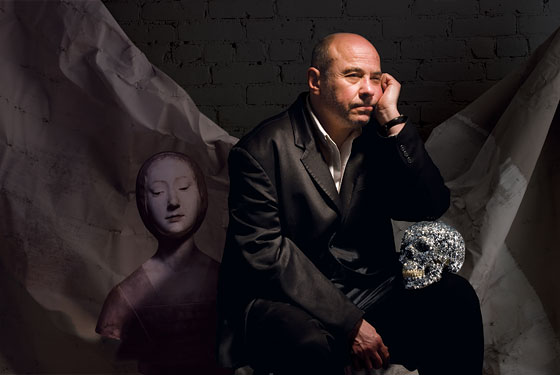
The Caravaggio, he was certain, would reverse the gallery’sfortunes. “There was always the sense that he was going to make that one big sale that would make him liquid, and he’d pull it off,” says Roland Augustine, director of the Luhring Augustine gallery. The $100 million price tag was not arbitrary, either. A diamond-encrusted skull by the artist Damien Hirst had allegedly sold for the same amount in London. Salander’s Caravaggio would directly challenge Hirst’s backers and set up a showdown between the contemporary and old-master markets.
Yet just as the exhibition began to take shape, Salander’s partnership with Donald Schupak was falling apart. With the lawsuits now appearing regularly in the press, Schupak did everything he could to prevent the show from opening. Starting that summer, Schupak had become a regular presence in the gallery, often with his son Andrew. (Gallery workers nicknamed the pair Dr. Evil and Mini-Me.) According to one former Salander employee, Schupak “made it clear that he needed total control over everything. It wasn’t about the money anymore. He screamed into the phone a few times that he was literally going to get us and have his way.”
A few days before the October opening, Schupak and his lawyer filed a series of motions in New York Supreme Court designed to constrain Salander’s control of the gallery. Schupak installed a private security firm outside the gallery to videotape activity and search those exiting the building. He convinced a judge to padlock the gallery temporarily. Salander fought back, but the confrontation took its toll.
At 3 p.m. on the day of the opening of “Masterpieces of Art,” a rattled Whitfield showed up at the gallery. Tearful, he announced to Salander that he was pulling his paintings. As reporters and invited guests began to collect outside, Whitfield tossed his Caravaggio and other loans onto a truck and fled. At the same time, with the help of private security, Andrew Schupak began rolling out works from Salander’s storage that he claimed belonged to RAI. Salander left the gallery later that afternoon with his wife, Julie, daughter Ivana, and son Jonah, who lunged at a Bloomberg News photographer before walking home. The gallery, suddenly, was finished.
"Masterpieces of Art” never officially opened. Absent Schupak’s legal maneuvers, it might have, although it is doubtful the gallery could have stayed afloat for long. Upon Salander’s exit, the door was locked by court order. The district attorney’s office executed search warrants on the gallery and Salander’s townhouse and launched a criminal investigation, seizing computers, servers, and 90 boxes of documents. In November, Larry and Julie Salander filed for Chapter 11 personal bankruptcy from their second home, upstate, protecting them from the avalanche of suits filed against the gallery over the previous two years.
“The scenarios range from ‘He got in over his head’ to the other extreme, where he perpetrated a massive fraud,” says Robert J. Feinstein, who represents a committee of unsecured creditors against Salander. Roy Lennox has been more direct, accusing Salander in court of operating “an illegal Ponzi scheme.” But Salander denies any fundamental wrongdoing and shows little regret: “Why should that place be closed down by people who were late being paid and didn’t need the money anyway?”
In any case, when the bankruptcy is over and his assets are sold, Salander believes he will be left a rich man. (“The art,” he says, “is worth much more money than I owe.”) But there will still remain one fascinating question: Could Salander’s spectacular gamble ever have paid off?
“The old-master market operates in total ignorance of the twentieth-century market,” says the dealer Richard Feigen, who runs a successful backroom business in older art. “To attract the hedge-fund buyers is very speculative. They hear about Damien Hirst and Jeff Koons since they use their ears and not their eyes. How do you turn them on to the old masters?” And Leon Wieseltier admits that Salander “sometimes seemed like he was out to amass the most unpopular art he could.”
But it is possible to imagine the market changing—especially if the old masters began to take on the glamour of contemporary art. “If press and public could be persuaded,” says Whitfield, “if Martin Scorsese could have taken an interest, if Geffen and Wynn could have noticed, it could well have worked. Maybe there was a little bit of grandiosity in the thinking, but we know this piece of alchemy can be done.”
As for Salander, he’s certain his plan would have worked. “The timing was perfect,” he says. “There are now stories of hedging your bets against this bubble by buying old-master pictures.” This is no doubt true; Jeff Koons himself has been on an old-masters buying spree, spending $6.3 million for a sixteenth-century limewood carving just last month.
The prospect of Koons—Koons!—cornering the old-masters market is perhaps too much for Salander to bear, but it confirms he was onto something. “It’s an incredible thing when you have a vision,” he says as we clear the plates from lunch. “I don’t have the academic background. I don’t have any credentials. I love art as much as it can be loved. I understand what the morality of it is.”