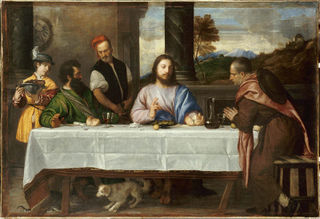
Titian, Supper at Emmaus, 1533-43
ART & ANTIQUES
March 2009
Pictures at an Exhibition
by James Panero
Behind the scenes at the MFA Boston's Titian, Tintoretto, Veronese
As the march 15 opening approaches for his exhibition “Titian, Tintoretto, Veronese: Rivals in Renaissance Venice,” at the Museum of Fine Arts, Boston, the curator Frederick Ilchman moves from conservation to design to exhibition space with an amiable twitter. Dressed in a natty three-piece suit, he looks as if he just stepped off a vaporetto on the Grand Canal. He is a specialist in Tintoretto—he spent five years in Italy researching the expressionistic cinquecento painter—and seems to know every painting and every person in Venice.
Curators are a museum’s ghostwriters; they write in pictures and let the pictures speak for themselves. A name on a wall, an essay in a catalogue, a voice on an audio guide—the curator works behind the scenes, but the choices someone like Ilchman makes in the conception, selection and execution of a show will leave an indelible impression on the way we see the work and on the story we take away. At 41 years old, Ilchman is about to mount the most important exhibition of his career.
With only weeks to go, Ilchman keeps busy with all aspects of his show’s preparation. The catalogue is done and off at the printers, but some of the loan guarantees are yet to be finalized. The museum’s own paintings destined for the exhibition are still up in the conservation lab for cleaning. An extensive X-ray analysis, undertaken by the conservator Rhona MacBeth, is revealing new secrets of the creation of one unusual work. Back at the design department, a model of the exhibition hall—a sort of curatorial dollhouse—is being fitted with foam-board walls and postage-stamp-sized printouts of paintings. “For the last room, I’m thinking of the autumn of their years. Fall colors,” Ilchman says to designer Keith Crippen while sticking a miniature wall up with putty. “This one you showed me a moment ago is way too Martha’s Vineyard. It’s preppy cranberry.”
Ilchman is the Mrs. Russell W. Baker assistant curator of paintings at the museum. After Princeton he did graduate work in art history at Columbia University under the advisement of the Renaissance scholar David Rosand. A visit to Italy at the completion of his master’s degree convinced Ilchman to focus on Tintoretto, the rebel painter of the late Venetian Renaissance. Although he was a favorite of John Ruskin, the artist has lacked for good modern scholarship. “Tintoretto occupies a special place in my heart, and I appreciate the underdog,” he says.
Ilchman immersed himself in Venetian painting for his on-site dissertation research. He also became an important player in cultural politics by working for the philanthropic
organization Save Venice, and these connections have now helped him secure the loans for his show and even underwrite, through a donation to Save Venice, the restoration of one of the works destined for display (A Deposition of Christ, from Venice’s Accademia).
Upon arriving in the museum world, Ilchman says he first contemplated mounting a monographic exhibition of his dissertation subject. Then a major 2007 show of Tintoretto at the Prado in Madrid, to which he contributed, mitigated the necessity of such a project. “Incredible attendance, 400,000 people,” Ilchman recalls. “Tintoretto is smiling and looking down at that.”
So he began thinking about new ways of approaching the Renaissance master. Out of this emerged the present show, which is destined to make headlines through a comparative examination of the three-way rivalry between a grand Venetian patriarch (Titian) and his heirs at once repudiating (Tintoretto) and respectful (Veronese). “To understand Tintoretto you have to spend a lot of time considering Titian and Veronese,” Ilchman explains. “While there are other artists in Venice, these were the rivals. Here’s the important thing to remember: Titian was born 30 years before Tintoretto and 40 years before Veronese. These painters’ careers then overlapped for nearly four decades.” (Titian lived more than 90 years.)
“Instead of the usual effort to locate art within a political or social context,” says Rosand of the upcoming exhibition, “the Boston project makes the studio itself the context, that is, the art of painting is the subject of the exhibition. And this very focus—on the aesthetic and technical—testifies to the imagination of its curator. Frederick Ilchman envisioned an exhibition that would focus on the art, its materials and techniques, and by bringing these three painters together he is in effect reconstructing the artistic context of 16th-century Venice, its world of artistic competition.”
Ilchman’s focused survey will be his first exhibition as lead curator at the MFA, which he joined in 2001. The museum has pulled out all the stops for him, setting aside its Gund Gallery in the I.M. Pei-designed Linde Family Wing, sending paintings from its permanent collection abroad in order to secure important loans back home, even promoting the exhibition with a press lunch at Mario Batali’s Del Posto in New York.
The show is set to display many of the finest works by these artists ever to travel to the United States. In the fall it will go up at the Louvre, which signed on as an exhibition partner in 2007—quite late by museum standards—after being impressed by Ilchman’s initial plans for the Boston show. “My colleague George Shackelford, the head of the department, went to Paris with the binder to borrow two great Titians—The Supper at Emmaus and the Madonna and Child. They asked if we were looking for a partner,” Ilchman explains of the serendipitous collaboration.
A snowstorm is bearing down on Boston and about to knock out part of a day from the show’s tight advance schedule. Ilchman has spent the morning in the recording studio working on the audio guide. Settling into a corner booth in the museum’s Bravo restaurant, steps away from the future location of his show (where a blockbuster exhibition of Assyrian treasures from the British Museum is installed), the curator places a well-worn three-ring binder on the table and, with a close eye on his watch, begins flipping through the pages.
“This binder is the physical manifestation of the evolving exhibition in my head,” he explains. “I’ve been carrying this binder around for four years. It’s been on 20 airplane flights. The process of a show’s refinement is extremely complex. It’s easy to assume the curator tries to get the best things, and puts up what’s best, but there has to be a coherence to the show.”
The binder is made up of plastic sleeves, each containing a printout of a painting destined for the exhibition walls and the direct comparisons he hopes to make: in portraiture, ecclesiastical painting and even in three nudes regarding themselves in the mirror (Titian’s Venus With a Mirror, circa 1555; Tintoretto’s Susannah and the Elders, circa 1555–56; and Veronese’s Venus With a Mirror, circa mid-1580s). This is Ilchman’s hand, his deck of cards reshuffled and restacked. What was once 100 paintings has been whittled down to 56. In the front pocket are loose images—the paintings that didn’t make the cut.
“A lot of the work in the exhibition is about shuffling these cards,” says Ilchman. “Every painting in the exhibition has to justify its presence. The crate that a painting travels in costs a lot to make, and there is limited real estate on the walls. You can’t be sentimental because you like something. Then there’s negotiating, refining the checklist, getting the best things to make your point. A huge amount of time is spent writing the request letters. I have to make it clear that the painting we’re looking to borrow is the missing piece. And,” Ilchman continues, speaking of the intricacies of museum politics and the labor in securing loans, “you do favors for each other. In Italy I put on one of my best suits, speak Italian and take this binder and explain why this painting is essential for the show.”
The introductory painting in the exhibition is a Bellini and Workshop, Virgin and Child With Saints, one of two paintings in the show not by the three rivals. “This is the kind of painting that Titian could have painted and would have learned in Bellini’s workshop,” says Ilchman. “It’s from the Met. It’s been off view since 1974. The whole doesn’t come together very well. The saints look like they were Photoshopped in.” Ilchman explains his decision to edit down his initial plans for a longer introductory section. “A colleague warned me you are going to spend all your time borrowing one Giorgione,” he says of the great early Renaissance Venetian painter, “when you could borrow three Veroneses. And where Giorgione was a huge influence on Titian, it’s not the case for Tintoretto and Veronese. The thing is to keep the focus.”
Turning to Titian’s Supper at Emmaus, Ilchman compares Titian’s version of the subject (from the Louvre, dated 1533–34) with a 1542 version by Tintoretto from Budapest and one mid-1570s Veronese from Rotterdam. “Tintoretto’s energy is spinning out of control. Compare this to Veronese’s close focus. And for the Veronese we’re helping the museum in Rotterdam. We’re helping them restore this painting in time for the exhibition by splitting the cost of the treatment three ways.”
The show also includes a strange nativity scene that belongs to the MFA, a painting consisting of five different canvases stitched together and executed by what appears to be an equal number of different hands. Amid the crudely worked over imagery, three exquisitely painted figures stand out. They seem to have been painted by Tintoretto himself. “We did a battery of scientific tests, and we found a painting underneath it,” Ilchman says. A 72-negative X-ray analysis, which picks up the lead content in white underpainting, revealed hidden angels and the feet of Christon the cross. Upon seeing the X-rays, one of Ilchman’s colleagues made a startling realization: sections two and four—those most likely by Tintoretto himself—were once joined together. Ilchman now speculates that in an act of Renaissance recycling, common in the workshops of Venice, an original, vertical crucifixion by Tintoretto, set among the angels in a cloud, was taken apart and transformed (not too convincingly) into a nativity scene.
Behind all of Ilchman’s decision-making for Titian, Tintoretto, Veronese is the one technical fact that defines the Venetian Renaissance and makes such an exhibition as this a possibility outside of Italy. It is the development of oil on canvas. “You can never do a Michelangelo show,” the curator says. “His best work is fresco painting and monumental sculpture. There have been impressive shows of Renaissance Florence, but many of those artists are truly best defined by works that are not moveable. But you can approximate Venetian artists like Tintoretto accurately because you can move many of his key canvases.”
The consistent combination of oil with canvas was new in the early 15th century, Ilchman explains. Up until then, prestige paintings were made on wooden panel or as frescoes. The humid and saline climate of Venice finally encouraged artists and patrons to adopt a technique that up to that point had been used for banners and other forms of low art. In 1474 the Venetian government decreed that the redecoration of the main room of the Palazzo Ducale would be done on canvas. If Titian, Tintoretto and Veronese had been painting two centuries before, much of their work would have most likely been Venetian fresco, and given the climate, little of it would remain today.
But the development of oil on canvas did not just lead to work with a longer shelf life. It also encouraged the building up of textured surface. Paintings defined by layered coloring and expressionistic brushwork eventually became the hallmarks of Venetian art and defined it against the sharp contours and refined draftsmanship of Florence.
Finally, oil on canvas led to transportability and the birth of the secondary painting market. Titian became the first nonresident court artist by shipping work to two successive Spanish monarchs, Charles V and his son Philip II, largely without leaving home. It also created an art world of celebrity painters that we would have little trouble recognizing today. The artistic ego, the concept of the artist as something greater than an artisan for hire, took root in Venice, and it was nurtured in the competition of three great artists.
“In many of its aspects,” Ilchman writes in the exhibition catalogue, “our modern concept of painting, and the artistic self-determination it assumes, owes much to the rivalry between Titian, Tintoretto and Veronese in Cinquecento Venice.” It might also be said that the modern museum, with its library of moveable art, owes much to the developments these artists made half a millennium ago. It’s a story tailor-made for a museum exhibition, worth telling by the curator who can bring the paintings together to tell it.