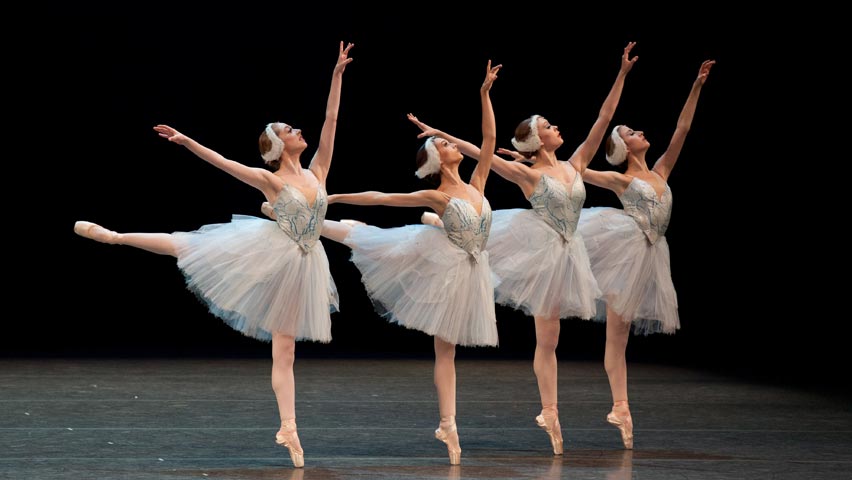
The New York City Ballet 'Family Saturday'

Slide-02
Corps de ballet members performing an excerpt from Peter Martins’s Swan Lake as part of a NYCB "Family Saturday."

James writes:

A cultural highpoint of classical music must be the development of engaging programs for children. Such events combine just the right mix of performance and narration to captivate and educate future generations (while also delighting the parents in tow).

The "Young People's Concerts" series at the New York Philharmonic offers the best, longest, and most consequential example of how this can be done right. The YPCs started as weekend children's matinees back in the late nineteenth century, became a regular feature in 1926, and reached their zenith (and "the Zenith") in the televised broadcasts of Leonard Bernstein starting in 1958. Some years ago, I watched the full run of these TV broadcasts, which is now available in a nine-DVD set from Kultur video, and wrote about it here.

I grew up attending the children's concerts at Lincoln Center (just after the Bernstein era). Now that I have a young daughter, I am back again. But as we've found, just because they are aimed at children, such concerts are not easy to perform well. A good children's concert is not a short, poorly orchestrated, dumbed-down version of an adult concert, which was what we unfortunately found last summer on the lawn at Tanglewood. All the Boston Symphony Orchestra did with that performance was drive a generation away from live performance, or at least the BSO's approximation of it, and back to YouTube. (If you didn't already know, some of the most captivating classical performances for children can now be found online. Just take a look at our current favorite--the Mariinsky's Nutcracker in flawless HD).    

Coming off the BSO experience, we were unsure what we'd find at last weekend's New York City Ballet "Family Saturday." Billed as a one-hour presentation "designed especially for family audiences," the performance promised "short works and excerpts from New York City Ballet's diverse repertory" with narrative instruction by NYCB artists "offering insights on the music and choreography." 

The answer was the finest children's performance I could imagine. Kept to a captivating, fast-paced hour, the NYCB performed excerpts from the season's repertory. This meant Emeralds with music by Gabriel Fauré, The Concerto Barocco with music by J. S. Bach, Who Cares? with music by George Gershwin, Barber's Violin Concerto, Dances at a Gathering with music by Frédéric Chopin, Todo Buenos Aires with music by Astor Paizzolla, and excerpts from the second and third acts of Coppélia with music by Léo Delibes.

Of the entire selection, the opening performance of Emeralds was the one letdown. At least one of the dancers was off a beat, and viewed from left orchestra, some of the staging was obscured by the musicians who were performing stage right.    

Screen Shot 2014-02-24 at 12.36.31 PM

But it all came together as soon as the morning's emcee, Silas Farley, stepped on stage. Farley may for now just be a young member of the corps de ballet, but his star quality can already outshine the principals of the company. My daughter and I first got to know about him through the NYCB's new online reality show, a high-production-value if slightly clichéd web series produced by AOL of life inside the company, with Sarah Jessica Parker narrating and ballet master Peter Martins acting as the heel (he would make a great villain in a 1970s-era James Bond film).

Here's a tip for next season's videos: less talking, more dancing. But between the catty gripes, the show did give us a glimpse of Farley, who was filmed the moment he received his contract to join the company. Taking bets now: With his great poise and bright attitude, Farley may one day be, what, Principal Dancer? Ballet Master? President of the United States? Until then we were lucky to catch him leading the NYCB's Family Saturday.

On stage, Farley's enthusiasm for dance was infectious as he (and the show's writers) made intelligent and fun comparisons between the programs--such as the differences between the choreography of George Balanchine in Jewels (with its performance directed at the audience) and Jerome Robbins in Dances at a Gathering (played more towards the other dancers on stage). He helped us appreciate the fun of Martins's choreography in the Barber Violin Concerto (with ragdoll moves by Megan Fairchild). He introduced us to an accordion-like instrument called the Bandoneon, played by JP Jofre, in Todo Buenos Aires. Finally, for Coppélia, with its robotic doll, he had the children of the audience stand up and move like marionettes.

It seems to be just the right metaphor. Here was a concert that pulled every string to further a child's appreciation of ballet.  

The NYCB's next Family Saturday is May 10, 2014, hosted this time by Principal Dancer Daniel Ulbricht. Tickets are for general admission and $20 each.  
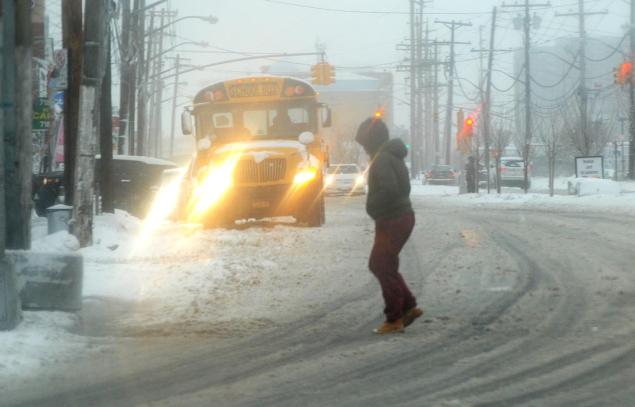
The Real Reason School Stayed Open

Panero14e-1-web

NEW YORK DAILY NEWS
February 14, 2014

The Real Reason School Stayed Open
by James Panero

Ideology trumps safety and common sense

In Bill de Blasio’s New York, apparently, you do need a weatherman to know which way the wind blows.

How else to explain the rash decision to keep city schools open during yet another dangerous blizzard, which slammed the city Thursday just as predicted?

When it comes to declaring a snow day, the safety of city parents, children, teachers, school staff and caregivers should come first. But that’s not what happened during this current storm — and the reason is ideological.

Wednesday evening, Schools Chancellor Carmen Fariña declared that schools would stay open despite the “anticipated inclement weather conditions.”

The strange logic of this decision was made even stranger by what de Blasio had said earlier in the day: “Because of its timing and intensity, this storm is going to make both the morning and evening rush hours extremely difficult. If you do not need to drive, you will help yourself and everyone else by staying off the roads.”

So, adults should stay off the roads, but kids need to come to school?

The paradox left families scratching their heads. Judging by the online reaction, it also gave some young de Blasio supporters a bit of buyer’s remorse.


“It is pouring snow and de Blasio says no snow day, my 7y old just said ‘I miss Bloomberg,’” school parent Richard Bonneau wrote on Twitter Thursday.

Michael Mulgrew, president of the United Federation of Teachers, had harsher words: “I understand the desire to keep schools open. The only thing that trumps that is safety. Having students, parents and staff traveling in these conditions was unwarranted. It was a mistake to open schools today.” Public Advocate Letitia James agreed.

What they’re not saying is that there’s a philosophical reason why de Blasio and Fariña have now kept school open despite several severe storms.

Fariña believes in the social-justice mission of city schools. This means that for her, schools are the custodians as much as the educators of children.

“My decision is where the kids are safest and the most taken care of, and the answer to that is in schools,” she has argued. When schools are closed, “Many of our kids don’t get a hot lunch and, in many cases breakfast.”

Such logic appears to have led Fariña to declare that schools would be open before waiting to see conditions on the ground. Her indifference to meteorological reality even continued through the storm: “It is absolutely a beautiful day out there right now,” she said Thursday morning.

The problem is that, while some city families may indeed be safest inside school, Fariña put all families in danger by deciding they should attempt to come to school in such hazardous conditions. What’s worse: missing breakfast, or breaking your leg trying to get it?

The street-side danger of heavy snow is no joke. Last week, the video of a man getting knocked down by the spray of a speeding plow in Sheepshead Bay went viral. And Thursday, a 36-year-old pregnant woman was killed by a snowplow in Brooklyn.

There’s a reason why the city’s independent schools, which in the past tied their closings to the city’s decision-making process, now largely make their own calls.

Thursday morning, my wife and I made our own decision to ignore the city’s illogic, and kept our daughter home from nursery school. Statistics show that a majority of public-school families did the same thing: Attendance Thursday was a dismal 44.65%.

Last month, de Blasio said that pedestrian safety would be a top priority of his office. He also renewed his campaign pledge to work for the elimination of traffic-related injuries and deaths through an initiative known Vision Zero.

Unfortunately, when he keeps school open despite serious street hazards, he merely demonstrates zero vision.

Sorry, Writers, but I'm Siding With Google's Robots

THE WALL STREET JOURNAL
February 8, 2014

Sorry, Writers, but I'm Siding With Google's Robots
by James Panero

Copyright laws too often stifle the creativity they claim to protect. Time for a 21st-century update.

How much did mention of "copyright" increase in American books published in the second half of the 20th century? The answer is by nearly a factor of three. How about "intellectual property," a neologism designed to equate copyright with real property? By a whopping factor of 70. But what about "public domain," the term for our creative commons where the arts are replanted and renewed? The answer is almost not at all.

We know this thanks to a new program called Ngram, an offshoot of Google Books that analyzes the metadata of what is now the world's most extensive literary index. Ngram gives us a sense of how ideas have circulated over the past 200 years. And when it comes to creative freedom, the numbers don't look good.

Since the 1970s, U.S. terms of copyright have been extended and tightened at the behest of the film, music and publishing industries in a way that hurts how we can enjoy, share, study and repurpose culture. Don't believe me? When was the last time you saw Martin Luther King's "I have a dream" speech on television in full? As a copyrighted work zealously guarded and monetized by the King estate, it's still rarely shown.

Technology companies have emerged as the key counterweight to the lawyers and lobbyists of the content giants. And that's one reason November's victory for Google Books in Authors Guild v. Google is important.

In 2004, Google announced a partnership with Harvard, Stanford, Oxford, the University of Michigan and the New York Public Library to begin scanning their holdings, turning the printed pages of millions of books into digital grist for its search mill. The robot scanners ran their eyes over everything, from books in the public domain to copyrighted material, which under current law includes most of what's been published since 1923. The results have been a boon to the culture of ideas.

Yet since Google never tracked down the millions of rights-holders of more recent works, the initiative has been embroiled in litigation over copyright infringement since its inception—even though Google has used copyrighted books only for its search index (as opposed to showing the full text). The Authors Guild, one of the plaintiffs against Google, declared the scanning "exploitation" and a "hazard for every author." U.S. Circuit Judge Denny Chin in Manhattan disagreed and dismissed the group's claims after eight years of litigation, declaring Google's project a "transformative" fair use. The Authors Guild has vowed to appeal.

As a writer, I'm siding with the robots. Google Books is far from perfect: Even advocates have worried about the consolidation of scanned information, fearing it will lead to a new digital monopoly. But it brings literature into the online world, exposing a younger generation to books they otherwise would never encounter.

Google Books' legal victory can also be seen as a chink in the armor of ironclad copyright laws. Copyright was never meant to be an indefinite "intellectual property." Article I, Section 8 of the U.S. Constitution gives Congress the power "To promote the Progress of Science and useful Arts, by securing for limited Times to Authors and Inventors the exclusive Right to their respective Writings and Discoveries." Much like patents, copyright was a utilitarian measure to protect creative work through a temporary government-granted monopoly.

For the founders, that meant a protective period of 14 years with the right of renewal for another 14. Since then, and especially over the last three decades, the terms have exploded. For self-made work, copyright is now in effect for the life of the author plus 70 years. For work-for-hire, the terms are 95 years after publication or 120 years after creation, whichever is shorter.

In Congress, the terms have tended to have the curious ability to grow just as Mickey Mouse is set to exit copyright, effectively locking down America's cultural patrimony to protect Disney. The "Copyright Term Extension Act" of 1998 is commonly derided as "The Mickey Mouse Protection Act," since it extended Disney's control of the cartoon character for another 20 years. The motion picture industry has argued for even more—a perpetual copyright, or "forever less one day." But would this actually be good for the arts? Numerous studies, such as a 2007 analysis by economist Rufus Pollock at Cambridge, have shown that far shorter terms would maximize creative output.

Considering the Democratic Party's ties to Hollywood, Republicans should be the natural leaders on intellectual property reform. Conservatives such as Reihan Salam, Patrick Ruffini, Timothy P. Carney and Jordan Bloom have argued convincingly for it—but so far the party isn't listening. When Derek Khanna, a young policy analyst, wrote a white paper in 2012 for the Republican Study Committee on rolling back copyright, he was shown the door. "The Republican Party hasn't been pro-innovation," he explained to me. "Copyright reform is a vital component of a more forward-leading platform."

At the start of 2014, Duke Law School's Center for the Study of the Public Domain published a list of books that would be entering the public domain under the laws that existed through 1978. For works ranging from Jack Kerouac's "On the Road" to Dr. Seuss's "Cat in the Hat," "you would be free to translate these books into other languages, create Braille or audio versions for visually impaired readers . . . or adapt them for film." Too bad: Under current law, you can't.

"Poetry can only be made out of other poems; novels out of other novels," wrote the critic Northrop Frye. "Literature shapes itself, and is not shaped externally." The freedom to work with a renewed public domain should be our inheritance—if only we stopped Mickey Mousing around with copyright.