Hungry like the rabbit

THE SPECTATOR USA, January 2021

Hungry like the rabbit

In the darkest hour, there emerged a new light. It was 1940 when the double-barreled shotgun of the world first took aim at a little hole called home. At first, it seemed as if the hole’s inhabitant would be taken in by the old carrot trick. At least he would be careful enough not to stick his neck out. With an unblemished, white-gloved, four fingered hand, he feels around his immediate borders and takes the carrot.

Of course, it’s a trap to draw him out. Did he know that all along? He would soon enough. The next time, it’s not a carrot but the hard steel of a gun aiming straight down his burrow. He flicks the barrels with his finger — plink, plink, plink — just to be sure. He tosses back the half-eaten carrot and pats the gun, but it is too late. The instinct to stay out of trouble will no longer do. Something is up.

Just what, precisely, is up was the question on the world’s mind. It was July 27, 1940 when a bunny named Bugs had the audacity — one might say, the insouciant foolhardiness — to go and ask what’s up of the world’s more doctoral minds in ‘A Wild Hare’, his first Merrie Melodies cartoon for Leon Schlesinger Productions, distributed by Warner Brothers Pictures.
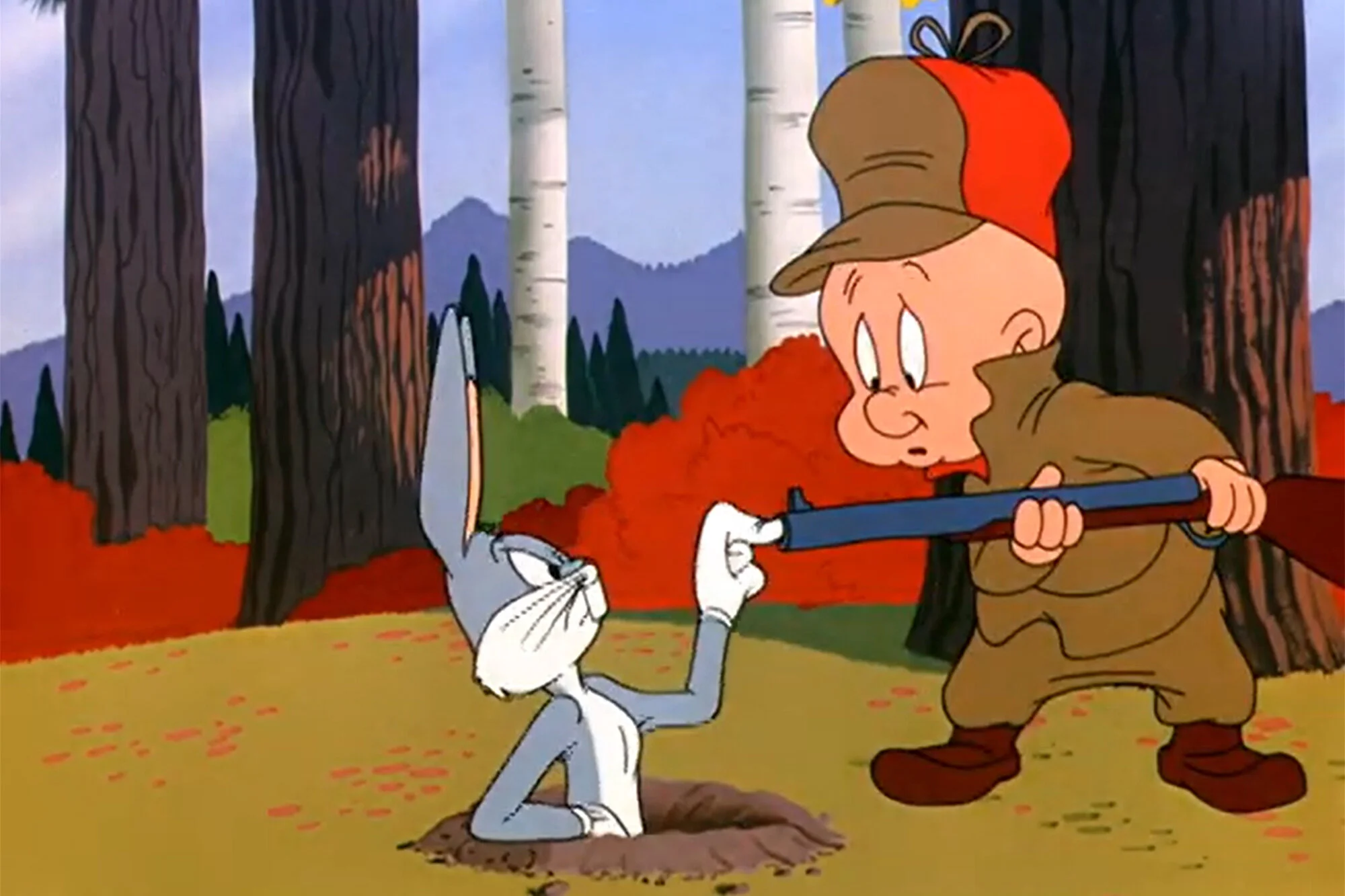
There was a lot of rabbit hunting going on that season. Far too much. Despite the aggressor’s warnings to ‘Be vawy, vawy quiet — I’m hunting wabbits,’ the time for silence is over. That ‘scwewy wabbit’ is about to reveal Elmer J. Fudd for the gun-pointing fool he is. A moment later and that shotgun is tied up in a bow. Butts get roundly kicked like the bell striker of a carnival strongman game. The hunter is now the hunted. At his wits’ end, Fudd relents — ‘Wabbits! Guns! Wabbit twaps! Cawwots’ — in abject defeat.

‘Can you imagine anyone acting like that?’ Bugs turns to ask the audience. ‘You know, I think the poor guy’s screwy.’ Channeling the ‘Spirit of ’76’, the rabbit then holds his carrot like a fife. To the tune of ‘The Girl I Left Behind Me’, he marches off stiff-legged back to his rabbit hole.

There are few American creations more endearing or enduring than Bugs Bunny. As voiced in the Noo Yawk accent of Mel Blanc, Bugs embodies a national character that combines street smarts with whimsy, reserve with reluctant but ultimately total engagement. He also emerged on the world stage at just the right moment in history.

Warner Brothers had been distributing short cartoon films since the early 1930s. Its two series, called Looney Tunes and Merrie Melodies, were originally distinguished by their storylines and musical components (the Melodies were meant to promote Warner songs). By the 1940s, the distinctions quickly disappeared as Bugs became the breakout star of both franchises by presenting a new type of American hero. In ‘Super-Rabbit’ from 1943, echoing the finale of ‘A Wild Hare’, Bugs even ends up dressed in a Marine uniform — a ‘real Superman’, he says, with ‘important work to do’ — and heads off to ‘Berlin, Tokyo and points East’. Inspired by the episode, the US Marine Corps inducted Bugs as an honorary private. At the end of the war, he was discharged having achieved the rank of master sergeant.
Bugs appeared in over 150 Warner cartoons during the golden age of American animation. Directed by Tex Avery, Friz Freleng, Robert McKimson and Chuck Jones, among others, and scored for a full orchestra by the musical-quoting Carl W. Stalling, the lavishly produced shorts were eventually eclipsed by cheaper television cartoons in the mid-Sixties.

In May, HBO launched its new Max streaming service with a relaunch of this vast Looney Tunes library. Last month, Warner added to the merrie trove by releasing a three-disc Blu Ray set, The Bugs Bunny 80th Anniversary Collection. Be forewarned: even such seemingly encyclopedic collections come to our censorious age with amendments and redactions. On HBO, with their skipped numbers, the episodes omitted from the 31 seasons of Looney Tunes are easy to spot. They are much harder to track down and see. When combined, copyright extension and political correctness are potent content killers, two of the horsemen of our oncoming techno-apocalypse.

‘All This and Rabbit Stew’, a 1941 Freleng episode, was among the original ‘Censored Eleven’ Warners shorts of 1931-44 that were pulled from syndication in 1968 for their ethnic stereotypes. ‘Hiawatha’s Rabbit Hunt’, a 1941 Freleng episode that was an Academy Award nominee, is also absent from the HBO archive. ‘Bugs Bunny Nips the Nips’ of 1944 and ‘Herr Meets Hare’ of 1945 established Bugs in full wartime mobilization as he outsmarts both Imperial Japan and Nazi Germany. These two historic episodes are nowhere to be seen as well. The latter episode, set in the Black Forest — Bugs gets lost on his way to Las Vegas — sees our hero face off against none other than Hermann Göring and Adolf Hitler. Was this episode pulled because it might upset today’s Axis viewers? In its use of Wagnerian music and imagery — Bugs mesmerizes Göring by riding on a white horse dressed as Brünhilde to the tune of the ‘Pilgrims’ Chorus’ from Tannhäuser — Freleng’s ‘Herr Meets Hare’ serves as the key prelude to Chuck Jones’s ‘What’s Opera, Doc?’ from 1957.

That episode, Jones’s masterpiece, has been called the best cartoon of all time. It was the first cartoon to be deemed ‘culturally, historically, or aesthetically significant’ by the Library of Congress. Here the melodies of Warner Brothers all come together in one Gesamtkunst-cartoon. Elmer Fudd now plays the antagonist as he and Bugs take on quick-changing Wagnerian roles. The music of the ‘Ring’, TannhäuserRienzi and The Flying Dutchman are all woven into the tapestry of the score. For many children, including this former one, their first exposure to the ‘Ride of the Valkyries’ was set to the libretto of ‘Kill the Wabbit!’

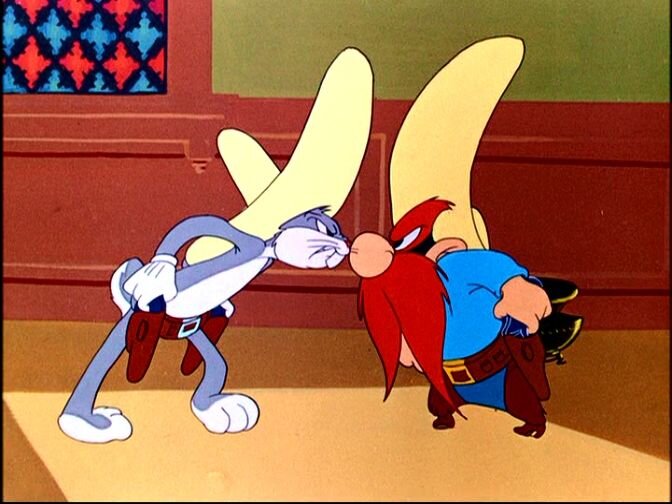
Jones’s ‘Rabbit of Seville’ (1950) similarly recasts Rossini with Bugs and Fudd. In ‘Hare Trigger’ (1945), Freleng introduced Yosemite Sam as a new Bugs adversary packing double the firepower of Elmer. Here it was the Old West versus the new East, as Bugs’s cool wit sets Sam’s bluster to boil. Meanwhile, Marvin the Martian, who had been introduced by Jones in ‘Haredevil Hare’ of 1948, became a new Cold War villain for the Space Age, as Bugs sets out to diffuse Marvin’s Earth-shattering ‘Illudium Q-36 Explosive Space Modulator’.

In 1950, for the rabbit’s 10-year anniversary, Warner released a tribute short about Bugs’s life directed by Robert McKimson called, appropriately, ‘What’s Up, Doc?’ The episode purports to tell the story of Bugs’s career on stage and screen as he goes from ballet school to the Broadway chorus. Eventually he is picked up by Elmer Fudd, a big vaudeville star, and the two take their act to Hollywood. Again, you won’t easily find the complete episode online. A brief cameo by Al Jolson saying ‘Mammy’ most likely tanked the full show. But non-offending clippings do readily exist, in particular the final ‘screen test’ with Bugs and Fudd adding words to the opening theme song that well sum up the antics that made Bugs the star he is:

‘What’s up, Doc? What’s cookin’?
What’s up, Doc? Are you’re lookin’
For Bugs Bunny bunting…?
Elmer’s gone a-hunting
Just to get a rabbit skin…
But now the rabbit’s gone again!’

There are many such looney gems in the tunes archive. The best are infused with melodies that are indeed merrie, featuring a rabbit who well knows the score.

Gallery Chronicle (January 2021)

THE NEW CRITERION, January 2021

Gallery Chronicle

On “Sam Gilliam: Existed Existing” at Pace Gallery, New York, “Martin Puryear” at Matthew Marks Gallery, New York, “Jack Whitten: I Am the Object” at Hauser & Wirth, New York & “Rico Gatson: Ghosts” at Miles McEnery Gallery, New York.

The experience of art is never more vital than in times of crisis. During the Blitz, Kenneth Clark’s “picture of the month” restored one masterpiece at a time to the walls of the National Gallery. Myra Hess’s lunchtime concerts returned live music to bombed-out London. So far, our best response to World War C has been outdoor dining. We could have been a little more spirited and inventive in our emergency initiatives. Yes, it is true that in today’s New York we can eat our meals in boxes built above the gutter. What we should be seeing are concerts in every park and theater on every corner.

The city’s commercial art galleries have been the exception to this rule. They too could have remained dark, all covered in the finest grades of low-knot plywood. Instead the galleries have returned to become the city’s great free cultural resource at a time when there are far too few alternatives. With timed tickets available in advance or, in most cases, simply when you walk in, the vitality of art remains a barcode-scan away. As the galleries have restored their cycles of new exhibitions, the experience of gallery-going has become salutary. In these times of clandestine gatherings, the shared encounters even feel revolutionary. Just imagine, actually seeing something with someone outside of Zoom. I just hope it lasts until the time of publication.

This season, in Chelsea, the interest of New York’s blue-chip galleries has coalesced around a selection of what we might now call black-chip art. In particular, this has meant the exhibition of several simultaneous shows by a generation of black male abstractionists who have each reached new levels of veneration and value. The contemporary art market can be notoriously ill-calibrated, of course, and one could attribute this latest trend to just another passing interest. In this case, however, the attention is well deserved. Before the mega-galleries ever got involved, long before the upheavals of last summer, certain galleries and dealers had been exploring the loose affinities of these artists who use the language of abstraction in new and profound ways.

At the age of eighty-seven Sam Gilliam showed, through last month, his latest work for the first time at Pace.1 Over half a century ago, Gilliam emerged out of the Washington Color School to bring a new spirit of alchemy to paint on canvas. He experimented with stained canvases and unusual media. Resisting agents, metallic powders, fluorescent pigments, and just about anything that could make colors swirl and sizzle went into his mix. He folded his loose, wet canvases to develop Rorschach-like effects. He then hung them out to dry in startling new ways. In some cases he stretched his canvases over beveled stretchers to create relief-like works. In others he suspended them as garland-like buntings in catenary curves. In all he tested the boundaries between painting and sculpture. He also merged the personal with the universal. The son of a seamstress, born in Tupelo, Mississippi, Gilliam draws on childhood visions mixed with the archaic, classical, and Renaissance influences of art history. Memories of clothes drying on the line flutter together with the colors of Titian and the forms of Dürer.

For anyone familiar only with Gilliam’s youthful work of the 1960s and ’70s, it remained to be seen what the 2020s would bring for this mature artist. The answer, at Pace, should have put octogenarians and just about everyone else on notice. At least one of us has had an astonishingly creative pandemic year.

The term “gallery” does not quite give mega-operations such as Pace their full due. This juggernaut of an enterprise is spread across two buildings on West Twenty-fifth Street and includes a new museum-worthy tower. Gilliam needed every square inch of Pace’s two ground-floor spaces to display the full range of his recent achievements. Of the two, the better venue to start with was the one down the block, towards Eleventh Avenue. Here Gilliam revisited the beveled canvases that first brought him to international attention. (In 1972, in a group invitational exhibition organized by Walter Hopps, Gilliam became the first black artist to represent the United States at the Venice Biennale; Hilton Kramer singled out Gilliam for his “strong showing.”)

Sam Gilliam, The Mississippi “Shake Rag,” 2020, Acrylic on canvas. Pace Gallery, New York.

Sam Gilliam, The Mississippi “Shake Rag,” 2020, Acrylic on canvas. Pace Gallery, New York.

Gilliam’s new beveled work may be similar in form to the old. What differs is the relative humidity of this latest series. Unlike the wet-on-wet soakings of earlier work, today Gilliam’s canvases can seem extra dry. With titles such as The Mississippi “Shake Rag” (2020), these canvases are each at least eight feet in one dimension. Two of them maxed out at twenty feet. A mottled, complex, sand-like encrustation covered every square inch and invited closer viewing. Where things got messy, as in some of the darker compositions, the materials never quite reacted to alchemical effect. In the better examples, surface scratches gently agitated the canvases into radiant lines. Substrates of reds and yellows seemed to come up from beneath the light, sandy sprinkling. Further hidden in the mix, tile-like circles, squares, and rectangles shook their way up to the surface. The beveled stretchers all gave extra depth to these hanging works. These intricate compositions felt like a constellation buried in a sandbox.

Up the street, the second part of this exhibition reveled in the full permutations and combinations of Gilliam’s penetrating sense for form and function. Pyramid-shaped sculptures on caster wheels were rolled about in one room. Circular forms of similar make hung in another. In a side gallery, a range of solid colors was soaked into large square works on paper. At first, it was not at all clear what to make of the assembly. Online images of these works looked silly. In person, the primary forms seemed to tease out Sphinx-like riddles. As you walked around them, the pyramid shapes flattened in optical effects. By the entrance, Gilliam even included two small, wondrous wall sculptures—Color Abacus and White Abacus—seemingly there to calculate the solutions.

The revelation of this display was how it connected to Gillian’s canvases down the street and his full, bound-together body of work. Constructed of wood, aluminum, die-stain, and lacquer, the intimately crafted pyramids were divided into strata and sub-strata. Taken one way, they were those beveled canvases laid flat. Or they were the accumulation of those stained papers stacked one on top of the other. The circles on the wall reflected the caster wheels beneath. Or something like it. The connections were dream-like, suggestions rather than conclusions meant to be sensed rather than thought out. Thank goodness they were there for us to conjure with through our confounding times.

When Martin Puryear represented the United States in the 2019 Venice Biennale, the form and facture of his enigmatic, surrealistic sculptures first appeared as reliquaries for some forgotten feast day. Look closer and it turned out the pageantry of this meticulous work was rooted in the lives of our own saints and sinners. Now at Matthew Marks, a selection of six of these sculptures is on display stateside for the first time.2 Just what Puryear creates is part dream, part nightmare, all made real through the obsessive craftsmanship of his constructions. In Venice, deposited in the neoclassical American pavilion, the works seemed like the floats of some parade gone by. In the white cube of a Chelsea gallery, the individual forms appear in greater relief. Tabernacle (2019) recalls the hat of a Union soldier made extra large. Peer inside this strange work—of red cedar, American cypress, pine, makore veneer, canvas, printed cotton fabric, glass, and steel—and you see a decorated space complete with cannon and silver ball.

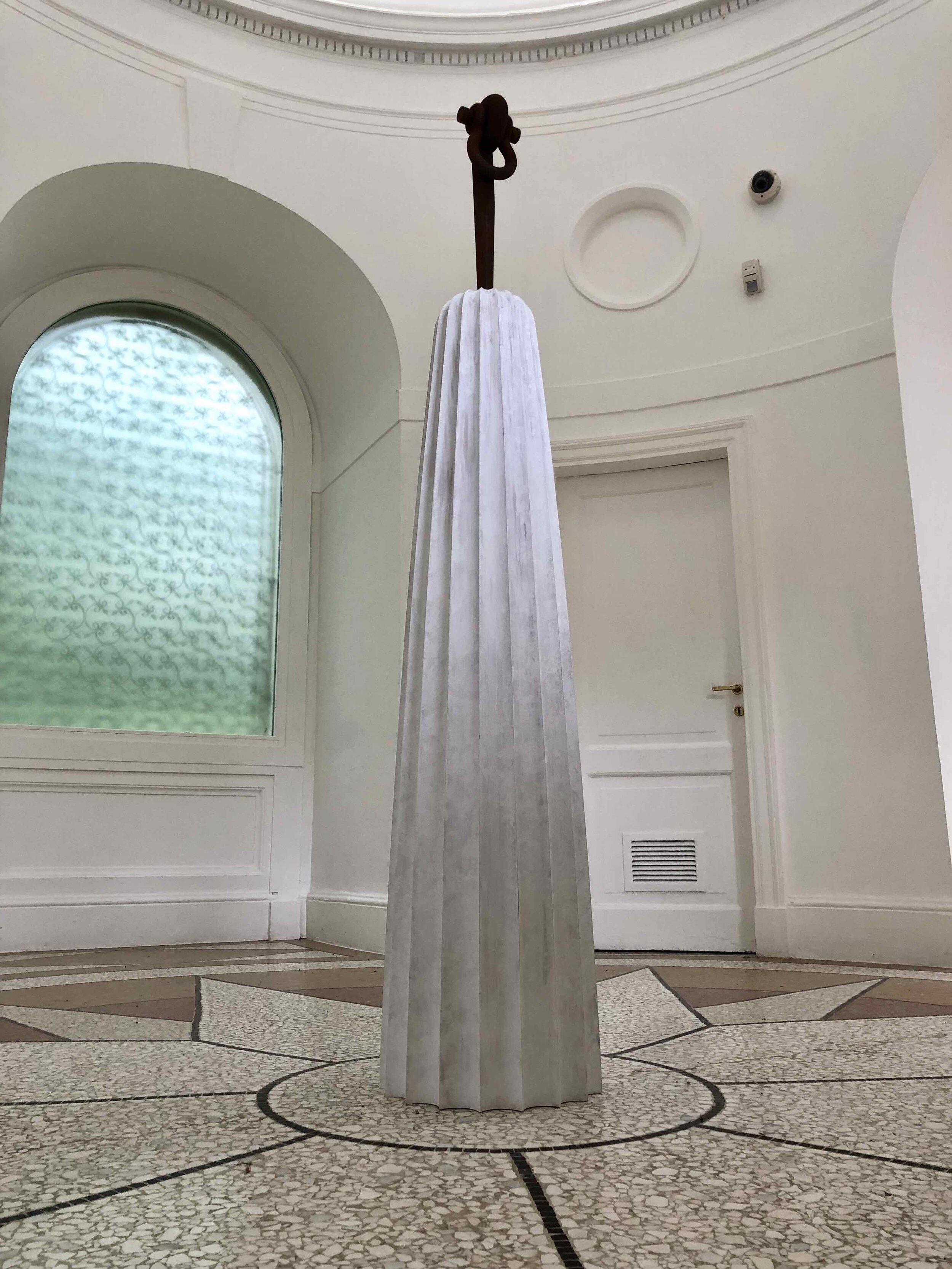
Martin Puryear, A Column for Sally Hemings, 2019, Cast iron and painted tulip poplar. United States Pavilion at the Venice Biennale, Venice. Photo courtesy Matthew Marks Gallery.

Martin Puryear, A Column for Sally Hemings, 2019, Cast iron and painted tulip poplar. United States Pavilion at the Venice Biennale, Venice. Photo courtesy Matthew Marks Gallery.

A Column for Sally Hemings (2019) is similarly freighted with signs and symbols. A shackle of rusted iron rises from a finely finished, white wooden base in the shape of a classical column. The lower form could be the architecture of Monticello, or perhaps the ribbings of a skirt. The upper can take on human form, or maybe it is a flower sprouting out of the hard earth. Repeated forms come to haunt Puryear’s œuvre, as the rusted shackle here recalls the golden hardware of his monumental sculpture Big Bling, on display in Madison Square Park in 2015.

There is an impurity in such abstraction, one that, done right, creates an expressive alloy able to convey the personal and the political bonded to the pictorial. The durability of such art relies on the particular mix of reflection and reference. For art to be about something else, of course it first must be about itself. Now at Hauser & Wirth, an exhibition of the work of the late Jack Whitten reveals where this chemistry can come up short.3

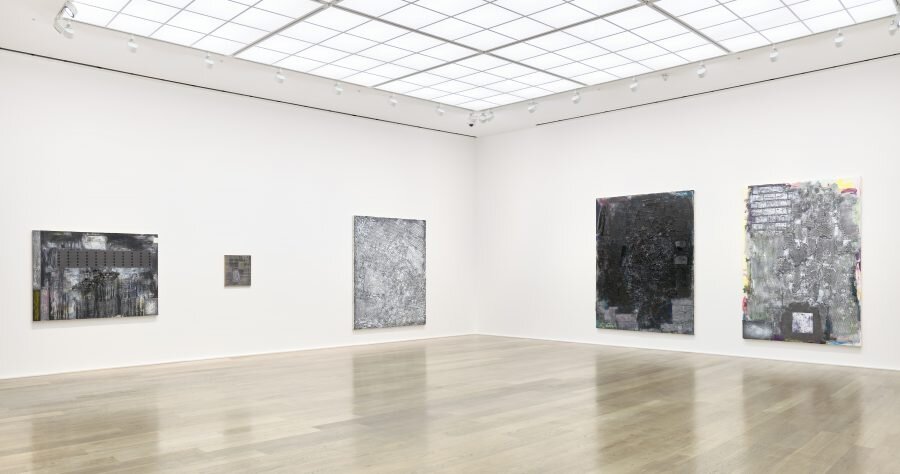
Installation view of “Jack Whitten: I Am the Object” at Hauser & Wirth, New York. Photo: Courtesy of the artist and Hauser & Wirth, London. Copyright Jack Whitten. Photo by Alex Delfann.

Installation view of “Jack Whitten: I Am the Object” at Hauser & Wirth, New York. Photo: Courtesy of the artist and Hauser & Wirth, London. Copyright Jack Whitten. Photo by Alex Delfann.

Over a large tableau, especially in his later work, Whitten could piece together dried paint fragments, which he called tesserae, into a profound whole. Such compositions convey both surface form and deep excavation. At Hauser & Wirth, a preponderance of smaller mosaic work from the 1990s, meant as totems for famous figures, largely fails to find the same map and territory. Of archival interest, the selection mainly serves to reveal the development of Whitten’s unusual process. In one, Mask III (1991), early fragmentary components begin as cracked eggshells and hair. In larger compositions such as Natural Selection and Memory Sites, both from 1995, we can see haunting figures emerging from the tessellated assembly—it will just take some work to get there.

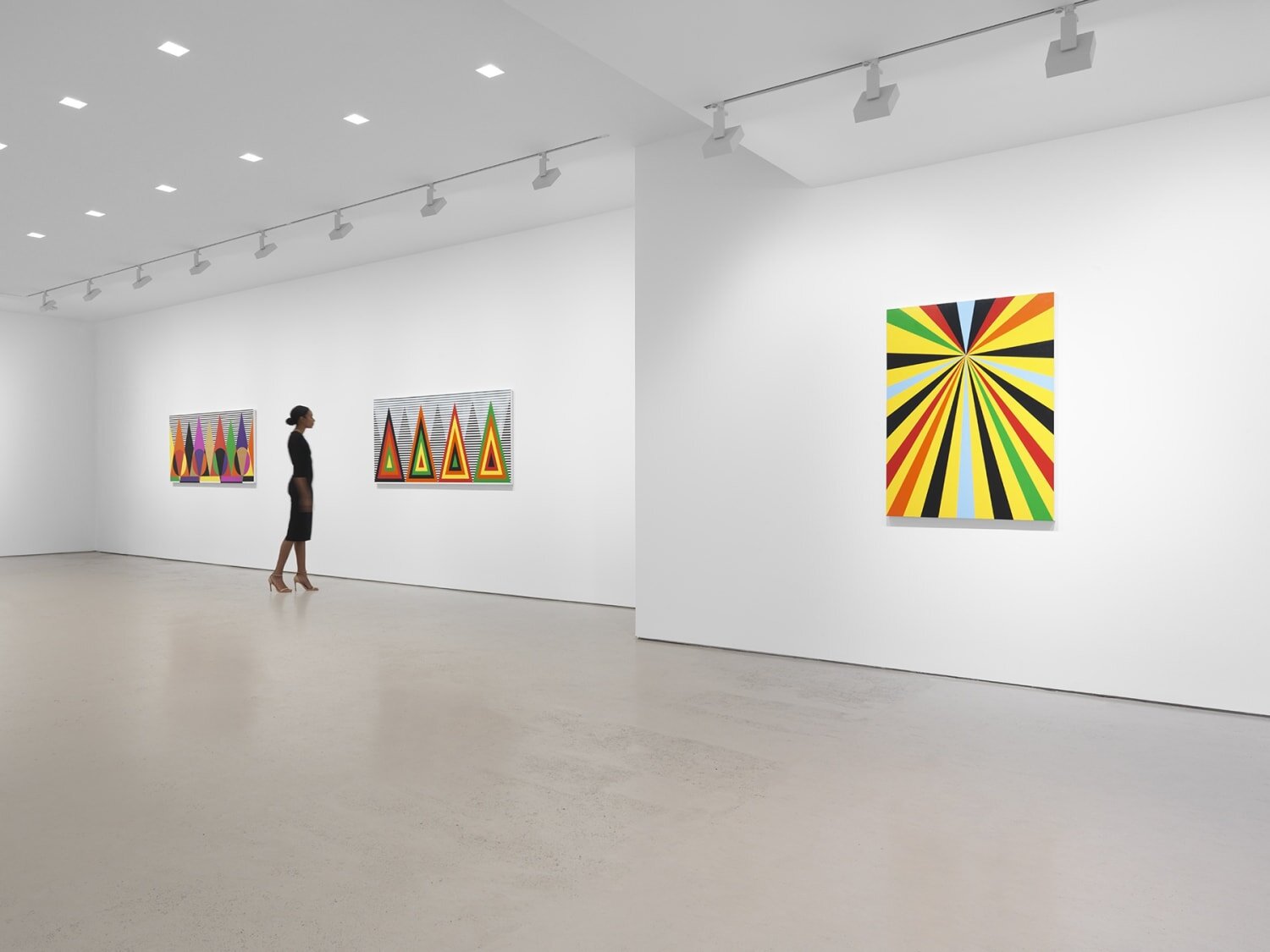
At Miles McEnery Gallery, a captivating exhibition by Rico Gatson revealed the power of pure abstraction to impure effect.4 A generation younger than the black abstractionists on view elsewhere in Chelsea, Gatson has been even more forthright in exploring the confluences of color in his work. In “Icons,” a series on paper that he began in 2007, Gatson uses radiating lines to depict the power of black figures, images of whom he has affixed to the work. The series has a sonic quality that is all horn, a tone well represented in a recent retrospective at The Studio Museum in Harlem. In the latest exhibition, Miles McEnery Gallery presented a selection of them. More are now on permanent display as art-in-transit mosaics in the 167th Street subway station.

Installation view of “Rico Gatson: Ghosts” at Miles McEnery Gallery, New York. Photo: Miles McEnery Gallery.

Installation view of “Rico Gatson: Ghosts” at Miles McEnery Gallery, New York. Photo: Miles McEnery Gallery.

In his abstractions, Gatson has tended to work with pan-African patterns and colors. The merging of modernism and Africanism is one that groundbreaking artists such as Aaron Douglas pioneered a century ago. Of course, one may even say that modernism itself represents a confluence of African and European artistic traditions.

Through his new abstractions at Miles McEnery, Gatson seemed freer than before in going his own way, unencumbered by particular references to time and place. His geometric arrangements of circles, lines, and triangles were like radiant peaks atop mystical mountains. The graphic excitement of his earlier work is still here, just now made personal. After fifteen years of depicting famous icons, this time the iconography is his own.

1 “Sam Gilliam: Existed Existing” was on view at Pace, New York, from November 6 through December 19, 2020.

2 “Martin Puryear” opened at Matthew Marks Gallery, New York, on November 12, 2020, and remains on view through January 30, 2021.

3 “Jack Whitten: I Am the Object” opened at Hauser & Wirth, New York, on November 5, 2020, and remains on view through January 23, 2021.

4 “Rico Gatson: Ghosts” was on view at Miles McEnery Gallery, New York, from November 19 through December 19, 2020.

New podcast: Benjamin Riley & Andrew L. Shea on art & architecture

James Panero, Benjamin Riley & Andrew L. Shea discuss the 2020 art issue and look ahead to 2021. Read “Albert Pinkham Ryder: isolato of the brush,” by Andrew L. Shea: https://newcriterion.com/issues/2020/12/albert-pinkham-ryder-isolato-of-the-brush Read Benjamin Riley’s interview with Clive Aslet & Dylan Thomas: https://newcriterion.com/issues/2020/12/an-interview-with-clive-aslet-dylan-thomas Read “Unmaking the met,” by James Panero: https://newcriterion.com/issues/2020/12/unmaking-the-met

Benjamin Riley & Andrew L. Shea, my colleagues at The New Criterion, discuss the 2020 art issue and look ahead to 2021. Occasioned by Andrew L. Shea’s “Albert Pinkham Ryder: isolato of the brush,” Benjamin Riley’s interview with Clive Aslet & Dylan Thomas, and my own essay on Unmaking the Met.