THE NEW CRITERION, October 2026
America inside out
On the Tang Wing for American Democracy & “Democracy Matters,” at the New-York Historical Society.
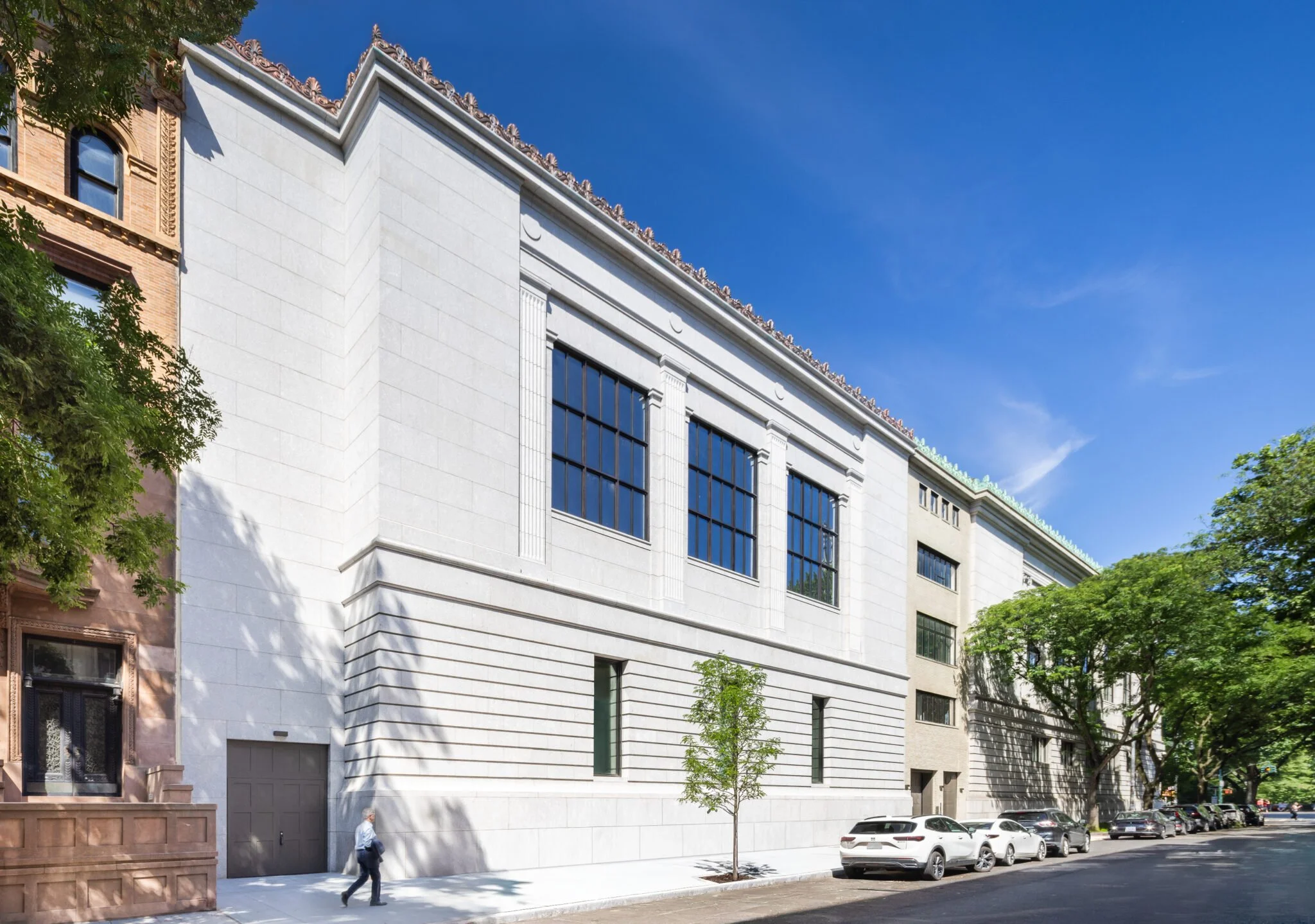
Few buildings differ so much in effect between exterior and interior as the new Tang Wing for American Democracy. From the outside, this extension to the New-York Historical Society that opened last summer is a triumph. The institution’s first expansion since 1938, the wing is one of the final projects undertaken by Robert A. M. Stern Architects while its namesake founder was still alive. The $175-million building has been seen as a capstone work by Stern, who died last November at age eighty-six, and rightly so. A walk around the block reveals just what he and his partners achieved.
Start on Central Park West, where the society occupies the block just south of the American Museum of Natural History, between Seventy-sixth and Seventy-seventh Streets—its eighth location since its founding downtown in 1804. Here the building’s original Beaux-Arts elevation appears as a unified whole, but in fact this façade reveals two different eras of development: a central portion designed by York & Sawyer, built between 1903 and 1908; and two complementary wings, extending the structure to the north and south corners of the block. Designed by Walker & Gillette, these extensions based on York & Sawyer designs were built between 1937 and 1939, along with a tower for the library stack and a utilitarian service wing on Seventy-sixth Street. In 2011, Platt Byard Dovell White Architects made some discreet modifications to the Central Park façade by opening up the entranceway but fortunately did little to alter its essential character.
I doubt many other firms could have been as faithful as Robert A. M. Stern Architects in appreciating York & Sawyer’s classical language and now continuing the conversation west down Seventy-sixth Street. (For more on its founder’s achievements, see “Robert A. M. Stern, 1939–2025,” by Peter Pennoyer, in the February 2026 issue of The New Criterion.) It’s one thing to push back against the modernist dogma that architecture must “reflect its times.” It is another to do it as convincingly as we find here, with such attention to form and materials. Designed by Stern and his partners Graham S. Wyatt and Preston J. Gumberich, the wing features granite sourced from the same Deer Isle, Maine, quarry as was used for the original buildings. The façade picks up the same street-wall height, window arrangement, and fluted pilasters of Walker & Gillette’s wings in an ever-so-stripped-down variation. Bronze window mullions and a copper cornice further tie the new materials to the older buildings.
It helps that, a century ago, the society made the felicitous decision to purchase the side-street parcel to the west of the existing institution—and then do nothing with it. Unlike the example of the Frick Collection’s East Seventieth Street garden, a 1970s confection that became sacrosanct to latter-day preservationists and antidevelopment locals, halting for a time the Frick’s own expansion plans, this property has been maintained by n-yhs as little more than an unappealing, walled-off lot.
Stern and his partners have now extended the institution into this reserved space with a design that speaks through the original building and the 1930s additions. Just as York & Sawyer’s central building and Walker & Gillette’s wings merge into a seamless whole, Stern has given us an expansion that, on the outside at least, registers no dissent with its older neighbors.
I doubt most people looking at these buildings will be aware of the near-century differences between them. Since the city’s preservationists had the society keep its utilitarian infill building from the 1930s, it’s easy in fact to mistake the desultory ninety-year-old loading dock between the Tang Wing and the Walker & Gillette extension as the newest building here. (As an example of how oddly zealous the city’s requirements can be for a landmark building in a landmark district, the new wing’s cornice could not connect directly with Walker & Gillette’s matching ornamentation, and so a tiny gap has been left between them.)
To the west of the society’s lots is a nineteenth-century residential neighborhood. The Tang Wing continues the inner garden court that runs down the middle of the block. One advantage of extending the garden is that this design could be built as-of-right. The need for zoning variances had been a hurdle that tripped up earlier, more ambitious designs for a residential museum tower as proposed by Richard Meier & Partners and Hardy Holzman Pfeiffer.
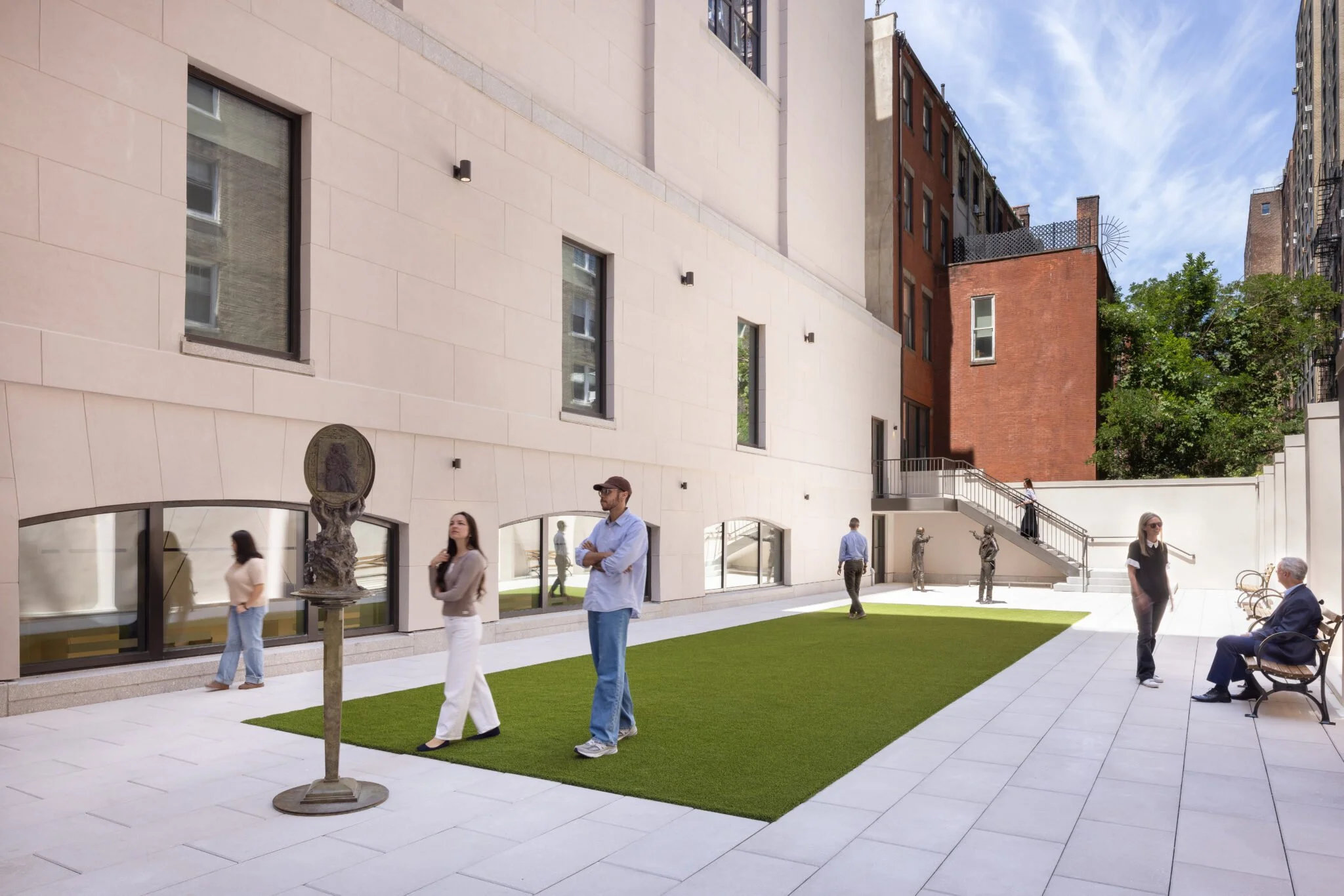
The Sculpture Court located in the Tang Wing for American Democracy at the New-York Historical. Photo: Bridgit Beyer.
Urban designers have a history of ignoring mid-block outdoor spaces, treating them as little more than lightshafts with no architectural interest. Here the new garden-side façade picks up and harmonizes with the street-facing elevation with some simplifications. More attention to detail, it should be noted, has been paid to the courtyard by Stern than did York & Sawyer or Walker & Gillette. The plaza is open to visitors and presented as a sculpture garden and event space, but its greatest interest is the view it affords onto the society’s new basement conservation studio, which can be observed through arched windows at foot level.
If only such successful details had been carried through to the Tang Wing interior. While the expansion remains faithful to the society’s existing exterior, its galleries dispense with Beaux-Arts classicism in favor of sheetrock minimalism. On the inside, the wing is a white box with a triple-height, forty-seven-foot-tall Kunsthalle. From a floor above, a glass-railing balcony overlooks the cavernous space. Two concrete Sonotube columns prop up the arrangement and reduce the studied massing of the new exterior to a postmodern stage set. The effect might have felt dated three decades ago.
The programmatic problems with this open-plan design should have also been apparent even before its inaugural show. The balcony has been presented as an attraction for schoolchildren as they are led to the upper-floor classrooms, affording glimpses of the city outside and the gallery below. Yet I imagine the vertiginous view will be more of a distraction for students and a headache for teachers. An even greater problem is the sun that now shines in from the three outsized, southern-facing windows and turns the gallery into an overexposed lightbox with no protection from the glare.
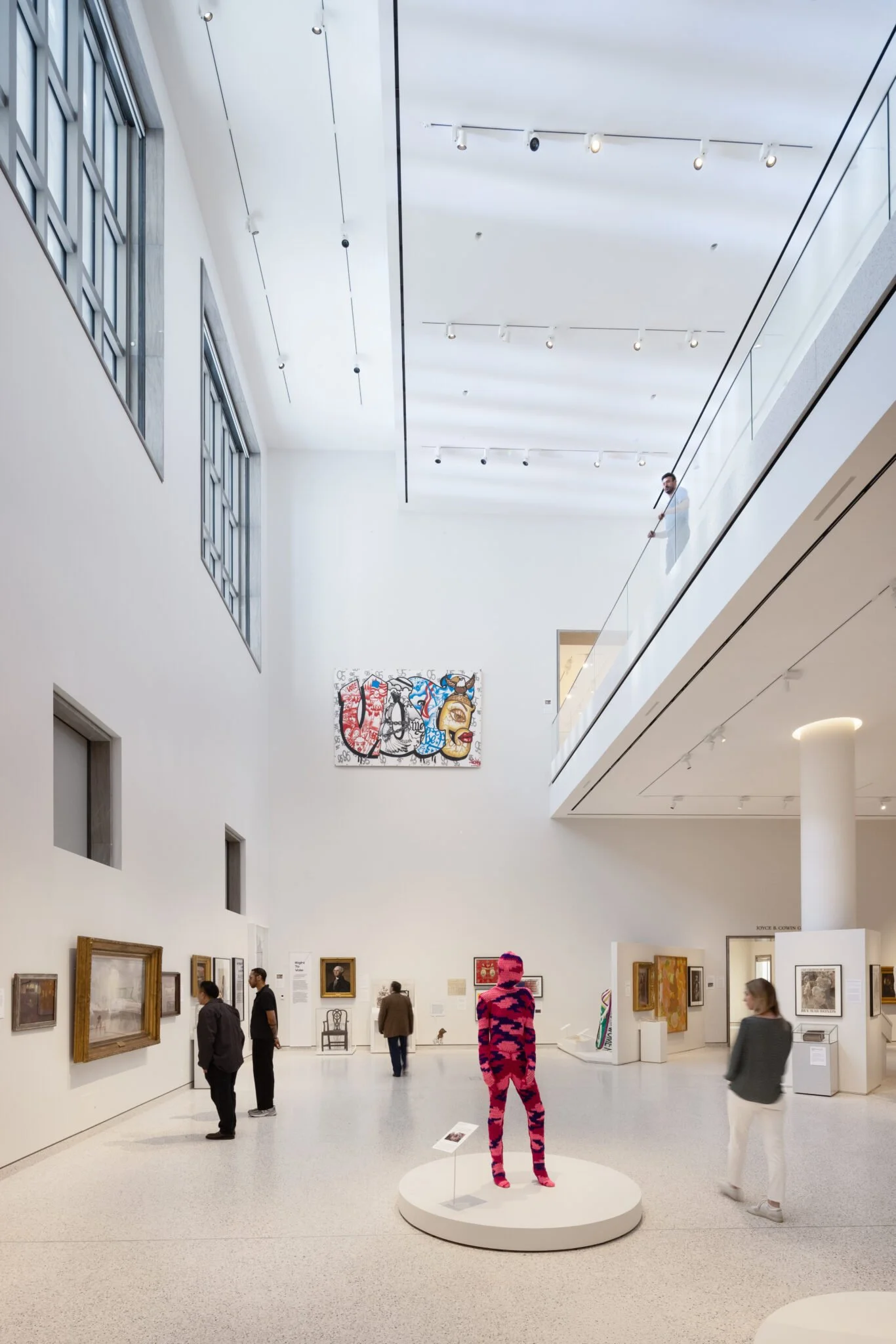
The Klingenstein Family Gallery, located on the first floor of the Tang Wing for American Democracy at the New-York Historical. Photo: Bridgit Beyer.
Over the summer, the institution’s decision to roll up the coverings on these windows made headlines, and not in a good way. “Yes, the Show Has Drawn Raves. But Some of the Objects Are Not Real,” read a New York Times exposé. The increased sun load from the uncovered windows sent nearly two dozen light-sensitive works scurrying back into storage. Several documents, textiles, posters, and other materials on view at the opening had to be replaced by facsimiles. The wing’s inaugural exhibition, titled “Democracy Matters,” suddenly looked like it came by way of the copy shop.1
It ultimately may be to our benefit that the sun has shone its light on this tendentious exhibition. The presentation makes every effort to connect the left-wing agitations of the present with the contretemps of the past. Organized by Wendy Nālani E. Ikemoto, the society’s former vice president and chief curator, who left the institution around the time of the exhibition’s opening, the show comes off as little more than party-politics agitprop. The exhibition begins with an introductory label declaring the “right to protest,” which we are told can be “quiet or loud, subtle to explicit, personal or public, violent or peaceful.” If only the label makers had absorbed the language of the U.S. Constitution’s First Amendment, also printed here, they might have noticed that a “right of the people peaceably to assemble, and to petition the Government for a redress of grievances” is not the same as loud and violent protest.
Yet the latter goes unquestioned in a hit parade of race, class, and gender upheaval. One early display features recordings of historical songs beginning with “Yankee Doodle” and concluding with the mantra “Show me what democracy looks like,” the chant employed by the anarchists manqués of Occupy Wall Street. Just beyond, a 2020 work (now displayed in reproduction) by the artist who goes by Dread Scott features an image of the U.S. Capitol created from the ashes of a burned American flag. This 2023 addition to the society’s permanent collection is titled We Don’t Need No Water, Let the Motherfucker Burn. Nearby, a 2024 work by Roberto Lugo presents the prosecution of the individuals who were accused of raping a Central Park jogger—now the activist saints known as the Central Park Five—in the form of a Greek amphora.
A nineteenth-century survey map by Gardner Avery Sage reveals the housing of the mixed-race neighborhood known as Seneca Village before “New York City seized the land by eminent domain to make way for Central Park.” This often-repeated story falsely presents the development of the park as a targeted act of institutional racism. The selective tale discounts the wholesale displacement of all races that occurred across nineteenth-century New York when the 1811 street grid, along with reservoirs and parks, was laid down over the existing city. It also ignores the compensation these landowners received.
The society is not the only institution that has used the U.S. semiquincentennial to draw a facile line between the toppling of the statue of George III at Bowling Green in 1776 and the unprecedented vandalism of American monuments over the past decade. Here on display are remnants of that equestrian George III sculpture salvaged by Loyalists, but nowhere do we learn that George Washington himself censured its destruction in “general orders,” according to Washington Irving, “as having much the appearance of a riot and a want of discipline.”
Johannes Adam Simon Oertel, Pulling Down the Statue of King George III, New York City, 1852–53, Oil on canvas, the New-York Historical.
If a case could be made for a historical exhibition of civic unrest, it would need to consider events across the political spectrum. There could be a playbill from the Astor Place Shakespeare Riot of 1849, or a flagpole from the Hard Hat Riot of 1970, when construction workers took on protestors of the Vietnam War. For that matter, shouldn’t material from the 2021 Capitol riots be treated with the same import as the suffragette-themed gown worn by Representative Carolyn B. Maloney to the 2021 Met Gala (which is now in the society’s permanent collection and here represented through a reproduction)?
In a wing dedicated to American democracy, the New-York Historical Society presents a narrative of Democrat America. The display ignores complexities and counterexamples in favor of a social-justice through line. Identity politics is sacrosanct. In a year, a new institution called the American LGBTQ+ Museum is scheduled to open on the fourth floor of the Tang Wing, where it will further develop “general and targeted content to serve the 4.5 million Pre-K–12 school children in the New York City metro area.” Already, bricks from the Stonewall Inn and matchbooks from leather bars are treated here like the splinters of the True Cross. One area invites children to leave Post-It Notes from their visit. “No Kings No Ice,” reads one. “No one is illegal on stolen land.” Message received.
For a different perspective, be sure to visit the wing’s new roofdeck. The patio was open on tours and should one day be available for public use. The stunning view of the New York skyline says more than any exercise in political logrolling. Here is the towering ambition of American democracy presented in brick and stone.
“Democracy Matters” opened at the New-York Historical Society on June 18 and remains on view through November 29, 2026. ↩