• Home
  • About
  • Writing + News
  • Media
  • Books
  • Search
  • Contact
  • Subscribe
Menu

James Panero

Street Address
City, State, Zip
Phone Number
writer, editor, critic

Your Custom Text Here

James Panero

  • Home
  • About
  • Writing + News
  • Media
  • Books
  • Search
  • Contact
  • Subscribe

ICYMI: Thoughts on WFB & NPG

June 5, 2025 James Panero

In yesterday’s Wall Street Journal, I wrote in with some thoughts on William F. Buckley Jr., occasioned by Barton Swaim's review of books by Sam Tanenhaus and Lawrence Perelman.

In the New York Times, I offered my view of the president's recent actions at the National Portrait Gallery.

Tags William F. Buckley Jr, Wall Street Journal, New York Times, National Portrait Gallery
Comment

WSJ: Review of "Jack Whitten - The Messenger"

April 14, 2025 James Panero

THE WALL STREET JOURNAL, April 14, 2025

Jack Whitten: The Messenger’ Review: A Creator’s Odyssey at MoMA

The American artist moved from the segregated South to the New York art world and beyond as he forged unique processes of painting and sculpting, the textured, totemic results of which are now on view in a staggering retrospective.

Can a painting also be a sculpture? Find out in “Jack Whitten: The Messenger,” the retrospective of the American abstractionist on view through Aug. 2 at the Museum of Modern Art. Following the survey of Jack Whitten’s free-standing work at the Met Breuer in 2018, we now get the full picture of this innovative and resonant artist, one who found freedom in the movement across fixed definitions.

The circuitous journey of Whitten (1939-2018) from segregated Bessemer, Ala., to the top floor of MoMA—by way of the Tuskegee Institute, Cooper Union, Manhattan’s 10th Street, SoHo and Tribeca, and the Greek island of Crete—was as epic as his compositions. The blood and sweat of his personal odyssey infused his methods and materials. At a time when black American artists might have been expected to address the subject of race through direct representation, Whitten abstracted his identity into layered works, both physically and metaphorically, of totemic power.

Organized by Michelle Kuo, MoMA’s chief curator at large and publisher, and assisted by Helena Klevorn, Dana Liljegren, Eana Kim, David Sledge and Kiko Aebi, the show features over 175 paintings, sculptures (mainly the former), works on paper and studio ephemera.

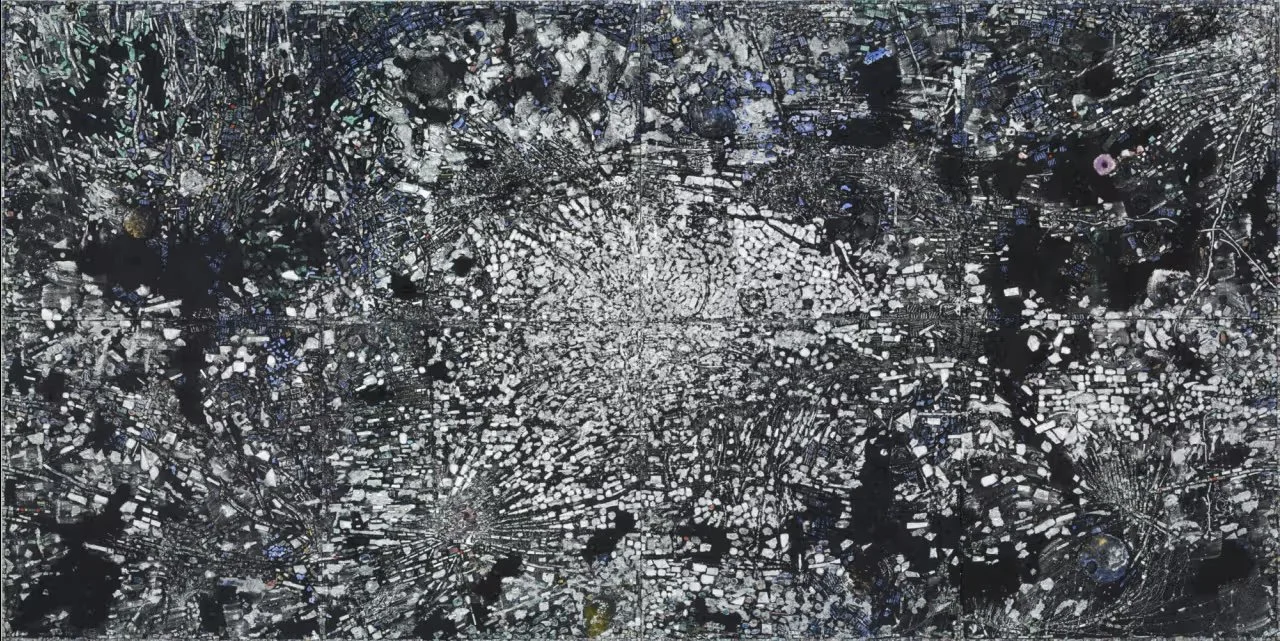
‘Atopolis: For Édouard Glissant’ (2014). The Museum of Modern Art, New York

Across his production, Whitten investigated the tension between the geometric structures of Piet Mondrian and the freewheeling gestures of Jackson Pollock. Along the way, he devised processes to remove the personal touch from his creations, opting to make his canvases as one might assemble sculpture.

“The Messenger (For Art Blakey)” (1990) inspired the title of this sprawling exhibition. Along with “Homecoming: For Miles” (1992), it serves as an introductory statement at the show’s entrance. Seen from afar, both works resemble starry constellations. Upon approach, drips of white paint on black ground come into focus. Come closer still and the true intricacy of Whitten’s process reveals itself. 

Beyond mere expressionistic drippings, these compositions are intricate mosaics of handmade tesserae—acrylic chips that Whitten poured, painted, dried, cut and arranged on the surface of each canvas. The result evokes Georges Seurat, Byzantine iconography, even digital imaging.

The exhibition then follows Whitten chronologically for roughly half a century. A suite of early black-and-white compositions, including “Head IV Lynching” (1964), echoes the photographic record of race-based terror. Resembling ghostly faces caught in a flash bulb, these abstractions were produced by pressing white acrylic through a dark fabric mesh.

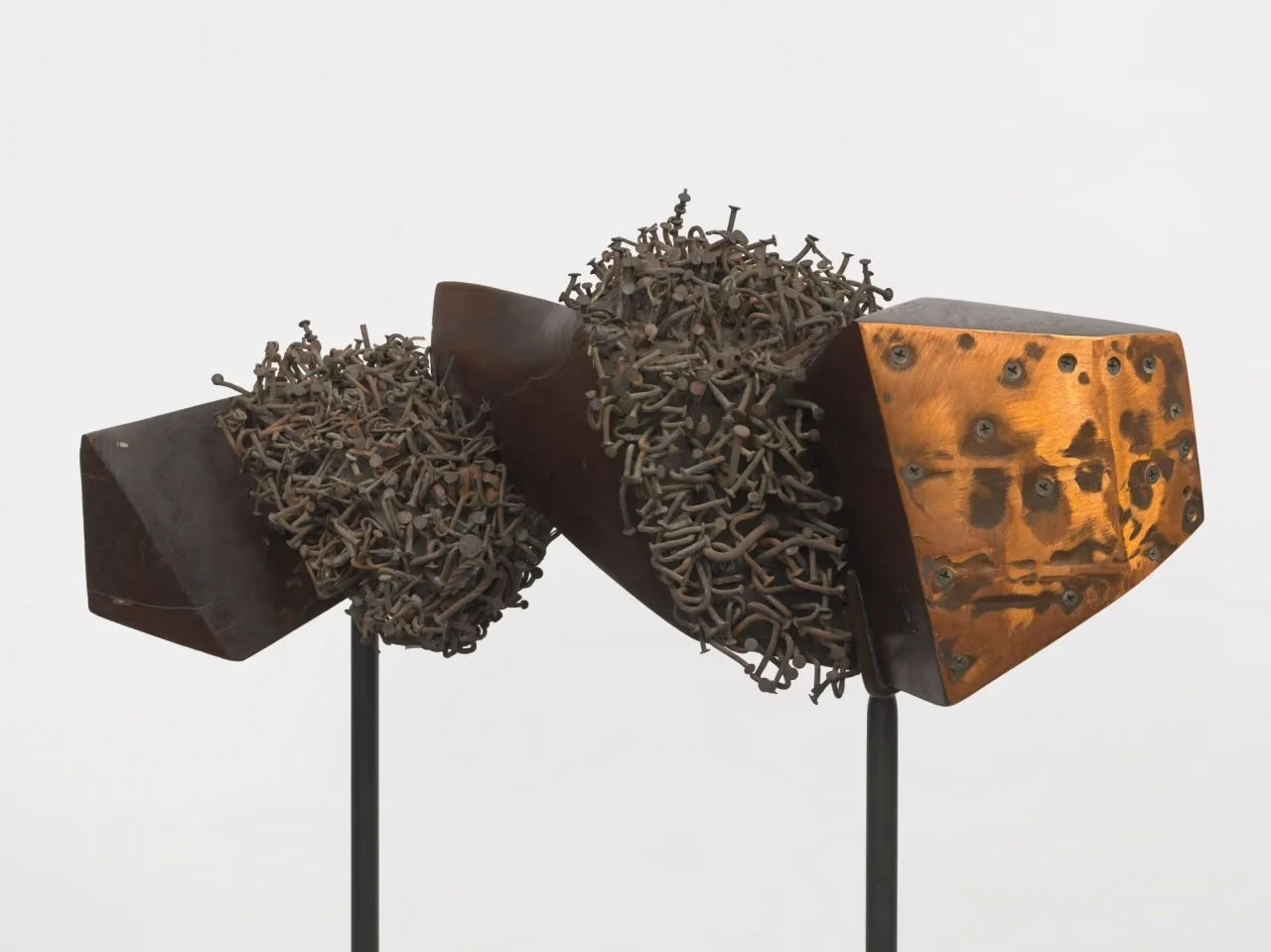
‘The Afro American Thunderbolt’ (1983/1984). Courtesy the Estate and Hauser & Wirth

Nearby, “Homage to Malcolm” (1965) is the first of his assemblages on display. In a piece of American elm that he carved, smoothed, feathered and burned, Whitten embedded nails, chains, keys, pliers, and a toilet handle, which he then coated in black paint and metallic dust. The horizontal object combines the Congolese power figures known as Nkisi N’kondi with the simplified forms of Constantin Brâncuși.

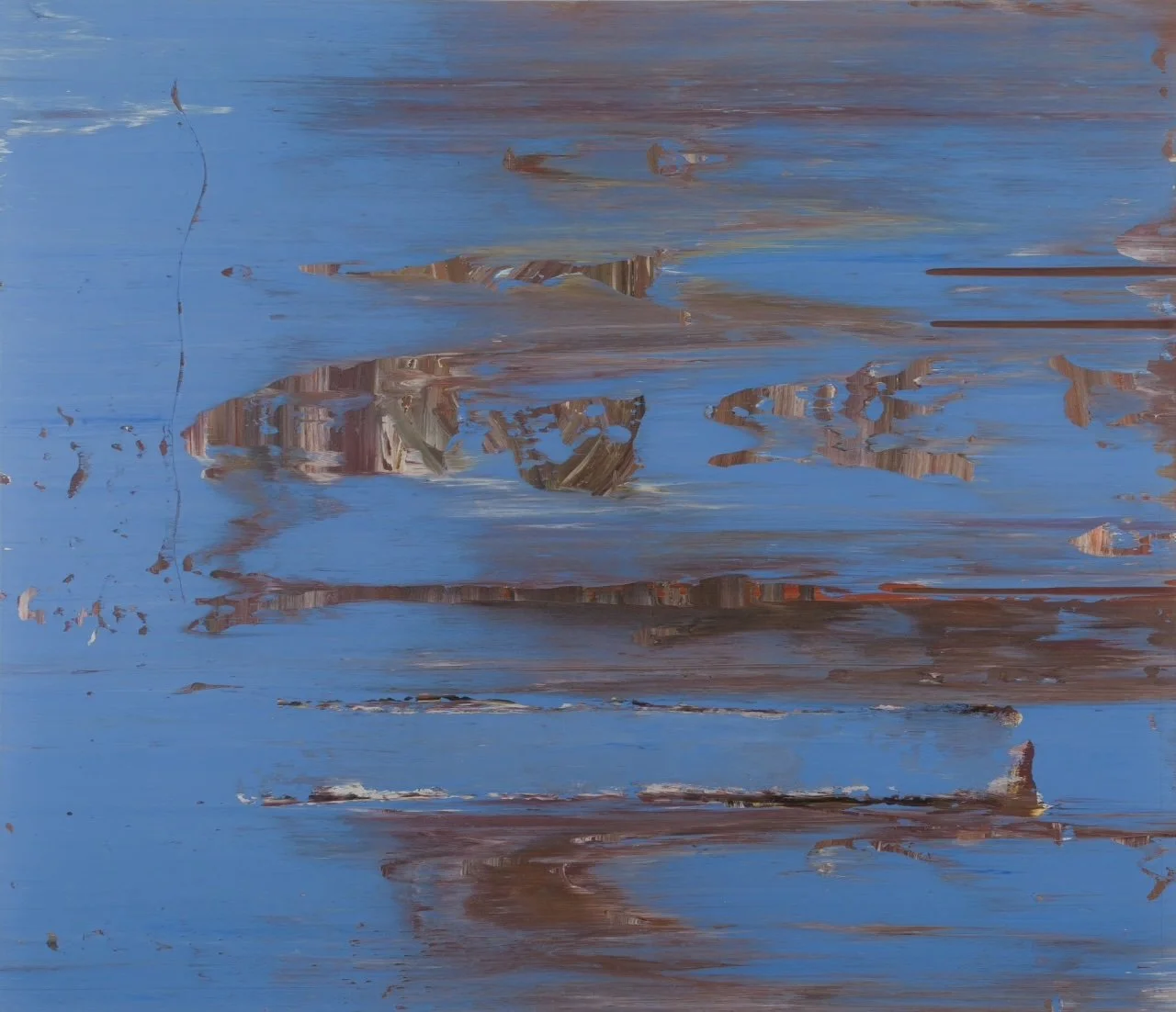
In the 1970s, Whitten constructed tools to “develop” his paintings by scraping them with giant squeegees and combs. He laid his canvases on the studio floor, applied layers of acrylic paint, and pulled his homemade rakes across them in one quick motion. Inspired by photography and xerography, works such as “Mirsinaki Blue” (1974) might call to mind the blurred abstractions of Gerhard Richter, but Whitten created his compositions years before the German arrived at his own squeegee technique.

‘Mirsinaki Blue’ (1974). Herbert F. Johnson Museum of Art, Cornell University

When Whitten turned to textured scrapers, including the use of a saw blade, the lines left by these tools produced mesmerizing effects. In a suite of works named after the Greek alphabet, inspired by summers in Crete with his wife Mary Staikos, flickers emanate from the lines of visual static.

By the 1980s, his work tipped into bas-relief, as in “Bessemer Dreamer” (1986), in which built-up circles resemble textured flooring. “Black Monolith I (A Tribute to James Baldwin)” (1988) might seem like a mix of street detritus—metal tread plates adhered to the paint surface. But in fact, Whitten molded these forms in acrylic before applying his casts to canvas.

In the 1990s, Whitten distilled such casts into handmade tiles, as in the two opening works. As he developed this mosaic process, his compositions reached their most ambitious. After Whitten witnessed the World Trade Center attack, over the next five years he made “9.11.01” (2006). At 10 by 20 feet, this composition of a black pyramid on a brick-like ground became his personal wailing wall to the victims of Sept. 11.

Whitten blurred the lines between painting and sculpture in a way that speaks to that larger foment of artists of his generation, those who remained faithful to abstraction when taste otherwise moved on to Pop. As he scraped, combed and recast the history of form, the great sincerity of his work is what ultimately shines through.

Jack Whitten: The Messenger

Museum of Modern Art, through Aug. 2

In Art, In the Press, New York Tags Wall Street Journal, Museum of Modern Art, jack whitten
Comment

Cloudy Concepts

January 26, 2021 James Panero
Nairy Baghramian’s ‘Knee and Elbow’ PHOTO:NAIRY BAGHRAMIAN/MARIAN GOODMAN GALLERY/PHOTO: THOMAS CLARK

Nairy Baghramian’s ‘Knee and Elbow’ PHOTO:NAIRY BAGHRAMIAN/MARIAN GOODMAN GALLERY/PHOTO: THOMAS CLARK

THE WALL STREET JOURNAL, January 25, 2021

Cloudy Concepts

At the Clark Art Institute, six new outdoor works engage with the museum’s 140-acre campus. A review of “Ground/Work.”

As the pandemic compels us to take our culture al fresco, outdoor sculpture is having its day in the sun. The next day, however, might be partly cloudy. And the next might bring a frost with the chance of freezing rain. In other words the outdoors, unlike the white cube of a gallery, can challenge sculpture itself as much as the scenery compels us as viewers.

When the Clark Art Institute looked to bring art into the wilds of its own backyard in Williamstown, Mass., the muddy, icy, windswept challenges of a New England hillside called Stone Hill suggested an opportunity to do something different with sculpture than just display art plopped in a plaza, as we often encounter such outdoor work. An exhibition called “Ground/Work,” organized by guest curators Molly Epstein and Abigail Ross Goodman and on view through Oct. 17, now presents six commissioned pieces by six contemporary artists (all created last year) scattered around a 140-acre woodland pasture. This landscape with trails that rise several hundred feet and connect with a larger conservation area means visitors should be prepared for more than a walk in the sculpture park.

As an institution best known for its collection of 19th-century European and American art, the Clark is wise to use this outdoor space to bring contemporary voices and its natural assets into the mix. Through a language of reserved modernist form, each of these new works is designed to engage with the weather and the vistas, the birds and cows, all in “active dialogue,” according to exhibition literature, with this specific environment. It’s just too bad we need a field guide to some of the works in order to understand the overwrought concepts behind their creation.

You could easily miss the first work on view, which is embedded in the museum architecture itself. Jennie C. Jones has attached a 16-foot sculpture of powder-coated aluminum, wood and harp strings to the end of a free-standing wall. Called “These (Mournful) Shores,” the work is an Aeolian harp, meant to be strummed by the wind, that, according to the label, refers to the Middle Passage. It’s an elegiac idea but with layers of conceptual meaning that muddy the effect. Its dark gray palette, meant to recall that of two seascapes by Winslow Homer in the Clark collection, further mutes what should be a more resonant work.

Head up Stone Hill for a three-part work by Haegue Yang. “Migratory DMZ Birds on Asymmetric Lens” focuses on three species found in the borderlands between North and South Korea. A lentil-shaped base of soapstone supports life-size clear resin models of these birds horizontally split in two. The bottom half of each model is an inverted form meant to serve as a birdbath for local species. If you missed all that, you are not alone. When it comes to innovative manufacturing, Ms. Yang cuts no corners. The Fresnel-lens-like striations of her soapstone are enigmatic and tactile. But derived as they are from specimen scans taken around the DMZ, her resin models are too clever by half and never take flight.

In a far corner of the grounds, Kelly Akashi’s “A Device to See the World Twice” trains an acrylic lens, over 6 feet tall, on an old ash tree that happens to have fallen after the sculpture was designed. Here an attempt at a rusticated frame holding up the lens detracts from the invitation to meditate on the natural ruin of the tree seen through it. For Eva LeWitt—daughter of Conceptualist Sol LeWitt—three thin “Resin Towers” of layered colored discs seem to bubble up like thermometers in red, orange and blue. On the day I saw it, the diaphanous forms got lost in the late fall light. But since “Ground/Work” will be on view through all four seasons, there will be ample opportunities for them to come alive again.

“Knee and Elbow” by Nairy Baghramian is the exhibition standout. This work of Carrara marble and polished stainless steel dances up the hillside in expressive skeletal form. Arching shapes mime the mountains beyond while two-toned stone refers to the white and pink facades of the buildings below. The bounding sculpture speaks for itself, no notes required. Now, if only it were bigger. This impressive work, just five feet tall, calls out for greater scale.

Returning to the Clark campus, we see a final sculpture. Analia Saban’s “Teaching a Cow How to Draw” is supposed to remind us of the cows’ presence on this active pasture by refashioning a working cattle fence into a visual tutorial for several theories of composition. It’s a conceptual joke, with forms built into the fence meant to represent the rule of thirds, the golden ratio, and two-point perspective. Having grazed on this last mealy offering of Stone Hill, I felt all-the-more ready to feast on the collection inside the museum.

SEE THE WALL STREET JOURNAL OF JANUARY 25, 2021 FOR THE FULL REVIEW

Haegue Yang’s ‘Migratory DMZ Birds on Asymmetric Lens Duiitt Vessel (Gray-Backed Thrush)’ PHOTO:HAEGUE YANG/KURIMANZUTTO, MEXICO CITY/NEW YORK/THOMAS CLARK

Haegue Yang’s ‘Migratory DMZ Birds on Asymmetric Lens Duiitt Vessel (Gray-Backed Thrush)’ PHOTO:HAEGUE YANG/KURIMANZUTTO, MEXICO CITY/NEW YORK/THOMAS CLARK

In Art, James's Publications, Travel Tags The Clark Art Institute, Sculpture, Wall Street Journal
Comment

POWERED BY SQUARESPACE