• Home
  • About
  • Writing + News
  • Media
  • Books
  • Search
  • Contact
  • Subscribe
Menu

James Panero

Street Address
City, State, Zip
Phone Number
writer, editor, critic

Your Custom Text Here

James Panero

  • Home
  • About
  • Writing + News
  • Media
  • Books
  • Search
  • Contact
  • Subscribe

The Spirit of ’76

February 17, 2026 James Panero

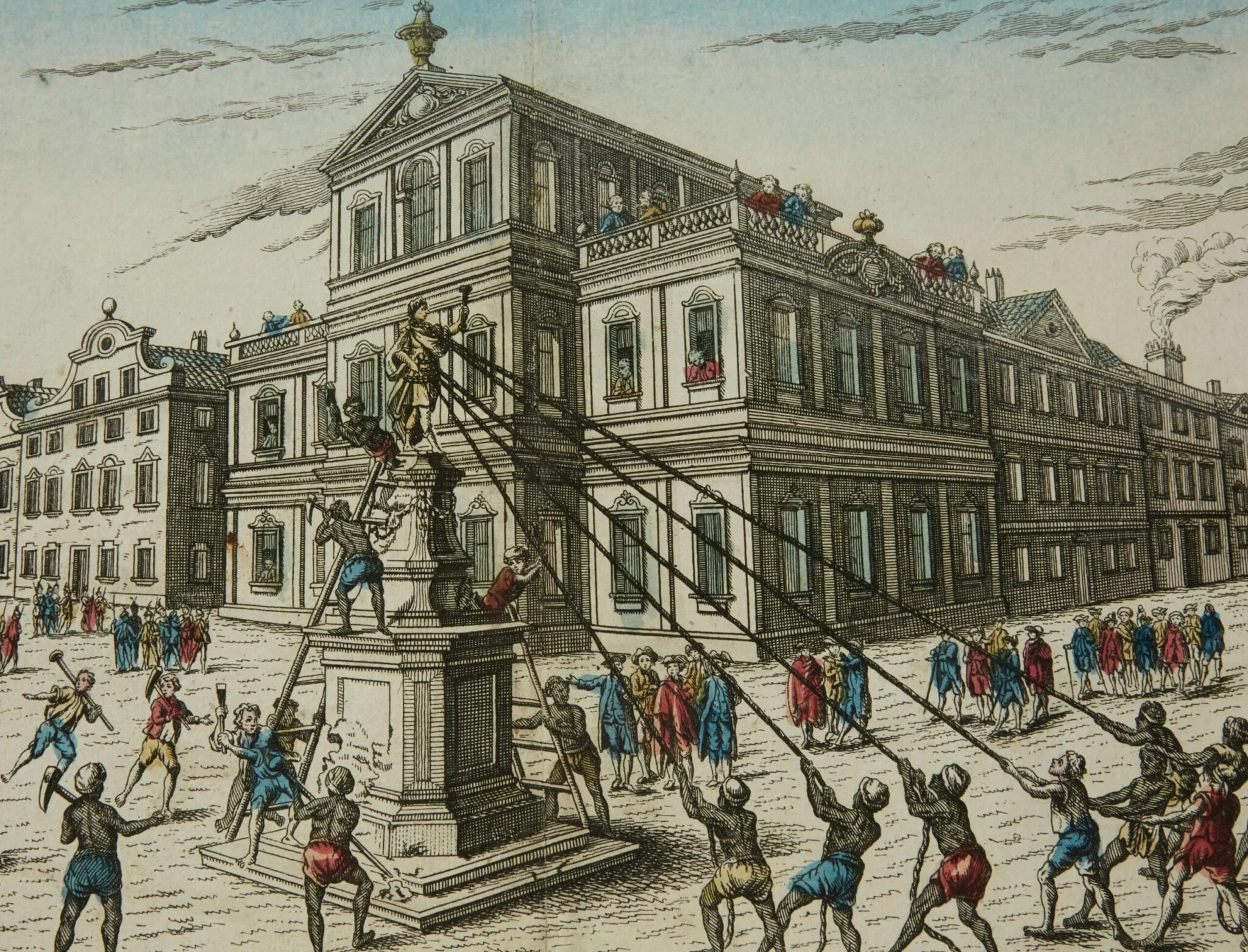
La Destruction de la Statue Royale a Nouvelle Yorck, 1776, Hand-colored etching. Photo: Vincent Dilio, courtesy of David M. Rubenstein.

THE NEW CRITERION, February 2026

The spirit of ’76

On “Declaring the Revolution: America’s Printed Path to Independence,” at the New-York Historical Society.

The nation’s semiquincentennial will provide many opportunities to revisit America’s founding. A small but enthralling show now at the New-York Historical Society deserves to be a foundational first stop. “Declaring the Revolution: America’s Printed Path to Independence” draws on the extraordinary collection of the philanthropist David M. Rubenstein.1 It tells the story of American independence through sixty documents that forged national resolve in a concise and compelling presentation. Curated by Mazy Boroujerdi, with detailed labels and a well-conceived arrangement of material, the one-room exhibition lays out the path to war and reveals the long road to American independence through the primary documents that took us there step by step. (A side note: now doing business as merely “The New York Historical,” the 222-year-old society is one of several institutions sadly struck with brand aphasia.)

“The tree of liberty must be refreshed from time to time with the blood of patriots and tyrants,” wrote Thomas Jefferson. So too must we refresh our understanding of these revolutionary materials. Take the Declaration of Independence. A well-recognized copy serves as the center of the historical society’s display. It may come as some surprise that the edition we most associate with this primary object of civic veneration was not created on July 4 or even in 1776 but in 1823, as this example attests.

The original Declaration, drafted by Thomas Jefferson with additions from a committee of the Second Continental Congress that included John Adams and Benjamin Franklin, was composed in manuscript. Their language built on the brief statement of the Lee Resolution, approved on July 2, 1776, which resolved that the colonies were “free and independent States.” July 2 might just as well be America’s independence day, but it was the July 4 adoption of the full and finely wrought Declaration that gives us our anniversary date.

On July 5, the congress rushed this manuscript to the nearby print shop of John Dunlap to produce between a hundred and two hundred broadsides for distribution across the colonies and soon around the world. Four days later, after receiving a copy by mail from John Hancock, George Washington had one of these broadsides read aloud to his brigades assembled on the commons in lower Manhattan. Following this 6 p.m. announcement, a mob tore down the statue of George III in Bowling Green, an action Washington lamented for its riotous “want of order” (the statue’s lead was recast into musket balls for the Patriot cause).
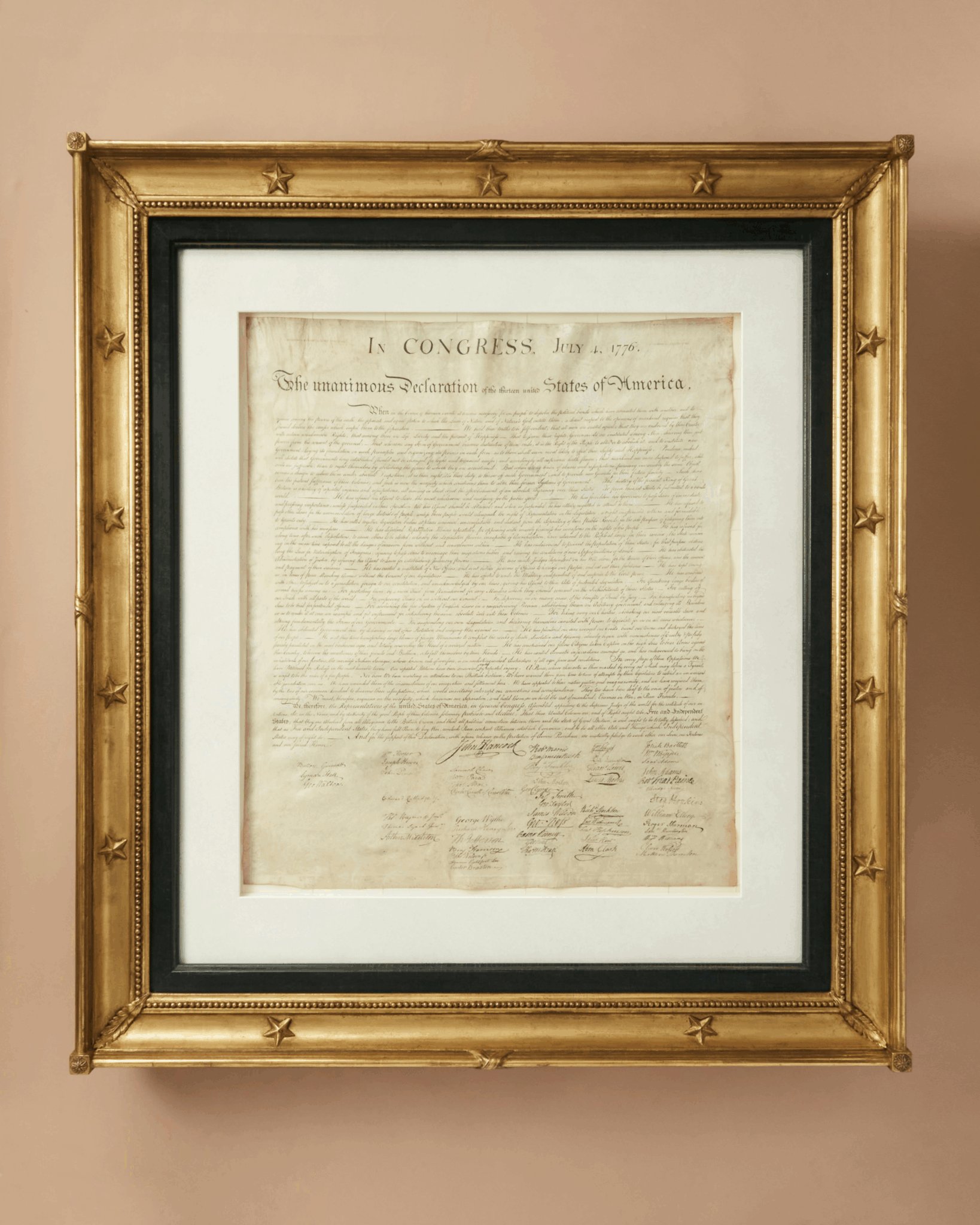
The Declaration of Independence, 1823, Engrossed print copy. Photo: Vincent Dilio, courtesy of David M. Rubenstein.

Dunlap’s poster-sized broadsides are the earliest extant records of the Declaration. The original manuscript was lost during typesetting. On August 2, the Continental Congress memorialized its adoption by commissioning an engrossed, or handwritten and enlarged, version on vellum, most likely from the pen of Timothy Matlack. This is the edition that famously received John Hancock’s John Hancock, along with the signatures of the other delegates present. Since the New York Provincial Congress officially adopted the Declaration only in the interim on July 9, the opening lines were updated from a “declaration by the representation of the United States of America in general congress,” as the broadside reads, to “the unanimous declaration of the thirteen United States of America.”

The engrossed Declaration is the one now on display in a titanium case filled with argon gas at the National Archives Museum in Washington, D.C. Yet it too most likely is not the edition we most closely associate with this document. That’s because, even less than fifty years after its creation, the condition of the engrossed Declaration had already deteriorated. In 1820, John Quincy Adams, then the secretary of state, commissioned a set of two hundred official copies of the engrossed Declaration from the Washington engraver William J. Stone. Working with the document for three years, through a system of mirrors and tracing, and perhaps the lifting of some ink from the original document, Stone created a copperplate negative of the engrossed Declaration, including its fifty-six signatures. As with the original, he printed these facsimiles on vellum.

The Stone facsimile, a faithful print of the engrossed Declaration with wording that was once again legible, was distributed to federal and state repositories and the living members of the founding generation. Thomas Jefferson, John Adams, Charles Carroll of Carrollton, James Monroe, James Madison, and the Marquis de Lafayette each received two copies.

Today fewer than fifty known copies remain of Stone’s 1823 printing. Yet this is the version now most regularly reproduced since it reads closer to the original Declaration than the faded document bathed in inert gas in Washington. David M. Rubinstein, the cofounder of the Carlyle Group, the private equity firm, has collected the few Stone facsimiles in private hands and dedicated them to public display alongside his collection of other key American documents. We may never be closer to the Declaration than with his copy now on loan and available for detailed examination.

“Declaring the Revolution” makes a compelling case for the cause of American independence as a continuation of English rights and liberties. As represented by the other documents on display, the Declaration comes at the fulcrum of a two-decade-long conflict as history’s least revolutionary document of revolution. “Prudence,” it reads, “indeed, will dictate that Governments long established should not be changed for light and transient causes.” Beyond its idealistic opening, the Declaration is mainly a legalistic enumeration of grievances, of a “long train of abuses and usurpations” with “repeated injuries” leading to a reluctant resolution grounded in law and custom. The great irony of American independence, and its greatest salvation, was its conservative assertion of English rights against an un-English monarch:

In every stage of these Oppressions We have Petitioned for Redress in the most humble terms: Our repeated Petitions have been answered only by repeated injury. A Prince whose character is thus marked by every act which may define a Tyrant, is unfit to be the ruler of a free people.
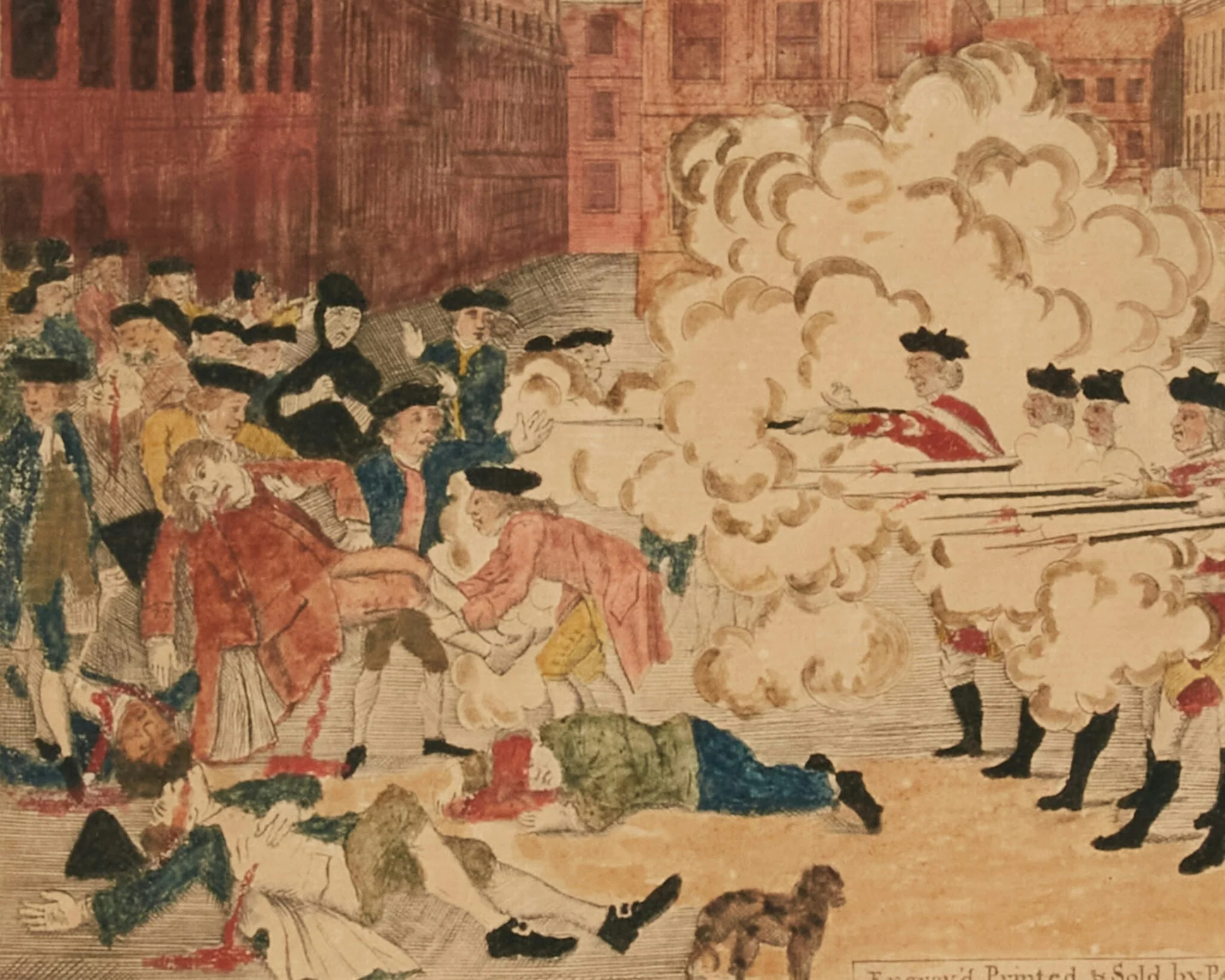
Paul Revere, The Bloody Massacre perpetrated in King Street, Boston, on March 5th, 1770, Hand-colored engraving. Photo: Vincent Dilio, courtesy of David M. Rubenstein. 

At the historical society, flanking the Stone facsimile to the left, is an edition of the Declaration of arguably even greater rarity and import. This is the version printed by the Pennsylvania Evening Post on July 6. It was the Declaration’s first truly public appearance, typeset from the broadside of a day before and available for “only two Coppers.” (Rubenstein purchased his copy at auction in 2013 for $632,500, the highest price then paid for a historical newspaper.) Immediately to the right of the Stone facsimile, the inclusion of a 1773 Slave Petition for Freedom feels forced. The document nevertheless serves to reveal the emancipatory impulse already in circulation at the time of revolution. “The divine spirit of freedom, seems to fire every human breast on this continent,” it asserts. The state of Massachusetts, where this petition was issued, abolished slavery seven years later.

In a center vitrine, in line of sight with the Declaration, are the documents and books that informed its ideals. Included here are copies of John Locke’s Second Treatise on Government, in an American printing from 1773. First published in 1689, this treatise arguing for the natural rights of “life, liberty and property” gained renewed attention in the revolutionary era. So too did Thomas Hobbes’s Leviathan, here in a copy from 1651, laying the case for the social contract between government and the governed.

Fronting this display is Magna Carta, represented by an eighteenth-century engraved facsimile of the 1215 document preserved at the British Library. (It is noteworthy that the only thirteenth-century version of this document in the United States is currently at the National Archives Museum—there on long-term loan from David M. Rubenstein).

As with the liberal arguments that surrounded Magna Carta and later the issuance of the English Bill of Rights, here in a 1689 first edition, the colonists saw their cause as grounded in English law. Their struggle for redress, at first, came about as forms of isolated resistance and then as a united colonial civil war. At the historical society, this story begins to the left with a copy of the 1765 Stamp Act. The much-maligned taxation scheme, designed to underwrite the British military presence along the colonies’ extensive frontiers following the French and Indian War, was met with compelling counterarguments from several American voices. Benjamin Franklin’s testimony against it in the House of Commons in 1766 is here represented in a printed account of his four-hour-long examination. “No, never” would the colonists pay the duty “unless compelled by force of arms,” he declared. While that act was repealed, new British taxes led to civic disturbances culminating in the Boston Massacre of 1770, made all the more bloody in the colonial mind by Paul Revere’s contemporaneous engraving. As Massachusetts became a center of colonial insurgency to British military occupation, the first shot of Lexington and Concord in 1775, “heard round the world” (in Ralph Waldo Emerson’s famous phase of 1837), brought the conflict into open rebellion.

A hallway wall, just around the corner from the main gallery and easy to miss, includes documents related to the prosecution of the Revolutionary War divided between its northern and southern theaters. The path to American independence was paved by more than just the writings of history’s most motivated lawyers. It involved nearly a decade of armed conflict and more losses than wins for the American side. These displays lay out the accounts, records, and maps of the campaigns while also revealing the rising international interest in American independence. Traité d’Amitié et de Commerce, Conclu entre le Roi et les États-Unis de l’Amérique Septentrionale, reads a vital 1778 treaty of French support for the revolution. Le Général Washington Ne Quid Detrimenti capiat Res publica is the title of a French print from circa 1780.

“Declaring the Revolution” reveals the indomitable spirit of ’76 that buoyed the Patriot cause to force the surrender of Charles Cornwallis, the commander of British southern forces, at Yorktown on October 19, 1781, and brought about the Definitive Treaty between Great Britain, and the United States of America, Signed at Paris, the 3rd Day of September 1783. The astonishing victory continues to inspire the spirit of liberty and recalls the debt of sacrifice made in the name of freedom.

  1. “Declaring the Revolution: America’s Printed Path to Independence” opened at the New-York Historical Society on November 14, 2025, and remains on view through April 12, 2026. ↩
In James's Publications, New York, Upper West Side, History Tags New York Historical Society, American Revolution, US250, the new criterion, The New Criterion
Comment

The museum of the present

December 1, 2016 James Panero

THE NEW CRITERION

December 2016

The Museum of the Present

What’s a museum? This is a question I have asked more than once in The New Criterion. It’s one this magazine has been asking since its first issue. And it’s one that I wish museums would ask more frequently of themselves. Because the answers are changing—through assumptions that are often unannounced, unacknowledged, and unexplored.

Writing nearly twenty years ago on “the ongoing transformation of the American museum,” the late theorist Stephen E. Weil identified how museums were moving from “being about something to being for somebody.” This is a phrase that has been taken up by critics of contemporary museum culture, but for Weil it signaled a positive change, a momentous redirection he traced back to the cultural revolts of the 1960s. The museum of the past, he said, was content to care for the “oldfashioned satisfaction,” “aesthetic refreshment,” and “pleasure and delight” of its permanent collection—or what the museum director Barbara Franco derided as the “salvage and warehouse business.” Through new evaluation standards tied to continued tax-exempt status, Weil argued, the museum of today “is being told that to earn its keep requires that it be something more important than just an orderly warehouse.” In other words, through historical inevitability and government coercion, Weil concluded, the museum of tomorrow must come to see itself not as the steward of a collection of objects but as “an instrument for social change.”

Twenty years on, the prophecy is coming true—but with increasingly ominous and destructive results, especially for collecting museums. In 1997 the Brazilian museum director Maria de Lourdes Horta envisioned how “a museum without walls and without objects, a true virtual museum, is being born” to be “used in a new way, as tools for self-expression, self-recognition, and representation.” Or as Neal Benezra, the director of sfmoma, more recently observed, “times have changed. Back then, a museum’s fundamental role was about taking care of and protecting the art, but this century it’s much more about the visitor experience.”

Over the last few decades the American museum has only been too successful at turning this vision into reality. By the numbers, museums have become thriving enterprises, competing and ballooning into what we might call a museum industrial complex. Today there are 3,500 art museums in the United States, more than half of them founded after 1970, and 17,000 museums of all types in total, including science museums, children’s museums, and historical houses. Attendance at art museums is booming, rising from 22 million a year in 1962 to over 100 million in 2000. At the same time, and hand in hand with these numbers, billions of dollars have been spent on projects that have largely focused on expanding the social-service offerings at these institutions—restaurants, auditoriums, educational divisions, event spaces—rather than additional rooms for collections. At the present rate, the museum of the future will virtually be a museum without objects, as new non-collection spaces dwarf exhibition halls with the promise that no direct contact with the past will disturb your meal. As London’s Victoria and Albert Museum once advertised, the museum of the future will finally be a café with “art on the side.”

The museum of the past focused on its permanent collection. The museum of the present forsakes the visited, and its own cultural importance, to focus on the visitor. From offering an unmediated window onto the real and astonishing objects of history, the contemporary museum increasingly looks to reify our own socially mediated self-reflections. This it does not learn from history but to show the superiority of our present time over past relics. The result is a museum that succeeds, by every popular measure, in its own destruction—a museum that is no longer an ark of culture, but one where the artifact at greatest risk is the museum itself.

Executive Editor James Panero discusses the character and trends of contemporary art museums.

The American art museum was born in the nineteenth century, a century later than its European counterparts and largely as an answer to those institutions, but with a unique American quality tied to its permanent collection. Unlike in Europe, where museums were either created out of revolutionary turmoil or acts of government, almost all American institutions were founded and supported by the free will of private individuals. The treasures these benefactors bequeathed became not only public objects of secular devotion but also tokens of the idealism behind the institutions that maintained them. As manifestations of private wealth transferred to the public trust, American museums were founded, in part, to represent our civic virtues. The aesthetic education offered through their permanent collections was not just about history and connoisseurship. It was also about how hard work can become an expression of virtue by gifting objects to the public trust. It’s truly an astonishing American story: no other country has seen such private wealth, accumulated through industry, willingly transferred to the public good.

But it wasn’t long into the twentieth century before some American museums began to attack their own cellular structure, usually in the pursuit of progressive social change. These assaults were most manifest in the physical transformations and deformations of institutional buildings. Now, in many cases it should be said that the changing appearance of our museums was benign. Rather than malignant tumors, they signaled healthy growth through evolving architectural styles. The dozen or so buildings that make up the Metropolitan Museum of Art have created a unified whole out of an assembly that range from Gothic Revival to Beaux-Arts to modern. These diverse structures complement one another and work to complete the museum’s founding vision.

In contrast, consider the history of the Brooklyn Museum—born in 1823 nearly a half century before the Met and a manifestation of rising civic confidence in a borough that was once America’s third-largest independent city. In the 1930s, a progressive director by the name of Philip Newell Youtz launched an assault on his nineteenth-century museum from which this great unfinished institution has never recovered. Believing that the “museum of today must meet contemporary needs,” Youtz attacked the museum’s 1897 home designed by McKim, Mead & White on Eastern Parkway and vowed to “turn a useless Renaissance palace into a serviceable modern museum.” Praising the educational practices of the new Soviet museums, he undertook the transformation of the Brooklyn Museum from a temple of contemplation into a school of instruction, where the arts were put in the service of progressive ends and funding would derive from the state rather than private philanthropy. Youtz sought to transform his institution into a “socially oriented museum” with, as he stated, “a collection of people surrounded by objects, not a collection of objects surrounded by people.” He even hired department store window-dressers to arrange exhibitions and transform his collection into a parade of teachable moments.

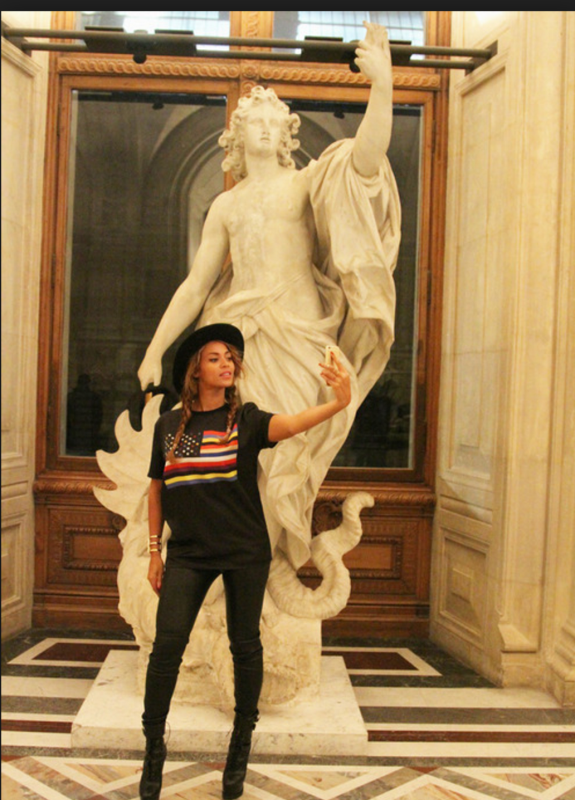
Beyoncé Knowles with Apollo killing the Python snake at the Louvre.

Beyoncé Knowles with Apollo killing the Python snake at the Louvre.

Youtz then turned his programmatic assault into a physical one. Historians may question the ultimate motivation behind his demolition of the Brooklyn Museum’s exterior Grand Staircase, which once resembled the entrance to the Metropolitan Museum of Art and was meant to elevate the museum-goer from Eastern Parkway into the refined precincts of the museum. What is not in doubt is Youtz’s belief that his iconoclasm, pushing the museum lobby down to street level, “improved” upon the McKim, Mead & White design. Continuing in this way, Youtz went about mutilating much of the museum’s ornamental interior.

In this example, we can see that a progressive strain agitating for a more “socially orientated museum” long predates the 1960s. But since the 1960s, such progressive ideology, combined with what I would call a non-profit profit motive that seeks ever larger crowds, greater publicity, expanding spaces, ballooning budgets, and bloated bureaucracy—a circular system that feeds on itself—has turned the American museum into a neoliberal juggernaut.

The expansion plans that museums now seem to announce by the day may appear to be the evidence of healthy organic growth. But their motivations are just as often closer in ideology to the removal of the Brooklyn Museum’s Grand Staircase—efforts at distancing the present from the past.

There are many examples. The 70,000-square-foot $114 million new wing of the Isabella Stewart Gardner Museum, which opened in 2012, is but one. Designed by Renzo Piano, the building, which required the demolition of Gardner’s historic carriage house, now serves as the only entrance to the institution and connects with the original museum through a glass-enclosed airlock. The addition offers a Kunsthalle for new art, eateries, shops, a greenhouse, a visitor “living room,” and apartments. All are attractive, but for what end? A greenhouse to cultivate new interest? A hundred-million-dollar engine to generate new donors—even as streaks of rust still stain the museum courtyard? I would argue that the expansion primarily serves to quarantine the original museum’s antiquity behind an architectural filtration system. With the anointment of “Renzo’s oil,” the museum shifts its focus from what is left of its collection onto the visitor experience. As the Gardner’s director explained to me at the time of the opening, finally those people in their cars on Fenway Park Drive will recognize the Gardner as a museum, because here is Renzo Piano. Nevermind that the Gardner’s fanciful palazzo has been a signature of the Boston streetscape since 1903.

Back in New York, the Whitney, a museum with a vastly different history, relocated in 2015 from the Upper East Side to a flood zone along the Hudson River with results that are surprisingly similar to the Gardner’s. We have heard the modern museum referred to as a “white box.” Designed, again, by Renzo Piano, here is the museum as sky-box, an institution built as much to be looked out of as looked into, a place where see-and-be-seen has moved from the periphery to the main event. As opposed to the Whitney’s former fortress of solitude on Madison Avenue, designed by Marcel Breuer in 1966, the new museum metaphorically explodes, reprocesses, and repackages its own history through a giddy, irrational space for spectacle and an incinerator for its dusty, unwanted past.

This may be one reason why the institution has been rechristened as, simply, whitney, dropping the words “museum,” “American,” and “art” from its branding. Yet while Piano increased the Whitney’s floorplan from 85,000 to 220,000 square feet, just 50,000 of that is going to indoor galleries, up from 33,000 on Madison Avenue. The rest goes to multi-million-dollar views and a circulation system that forces the museumgoer outside onto a fire escape turned against the skyline, which like Piano’s Pompidou treats the museum as an institutional theater.

Do all of these initiatives really turn museums into instruments of “social change”? Do they merely justify bigger budgets and higher ticket prices? I would argue that by mediating our experience through ever more gauzy filters they in fact blunt the true radicalism of our direct encounter with the objects of history. Rather than “decentering us at a radical moment of unselfing,” as the director James Cuno once observed, today’s institutions promote “museum selfie day” and roll out every trick at recentering the experience of the museum around you. What better way, after all, to reap the benefits of hashtag advertising while entertaining the egocentrism of your turnstile clientele.

But why not? What is so wrong about the Metropolitan Museum of Art’s recent promotion of “nail art sessions by Lady Fancy Nails” as it did around the show “Manus x Machina”?

Or what about a promotion by the Art Institute of Chicago that offered a “full-size replica of Van Gogh’s painting The Bedroom” available for nightly rental on AirBnB.

Or how about this season’s “Met Workout,” a museum-sponsored event that advertises: “Goodbye SoulCycle, hello Vermeer and Picasso. You thought just trying to stroll through The Met collection was a workout? Try doing stretches in the shadow of Diana or squats while pondering the shapely poise of John Singer Sargent’s Madame X.”

Maurizio Cattelan with his sculpture America t the Solomon R. Guggenheim Museum.

Maurizio Cattelan with his sculpture America t the Solomon R. Guggenheim Museum.

This fall the Guggenheim museum installed a working gold toilet designed by the neo-Dadaist Maurizio Cattelan in one of its bathrooms. The facility, which requires a special guard and janitor, attracts hour-long lines that snake up the rotunda. This interactive Duchampian sculpture, the most shared golden toilet on the internet, is called America (how original), but it might just as well be titled “the museum.” The provocation is presented as an inside joke, but it ultimately degrades the institution itself for one more social-media share. A golden toilet is an appropriate symbol for the museum fully dedicated to the visitor experience.

The problem is that such promotions, by converting the museum from a temple of culture into a cathedral of the self, spend down its reserves of virtue. The Instagram age has little need for more venues for “self-expression, self-recognition, and representation.” Our times yearn for a real, unmediated engagement with the objects of the past that only a traditional collection-based museum can offer. This may be one reason why we saw a widespread uproar over the recent rebranding of the Metropolitan Museum. It wasn’t so much over its lackluster typography and a spendthrift rollout at a time of operational shortfalls. It was that so many people deeply admired what the museum’s traditional brand had come to represent.

There are many counterexamples to this story—museums that resist progressive currents and reaffirm their original collection mandates. Increasingly I draw encouragement not from too-big-to-fail institutions but from those tributaries and backwaters of our museum mainstream—from New York’s Hispanic Society, for example, preserved in amber on 155th Street and Broadway, to house museums like the Morris-Jumel Mansion in Washington Heights, where Lin-Manuel Miranda wrote parts of Hamilton while sitting in Aaron Burr’s bedroom. Museum trustees still have the power to redirect their resources away from artless atriums and administrative bloat to true collection access through initiatives such as the visible storage centers sponsored by Henry R. Luce.

But I suspect we have only seen the proverbial tip of the iceberg now in the path of the museum at full speed. Museums may assume that new buildings and hashtag diplomacy will insulate them from the most destructive progressivist mandates, but these are just openings for a new generation of cultural leaders, contemptuous of the permanent collections of robber barons, to undermine their stewardship. Already, ill-adventuring museum directors such as Thomas Hoving have shown us what could be done through deaccessioning when, in the early 1970s, he began liquidating bequests over the objections of his curators to enhance his own discretionary spending. Now look for a further loosening of deacession standards.

For a generation, museums have chased after the numbers, with blockbuster exhibitions and amenities that have indirectly ceded curatorial control to the turnstile. The government now looks to accelerate this abdication of leadership through “reenvisioning our grant programs,” as the National Endowment for the Humanities announced this year.

If the museum visitor now expects to receive the keys to the collection, backed by government mandates, there may be little hope to save the museum from populist whim. In October an activist group called “Decolonize This Place” continued its targeting of museums by storming the rotunda of the American Museum of Natural History. Chanting “Respect! Remove! Rename,” they then covered the equestrian statue of Theodore Roosevelt and demanded “that City Council members vote to remove this monument to racial conquest.” At one time this might have seemed like an extreme suggestion, but given the current iconoclasm on university campuses, the protesters know they are part of a populist insurgency. This is the end result of the “museum for somebody”: a museum without objects that is ultimately objectless—a museum for nobody.

In Art, New York, James's Publications Tags the new criterion, museums
3 Comments

POWERED BY SQUARESPACE