• Home
  • About
  • Writing + News
  • Media
  • Books
  • Search
  • Contact
  • Subscribe
Menu

James Panero

Street Address
City, State, Zip
Phone Number
writer, editor, critic

Your Custom Text Here

James Panero

  • Home
  • About
  • Writing + News
  • Media
  • Books
  • Search
  • Contact
  • Subscribe

Escape Artist

May 7, 2026 James Panero

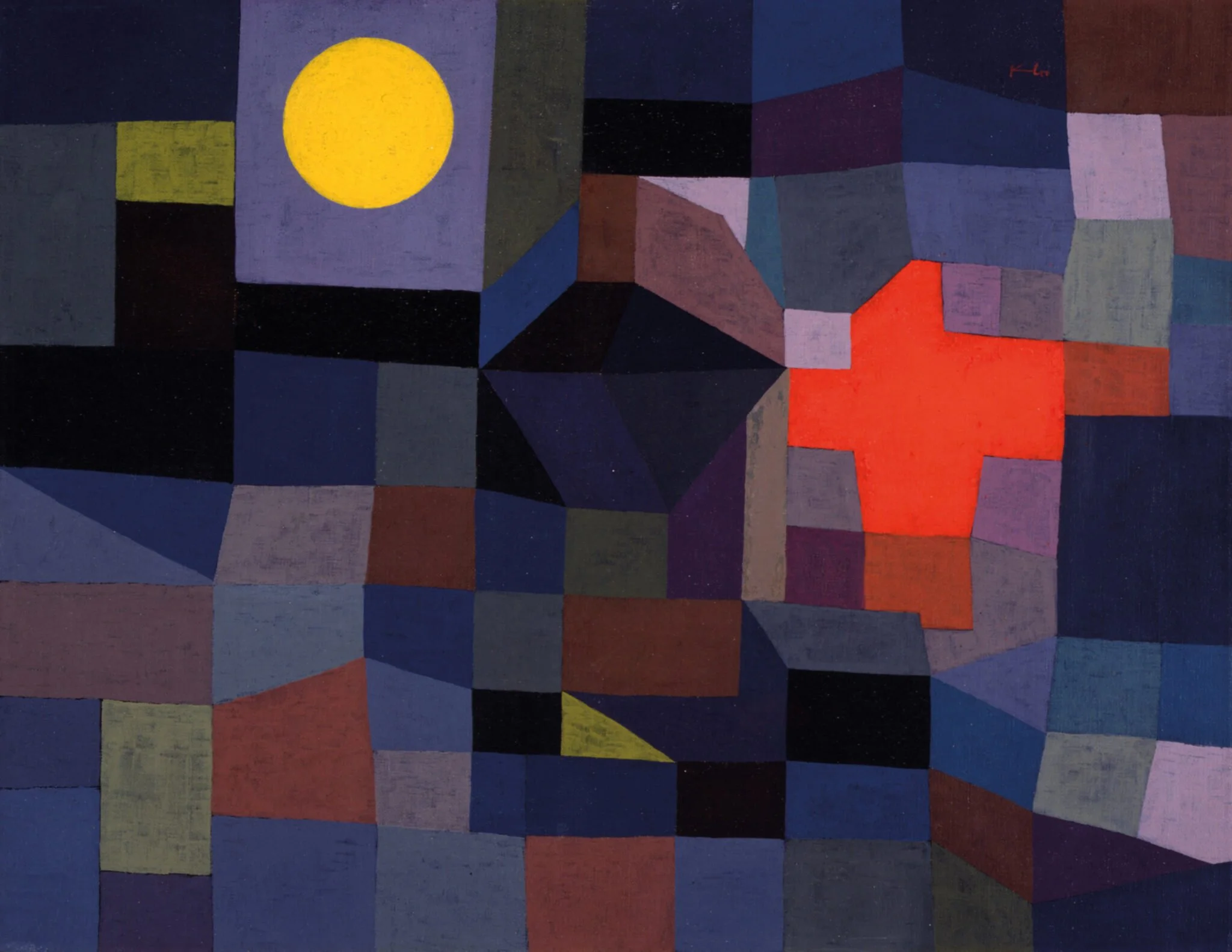
Paul Klee, Fire at Full Moon, 1933, Mixed media on canvas, Museum Folkwang, Essen. © 2026 Artists Rights Society (ARS), New York.

THE NEW CRITERION, May 2026

Escape artist

On “Paul Klee: Other Possible Worlds,” at the Jewish Museum, New York.

The Nazis wasted no time in denouncing the artist Paul Klee (1879–1940). On February 1, 1933, less than a month after Hilter’s ascendance, the periodical Die Rote Erde (The Red Earth) published a hit piece on the Düsseldorf Academy and its fifty-three-year-old instructor:

Then the great Klee makes his entrance, already famous as a teacher at the Bauhaus. . . . He tells everybody he has pedigree Arabian blood in his veins, but is actually a typical Galician Jew. He paints in a crazier and crazier way, he bluffs and baffles, his students goggle and gape, a new, unheard-of art makes its appearance in the Rhineland.

Born in Switzerland to a German father and Swiss mother, both musicians, Klee was not Jewish, Galician or otherwise. It made no difference. Within the year, Klee lost his academic post. The Gestapo raided his apartment in Dessau and seized six baskets of papers. Finally Klee was forced to relocate to Bern, the city of his birth. He lived out his final decade in Swiss exile.

Elusive, idiosyncratic, and wide-ranging, Klee’s work today might seem decorative and anodyne. Clement Greenberg was right to observe in 1957 that “almost everybody, whether aware or not, was learning from Klee.” The artist’s inventive and experimental mode, occupying a liminal space between depiction and description, became part of the post-war visual vocabulary. You can see his influence in artists from Jackson Pollock to Keith Haring.

The Nazis well understood his subversive encoding. Klee connected his art to child-like design, primitive symbolism, and parodic marginalia. He advocated for the sort of free-form line the Nazis looked to flatten. Identifying himself with the social outcast—at times the Harlequin, at others the Jew—Klee faced down the scourge of anti-Semitism by association. Occasionally he even made this association explicit. He deployed symbols such as the Star of David in his compositions. More than a decade before his persecution by the Nazis, as the artist went up for a professorship at the Academy of Fine Arts, Stuttgart, in October 1919, the press denounced him as “Paul Zion Klee.”

This history helps explain why the Swiss German artist now appears in “Other Possible Worlds,” a major retrospective at the Jewish Museum of a hundred works that focuses on Klee’s final decade.1 “He was not Jewish,” writes Mason Klein, the museum’s senior curator emeritus and the organizer of this exhibition, “but he might as well have been, given his particular denunciation by the National Socialists in 1933 in Germany.”
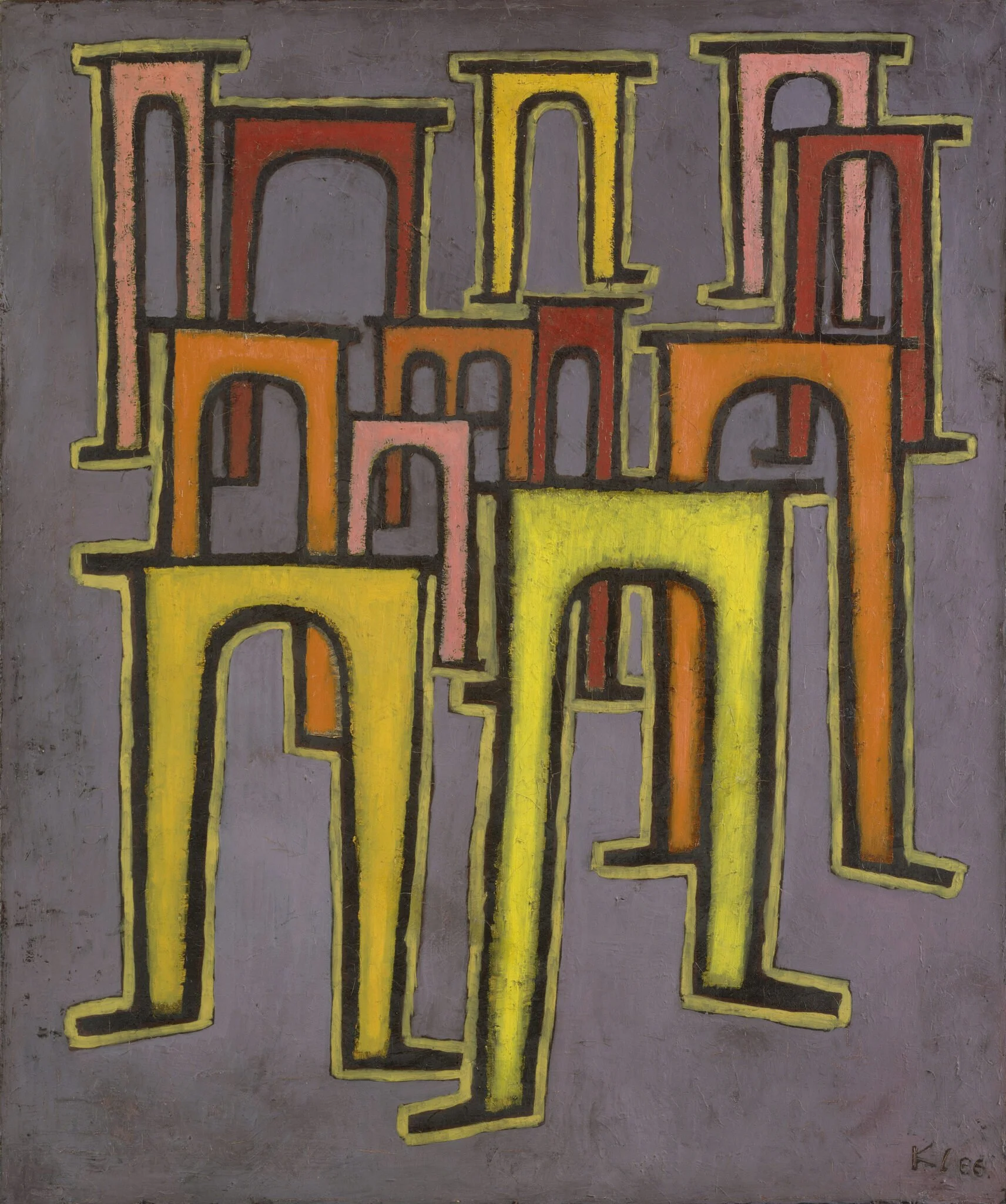
Paul Klee, Revolution of the Viaduct, 1937, Oil on cotton, Hamburger Kunsthalle. © 2026 Artists Rights Society (ARS), New York.

At the center of this presentation, and an impetus for the exhibition, is a selection of drawings from a rarely seen cycle of some two hundred works that Klee produced in 1933—a furious assembly created in response to what he called the “Nazi Socialist revolution.” Lost for decades, the works on paper were only rediscovered in 1984 by the Klee cataloguer Jürgen Glaesemer at Bern’s Paul Klee Foundation. In 2003, the art historian Pamela Kort presented them for the first time through four exhibitions in Germany and Switzerland.

Composed in wild scribbles of pencil and chalk, these drawings are expressive and explicit. In title and substance they take dead aim at the false verities of the Nazi regime: “He” a Dictator Too! (Auch “ER” Dictator!) features a man pointing down at an exclamation point; Child Murder (Kindermord), an attack on a domestic scene; Crawling Man (Kriechender), a quivering figure on all fours; Accusation in the Street (Anklage auf der Straße), a man directing a crowd’s attention; and Violence (Gewalt), a laughing stick-figure who shoots scribbles into a screaming, crouching victim.

The drawings, here on loan from the Zentrum Paul Klee, Bern, are different from the reserved and finely wrought designs we might expect from an artist who otherwise spun his compositions like intricate spiderwebs. Klee showed the series over dinner in the summer of 1933 to the sculptor Alexander Zschokke and the art historian Walter Kaesbach, both Düsseldorf colleagues, and Zschokke later recalled he thought the cycle missed its mark:

The start of the cycle was a drawing with a few pencil strokes, not very straight, that looked like a child’s drawing, helpless. I must confess that this beginning . . . had a somewhat comic effect and appeared not to remotely match the seriousness of the situation in which the artist found himself.

At the Jewish Museum, with a selection of work extending as far back as 1903, “Other Possible Worlds” reveals how, in the 1933 cycle, Klee was revisiting his graphic origins in illustration and satire. A selection of etchings from his series Inventions (Inventionen), of 1903 and 1905, here on loan from New York’s Museum of Modern Art, hints at his admiration for the caricatures of William Hogarth and Honoré Daumier. Virgin in the Tree (Jungfrau im Baum) presents an aging female nude sprawled out across dead branches. The Hero with the Wing (Der Held mit dem Flügel) features a figure with broken wings and heavy feet rooted in the earth. Two Men Meet, Each Believing the Other to Be of Higher Rank (Zwei Männer, Einander in Höherer Stellung Vermutend, Begegnen Sich) depicts Wilhelm II and Franz Joseph groveling down to one another. An example from another series, this one an illustration from 1911 for a chapter of Candide, dispenses with the modeled, sculptural effects of these early prints in favor of a simpler, more scribbled style later echoed in the 1933 cycle. “Satire must not be a kind of superfluous ill will,” Klee once said, “but ill will from a higher point of view. Ridiculous man, divine God.”

Other Possible Worlds” lays out a wide sampling of Klee’s circuitous output. At times it feels too wide. The exhibition attempts to be both a focused display and a retrospective survey and never quite delivers enough of either. A through line is not always apparent in the offerings. The exhibition also gives short shrift to Klee’s many formal innovations as it pursues his symbolic meanings. Klee’s creative processes of monoprinting and oil transfers, for example, freed his line from the artist’s controlling hand as he avoided a grand manner in favor of rhythmic ramblings. Coming from a musical background, Klee created visual sonorities that could be contrapuntal—semiautonomous points and counterpoints. One abstract watercolor here, from 1922, is titled Overture (Ouvertüre) (1922, collection of Alexander Berggruen). By never quite connecting the dots, Klee took a “line for a walk,” as he famously called his compositional style.

There are, nevertheless, some peripatetic highlights here. One is Chosen Boy (Auserwählter Knabe) (1918, anonymous loan, courtesy of the Mount Holyoke College Art Museum), of a child surrounded by a halo of dreamlike geometrical forms. In its selection, the Jewish Museum has also sought out works with explicit Jewish references. Harlequin on the Bridge (Arlequin auf der Brücke) (1920, Museum Berggruen, Neue Nationalgalerie, Stiftung Preußischer Kulturbesitz, Berlin) is a symbolic self-portrait in which the artist-figure straddles a river beneath a Jewish star.
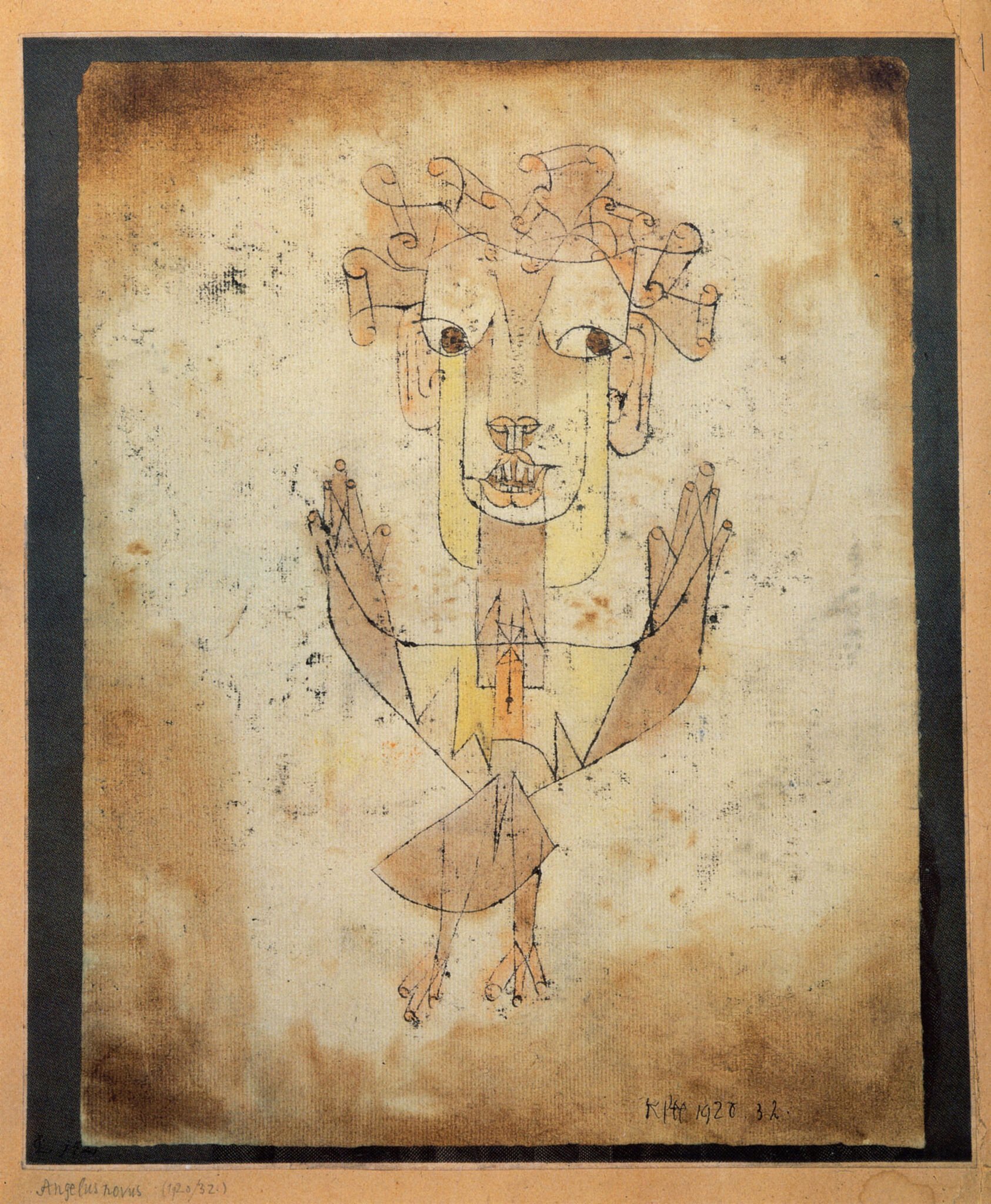
Paul Klee, Angelus Novus, 1920, Oil transfer & watercolor on paper, the Israel Museum, Jerusalem. © 2026 Artists Rights Society (ARS), New York.

Angelus Novus (1920), on loan from the Israel Museum, Jerusalem, is a mothlike apparition that has taken flight through its afterlife as something of a cultural icon. Purchased by Walter Benjamin in 1921, the work inspired the German Jewish philosopher of the Frankfurt School to call it the “Angel of History.” In his “Theses on the Philosophy of History” of 1940, Benjamin writes of this figure,

His face is turned toward the past. Where we perceive a chain of events, he sees one single catastrophe that keeps piling wreckage upon wreckage and hurls it in front of his feet. The angel would like to stay, awaken the dead, and make whole what has been smashed. But a storm is blowing from Paradise; it has got caught in his wings with such violence that the angel can no longer close them. The storm irresistibly propels him into the future to which his back is turned, while the pile of debris before him grows skyward. This storm is what we call progress.

Months after writing these lines, Benjamin was himself caught in the whirlwind. As he attempted to flee over the Pyrenees from Vichy France to Spain, he committed suicide after his arrest at Port Bo. Before his failed escape, Benjamin entrusted this drawing to Georges Bataille by hiding it in Paris’s Bibliothèque nationale, where Bataille was employed. When he was able to retrieve it, Bataille passed it to Theodor W. Adorno, who sent it on to Gershom Scholem in Jerusalem per Benjamin’s wishes.

As a postscript to these fraught iterations, the arrival of this work in New York for the current exhibition was delayed by Iran’s bombardment of Israel. At the time of the exhibition opening, the work could not travel to the airport for transport, at least to the satisfaction of its insurers. So it has been represented here at first by facsimile. What was meant to be the highlight loan of this exhibition took on additional meaning for the Jewish Museum and its director James S. Snyder—who, from 1997 through 2018, was the head of the Israel Museum.

Klee’s art aligned him at times with Dadaism, Expressionism, and Surrealism. Still, he was not an obvious adherent to any one group. “The Munich expressionists laid claim to him, the Zürich Dadaists hailed him, and to the French surrealists, he was a kindred spirit,” writes Klein.

In 1921, Klee joined the Bauhaus as an instructor. He taught there for ten years, following the school through its 1925 move from Weimar to Dessau. During his demonstration lectures, it is said he painted with his left hand while writing with his right. That same decade his art toured the United States along with work by Wassily Kandinsky, Lyonel Feininger, and Alexej von Jawlensky as part of Die Blaue Vier (The Blue Four). As moma’s Alfred Barr noted in 1930: “Nothing is so astonishing to the student of Klee as his infinite variety.”

By the early 1930s, Klee had left his Bauhaus post, was facing down Nazis, and had begun to show the degenerative effects of fatal scleroderma. In his work, his gossamer line became thicker and murkier. His output intensified and his symbolism became more explicit as he painted through the catastrophe. Mask: Red Jew (Maske Roter Jude) and Your Ancestor? (Dein Ayn?), both 1933 works on paper from private collections, leave little doubt as to the state of affairs. Revolution of the Viaduct (Revolution des Viadukts) (1937, Hamburger Kunsthalle), the painting that appears on the cover of the exhibition catalogue, turns Nazi marches into jackbooted abstractions. Meanwhile Struck from the List (Von der Liste Gestrichen) (1933, Zentrum Paul Klee, Bern), with a black X slashed across a face, becomes his latest self-portrait as Klee dedicated himself to “serve Beauty by drawing her enemies.”

Still, he found time to take flight. A series of angels, from 1939 and 1940, make up the final series in the exhibition—here, transformed into the avenging angels of war.

  1. “Paul Klee: Other Possible Worlds” opened at the Jewish Museum, New York, on March 20 and remains on view through July 26, 2026. 
In Art, James's Publications, New York Tags Paul Klee, Jewish Museum, The New Criterion
Comment

The Spirit of ’76

February 17, 2026 James Panero

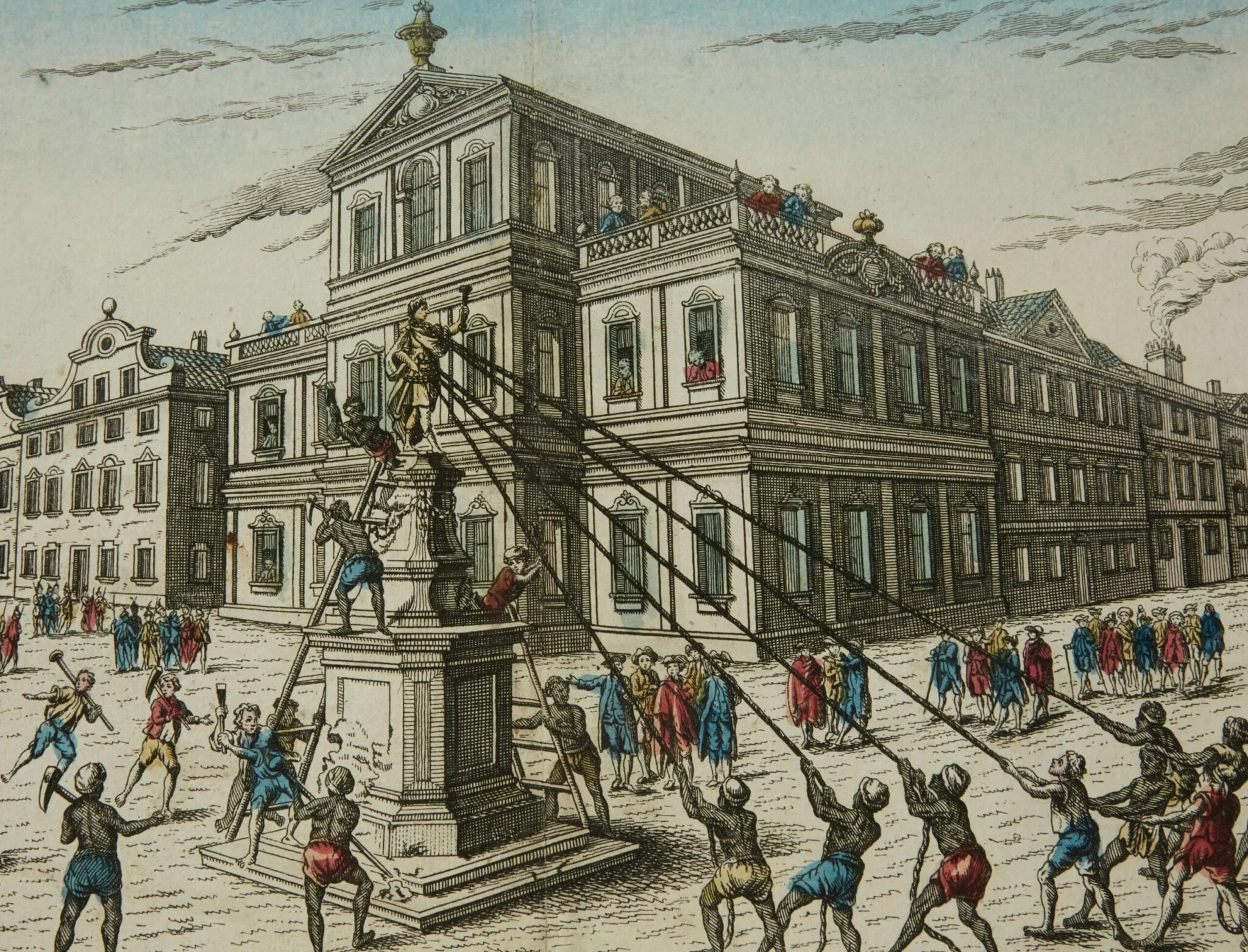
La Destruction de la Statue Royale a Nouvelle Yorck, 1776, Hand-colored etching. Photo: Vincent Dilio, courtesy of David M. Rubenstein.

THE NEW CRITERION, February 2026

The spirit of ’76

On “Declaring the Revolution: America’s Printed Path to Independence,” at the New-York Historical Society.

The nation’s semiquincentennial will provide many opportunities to revisit America’s founding. A small but enthralling show now at the New-York Historical Society deserves to be a foundational first stop. “Declaring the Revolution: America’s Printed Path to Independence” draws on the extraordinary collection of the philanthropist David M. Rubenstein.1 It tells the story of American independence through sixty documents that forged national resolve in a concise and compelling presentation. Curated by Mazy Boroujerdi, with detailed labels and a well-conceived arrangement of material, the one-room exhibition lays out the path to war and reveals the long road to American independence through the primary documents that took us there step by step. (A side note: now doing business as merely “The New York Historical,” the 222-year-old society is one of several institutions sadly struck with brand aphasia.)

“The tree of liberty must be refreshed from time to time with the blood of patriots and tyrants,” wrote Thomas Jefferson. So too must we refresh our understanding of these revolutionary materials. Take the Declaration of Independence. A well-recognized copy serves as the center of the historical society’s display. It may come as some surprise that the edition we most associate with this primary object of civic veneration was not created on July 4 or even in 1776 but in 1823, as this example attests.

The original Declaration, drafted by Thomas Jefferson with additions from a committee of the Second Continental Congress that included John Adams and Benjamin Franklin, was composed in manuscript. Their language built on the brief statement of the Lee Resolution, approved on July 2, 1776, which resolved that the colonies were “free and independent States.” July 2 might just as well be America’s independence day, but it was the July 4 adoption of the full and finely wrought Declaration that gives us our anniversary date.

On July 5, the congress rushed this manuscript to the nearby print shop of John Dunlap to produce between a hundred and two hundred broadsides for distribution across the colonies and soon around the world. Four days later, after receiving a copy by mail from John Hancock, George Washington had one of these broadsides read aloud to his brigades assembled on the commons in lower Manhattan. Following this 6 p.m. announcement, a mob tore down the statue of George III in Bowling Green, an action Washington lamented for its riotous “want of order” (the statue’s lead was recast into musket balls for the Patriot cause).

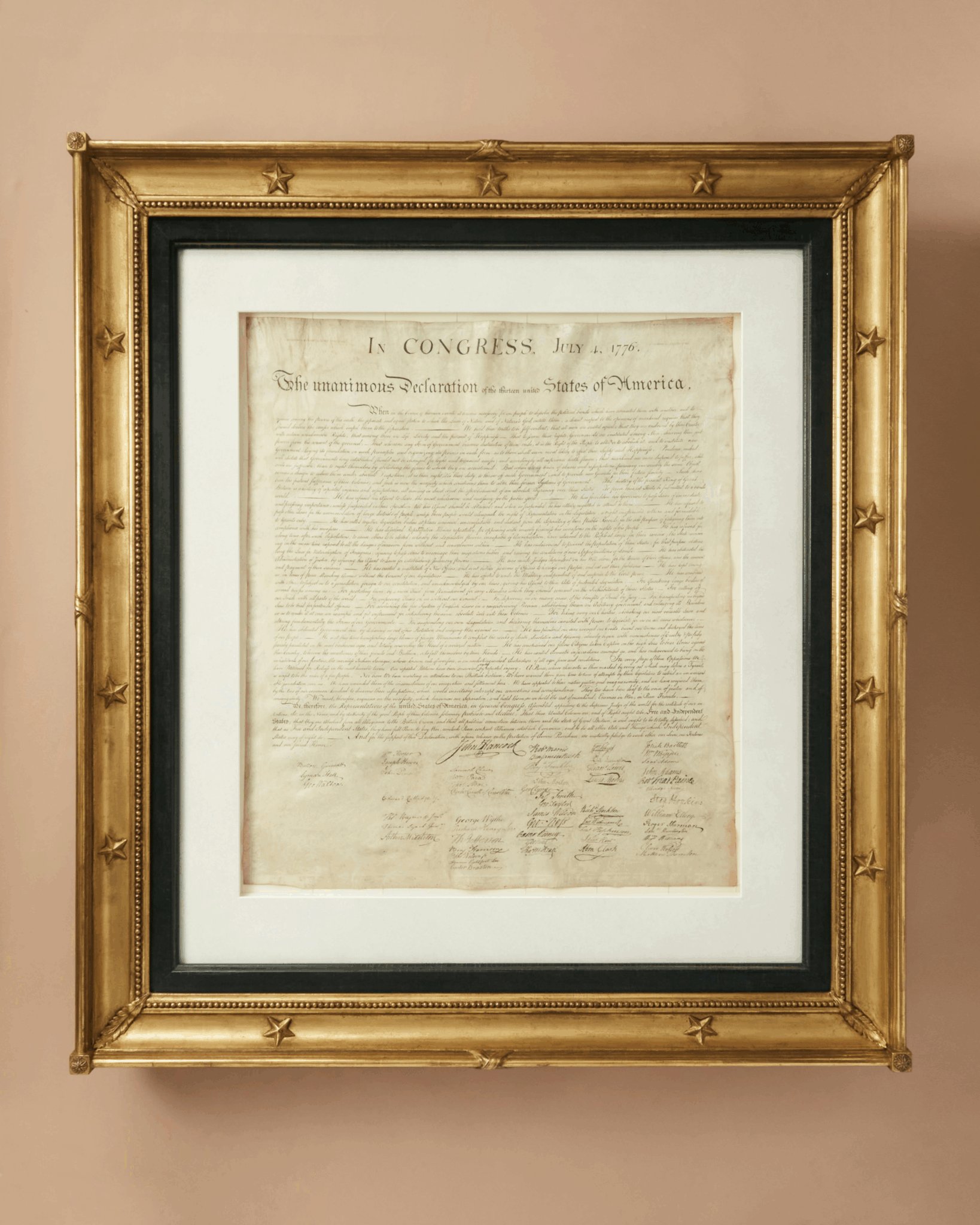
The Declaration of Independence, 1823, Engrossed print copy. Photo: Vincent Dilio, courtesy of David M. Rubenstein.

Dunlap’s poster-sized broadsides are the earliest extant records of the Declaration. The original manuscript was lost during typesetting. On August 2, the Continental Congress memorialized its adoption by commissioning an engrossed, or handwritten and enlarged, version on vellum, most likely from the pen of Timothy Matlack. This is the edition that famously received John Hancock’s John Hancock, along with the signatures of the other delegates present. Since the New York Provincial Congress officially adopted the Declaration only in the interim on July 9, the opening lines were updated from a “declaration by the representation of the United States of America in general congress,” as the broadside reads, to “the unanimous declaration of the thirteen United States of America.”

The engrossed Declaration is the one now on display in a titanium case filled with argon gas at the National Archives Museum in Washington, D.C. Yet it too most likely is not the edition we most closely associate with this document. That’s because, even less than fifty years after its creation, the condition of the engrossed Declaration had already deteriorated. In 1820, John Quincy Adams, then the secretary of state, commissioned a set of two hundred official copies of the engrossed Declaration from the Washington engraver William J. Stone. Working with the document for three years, through a system of mirrors and tracing, and perhaps the lifting of some ink from the original document, Stone created a copperplate negative of the engrossed Declaration, including its fifty-six signatures. As with the original, he printed these facsimiles on vellum.

The Stone facsimile, a faithful print of the engrossed Declaration with wording that was once again legible, was distributed to federal and state repositories and the living members of the founding generation. Thomas Jefferson, John Adams, Charles Carroll of Carrollton, James Monroe, James Madison, and the Marquis de Lafayette each received two copies.

Today fewer than fifty known copies remain of Stone’s 1823 printing. Yet this is the version now most regularly reproduced since it reads closer to the original Declaration than the faded document bathed in inert gas in Washington. David M. Rubinstein, the cofounder of the Carlyle Group, the private equity firm, has collected the few Stone facsimiles in private hands and dedicated them to public display alongside his collection of other key American documents. We may never be closer to the Declaration than with his copy now on loan and available for detailed examination.

“Declaring the Revolution” makes a compelling case for the cause of American independence as a continuation of English rights and liberties. As represented by the other documents on display, the Declaration comes at the fulcrum of a two-decade-long conflict as history’s least revolutionary document of revolution. “Prudence,” it reads, “indeed, will dictate that Governments long established should not be changed for light and transient causes.” Beyond its idealistic opening, the Declaration is mainly a legalistic enumeration of grievances, of a “long train of abuses and usurpations” with “repeated injuries” leading to a reluctant resolution grounded in law and custom. The great irony of American independence, and its greatest salvation, was its conservative assertion of English rights against an un-English monarch:

In every stage of these Oppressions We have Petitioned for Redress in the most humble terms: Our repeated Petitions have been answered only by repeated injury. A Prince whose character is thus marked by every act which may define a Tyrant, is unfit to be the ruler of a free people.

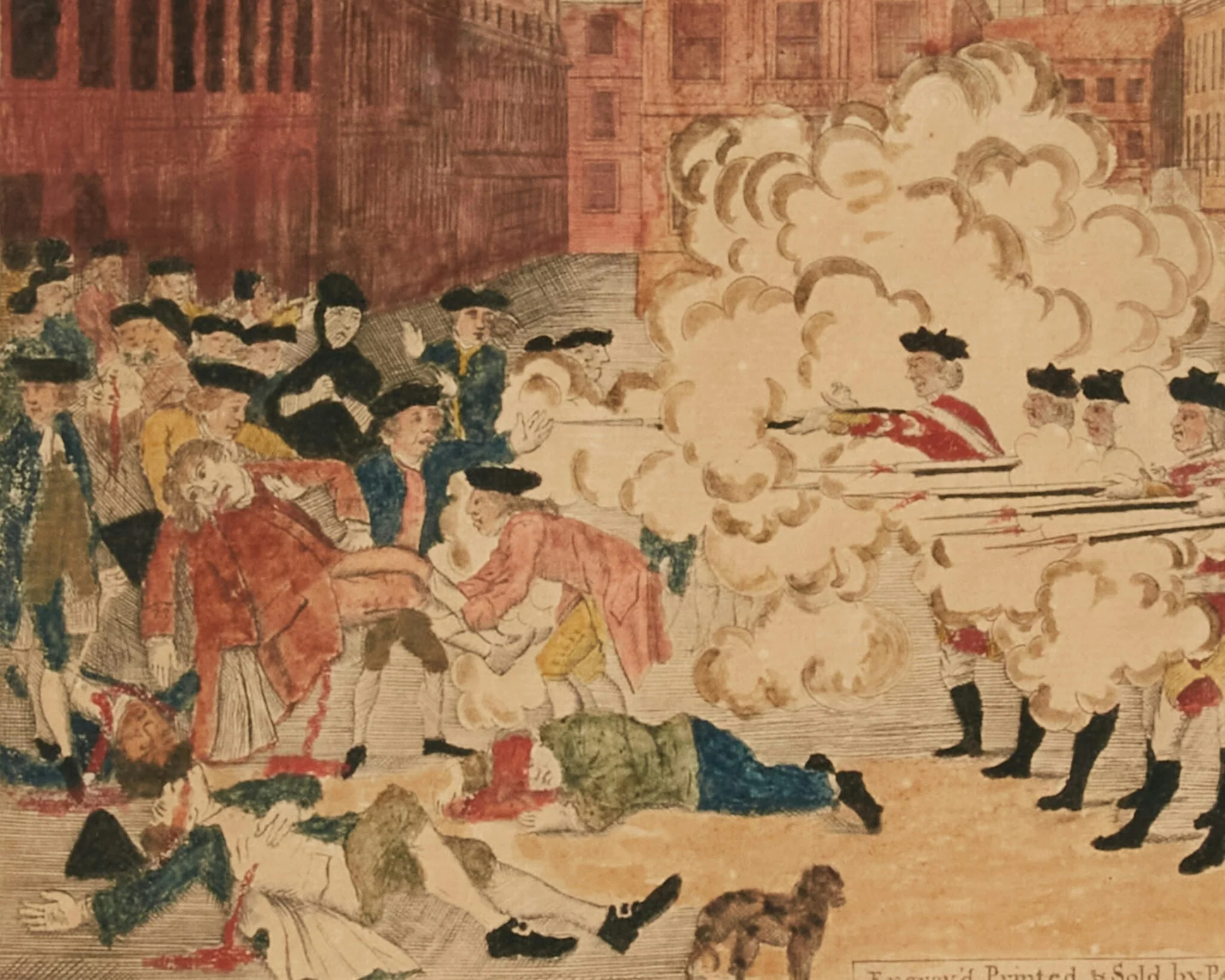
Paul Revere, The Bloody Massacre perpetrated in King Street, Boston, on March 5th, 1770, Hand-colored engraving. Photo: Vincent Dilio, courtesy of David M. Rubenstein. 

At the historical society, flanking the Stone facsimile to the left, is an edition of the Declaration of arguably even greater rarity and import. This is the version printed by the Pennsylvania Evening Post on July 6. It was the Declaration’s first truly public appearance, typeset from the broadside of a day before and available for “only two Coppers.” (Rubenstein purchased his copy at auction in 2013 for $632,500, the highest price then paid for a historical newspaper.) Immediately to the right of the Stone facsimile, the inclusion of a 1773 Slave Petition for Freedom feels forced. The document nevertheless serves to reveal the emancipatory impulse already in circulation at the time of revolution. “The divine spirit of freedom, seems to fire every human breast on this continent,” it asserts. The state of Massachusetts, where this petition was issued, abolished slavery seven years later.

In a center vitrine, in line of sight with the Declaration, are the documents and books that informed its ideals. Included here are copies of John Locke’s Second Treatise on Government, in an American printing from 1773. First published in 1689, this treatise arguing for the natural rights of “life, liberty and property” gained renewed attention in the revolutionary era. So too did Thomas Hobbes’s Leviathan, here in a copy from 1651, laying the case for the social contract between government and the governed.

Fronting this display is Magna Carta, represented by an eighteenth-century engraved facsimile of the 1215 document preserved at the British Library. (It is noteworthy that the only thirteenth-century version of this document in the United States is currently at the National Archives Museum—there on long-term loan from David M. Rubenstein).

As with the liberal arguments that surrounded Magna Carta and later the issuance of the English Bill of Rights, here in a 1689 first edition, the colonists saw their cause as grounded in English law. Their struggle for redress, at first, came about as forms of isolated resistance and then as a united colonial civil war. At the historical society, this story begins to the left with a copy of the 1765 Stamp Act. The much-maligned taxation scheme, designed to underwrite the British military presence along the colonies’ extensive frontiers following the French and Indian War, was met with compelling counterarguments from several American voices. Benjamin Franklin’s testimony against it in the House of Commons in 1766 is here represented in a printed account of his four-hour-long examination. “No, never” would the colonists pay the duty “unless compelled by force of arms,” he declared. While that act was repealed, new British taxes led to civic disturbances culminating in the Boston Massacre of 1770, made all the more bloody in the colonial mind by Paul Revere’s contemporaneous engraving. As Massachusetts became a center of colonial insurgency to British military occupation, the first shot of Lexington and Concord in 1775, “heard round the world” (in Ralph Waldo Emerson’s famous phase of 1837), brought the conflict into open rebellion.

A hallway wall, just around the corner from the main gallery and easy to miss, includes documents related to the prosecution of the Revolutionary War divided between its northern and southern theaters. The path to American independence was paved by more than just the writings of history’s most motivated lawyers. It involved nearly a decade of armed conflict and more losses than wins for the American side. These displays lay out the accounts, records, and maps of the campaigns while also revealing the rising international interest in American independence. Traité d’Amitié et de Commerce, Conclu entre le Roi et les États-Unis de l’Amérique Septentrionale, reads a vital 1778 treaty of French support for the revolution. Le Général Washington Ne Quid Detrimenti capiat Res publica is the title of a French print from circa 1780.

“Declaring the Revolution” reveals the indomitable spirit of ’76 that buoyed the Patriot cause to force the surrender of Charles Cornwallis, the commander of British southern forces, at Yorktown on October 19, 1781, and brought about the Definitive Treaty between Great Britain, and the United States of America, Signed at Paris, the 3rd Day of September 1783. The astonishing victory continues to inspire the spirit of liberty and recalls the debt of sacrifice made in the name of freedom.

  1. “Declaring the Revolution: America’s Printed Path to Independence” opened at the New-York Historical Society on November 14, 2025, and remains on view through April 12, 2026. ↩

In James's Publications, New York, Upper West Side, History Tags New York Historical Society, American Revolution, US250, the new criterion, The New Criterion
Comment

Finding Common Ground

February 15, 2017 James Panero

Joseph Hogan of the Hauenstein Center  interviews me over two days for his fascinating and ecumenical podcast, Common Ground. 

In In the Press, Magazines, Art, Books, Current Affairs Tags The New Criterion, podcast
Comment

POWERED BY SQUARESPACE