Gallery Chronicle (May 2010)

Zucker
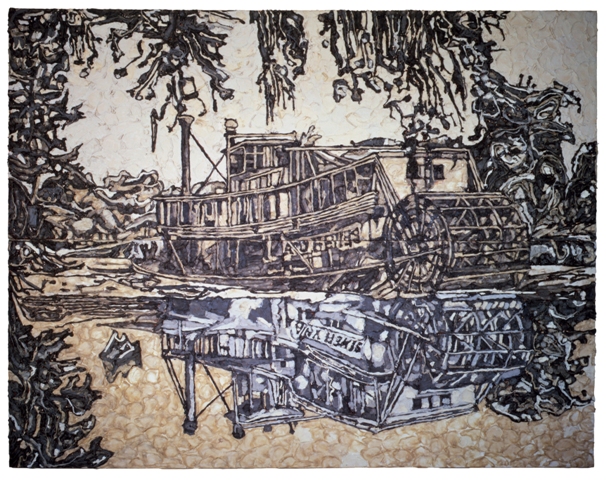
Joe Zucker Amy Hewes (1976), copyright: Joe Zucker, courtesy Mary Boone Gallery.

THE NEW CRTIERION
May 2010

Gallery chronicle
by James Panero

On “Joe Zucker” at Mary Boone Gallery, “Bruce Gagnier: Incarnate” at Lori Bookstein Fine Art & “Shirley Jaffe: Selected Paintings, 1969–2009” at Tibor de Nagy Gallery, “Lois Dodd: Second Street Paintings” at Alexandre Gallery & “Deborah Brown: The Bushwick Paintings” at Storefront, Brooklyn.

Joe Zucker was born in 1941 to a Jewish family on Chicago’s South Side, at a time when the Irish and Italian gangs of the area sparred over territories embroiled in black migration and white flight. He got out through varsity basketball and found a moment of jock glory on the squad at Miami University in Ohio. Yet Zucker also happened to be blessed with one of the more interesting minds in American art. This complicated his athletic career and his artistic one as well. Zucker has long been out of step with the dullness that has come to dominate contemporary artistic production.

In 1961, Zucker gave up playing basketball and returned to Chicago to enroll at the Art Institute, where he had been drawing in his spare time since the age of five. His teachers were thinking Braque and the School of Paris. Zucker was more interested in potboilers and the narrative art of Thomas Hart Benton. He passed through the Institute’s bachelor’s and master’s programs, and followed this up with a teaching stint in Minnesota. He arrived in New York in 1968, one of modern art’s more fruitful moments, when the avant-garde had just passed through the rabbit hole of minimalism and was beginning to re-embrace the craft and process of painting.

At the time, modernism’s recursive instinct seems to have reached its end-game. Minimalist art and sculpture had folded form back on itself to an infinite and emptying degree. Like other artists of his generation, Zucker used minimalist logic to structure his artistic practice, but he sought to expand this logic to maximal effect.

“You can be tempted into reducing and reducing to the point of emptiness, simply repeating terms dictated by the perimeter of the paint,” Zucker noted in an interview. “I wanted to breach the perimeter and get into the very substance of the painting. I saw that as a way of evading the self-defeating outcome implicit in the reductive logic of modernism.” By infusing his work with narrative and humor, Zucker charted out a singular artistic path.

From his graduate-school days, the subject of the painter’s canvas has been one of Zucker’s recurring interests. It was the material of oil, after all, that received the lion’s share of attention by the Abstract Expressionists. Taking a cue from the revival in weaving and craft-based art, Zucker turned this relationship around and moved the canvas to the foreground, from surface to subject matter. An early series of Zucker’s work consists of abstract weavings of colored strips, recalling the warp and weft of a painting’s canvas.

In the 1970s, Zucker developed work based on the “history of cotton,” which he first showed at New York’s Bykert Gallery, run by Klaus Kertess and Jeff Byers. A one-time assistant from the Bykert Gallery has now brought five of these large works back together for an important show. The fact that this assistant has become the mega-dealer Mary Boone may indicate her turn from the over-hyped painters of the 1980s to overlooked artists like Zucker, who came of age a decade before.[1]

Or maybe Boone is now turning to Zucker because this work from the 1970s appears to be the most politically charged of his career, and somehow relevant and palatable. On their face, these large canvases depict various sepia-toned scenes of the antebellum South: a paddle boat in Amy Hewes (1976); slaves and an overseer in Brick-Top, The Field Hand, and Lucretia Borgia (1976); bales of cotton stacked and hauled in Reconstruction (1976) and Paying Off Old Debts (1975); and the neoclassical facade of Old Cabell Hall in University of Virginia Law School (1976). Yet the layers of representation in Zucker’s cotton constructions complicate this single reading.

Zucker built his paintings through a self-invented process where craft, image, and logic came together in one worked-out puzzle. After dipping cotton in pigmented Rhoplex, a thick acrylic binder, Zucker applied the balls to canvas. The effect recalls pointillist brushstrokes frozen in high relief. By forming an image of its agricultural origin, the painting’s canvas becomes both medium and content, a work depicting its own history of production as much as the American past.

Just as minimalist logic can be air tight, even airless, Zucker’s systems risk closing up through their own hermetic seals. Zucker’s more recent work has consisted of drawings of container ships and pirates, constructed in various ways from rolls of canvas and paper, some illustrated, some literal, and all in need of unpacking. Zucker’s history of modernism has become Roger Fry by way of the Jolly Roger—a picture plane shot through with cannon balls.

The 1970s series stays more accessible by tapping into a main current of the evocative American narrative, when cotton was king. The rigor of Zucker’s flights of logic can still astonish. The craft that went into these works is remarkable to behold. Boone has done us a service by bringing together these history paintings that are a part of history, at a time when museums remain oblivious to the most important paintings of the living past.

Since Elie Nadelman first rubbed down the surface of his vernacular sculptures, modern artists have understood how the quality of an object changes through handling and care. Nicholas Carone has long been carving sculptures that resemble classical fragments, ones that could have spent some time at the bottom of Lago Maggiore. Such works have a sense of their own history sculpted right into them. The sculptures of Bruce Gagnier, whose art was recently on view at Lori Bookstein, show a similar physiognomy of neglect, maybe this time of self-neglect.

Some of Gagnier’s statues, like Seaman (the drowned sculpture) (2009), seem to have attracted barnacles while ingesting some brine. With mottled, raisin-like skin and distended bellies, other figures appear almost pickled, tipsy, as though their more uninhibited selves are showing through their classical skins. Gagnier molds each of his figures in hydrocal, a plaster-like medium, then applies a finish of pigment and wax. The unique surface treatment leaves the work with a worn, marble-like sheen.

Granted, these sculptures can be more than a little creepy. I am not sure I would want to share a studio apartment with one of the life-sized works—but I wouldn’t mind a visit. Odd figures have tales to tell.

The painter Shirley Jaffe is eighty-six-years young and has been a fixture in Paris for over half a century, yet the work of this native New Yorker can still be new to the American public. So much the better for us, as we get to discover her again and again. Following its exhibit at The Art Show earlier this year, Tibor de Nagy last month launched its third exhibition of Jaffe’s work with a survey from the last thirty years.[2]

Jaffe has led a career in reverse. The oldest work in the show, the hard-edged arrangement of The Gray Center (1969), is a mature construction of color planes and gentle surfaces. Jaffe’s more recent work, by contrast, shouts youthful indiscretion. In Hop and Skip (1987), Jaffe tossed those earlier, mature color planes sky-high and captured them mid-flight. Hard-edged confetti now spirals and twists against a white background.

The more the paintings open up, the more energy Jaffe manages to contain in them, even when hints of bricks and roofline pop through, as in the “New York Collage” series of 2009. The result, a mix of hard-edged color theory and expressionist line, has a comic boldness that seems both of the moment and for the ages, fresh and timeless.

For the past several years, Alexandre Gallery has been regularly showing Lois Dodd’s gem-like scenes of Maine, often oil on masonite measuring at most two feet square. This past month, Alexandre brought together a selection of Dodd’s older work matched with two recent cityscapes of the same scene painting over forty-years on.[3]

When Dodd first painted the city view from her studio window in the 1960s, she brought a hard-edged sensibility for structure and line to the urban scene. The highlight of this period on view at Alexandre was Men’s Shelter, April (1968). In this large oil on canvas, an ordinary back window opens to a geometry of rooflines, colors, and shadows, which come together like an abstract jigsaw puzzle. Planes of color edge up against each other and seem to pulsate from their edges.

Over several images, Dodd depicted the same scene at different times of day and different seasons. In another series from the same period, she captured the garden view from her apartment in April, October, and a foggy day in February.

When Dodd returned to this same “Second Street” view from her window many years later, she brought her growing lyrical sensibility. In the two works from 2009, hard edges gives way to color and fullness, as though the urban landscape has entered full bloom.

I wrote about the painter Deborah Brown three months ago in my survey of Bushwick and its new Storefront gallery. Brown’s urban skyscape was the show-stopper of this gallery’s inaugural group exhibition. Now a solo show of her recent work is on view in this vital little space.

Unlike many of her Bushwick colleagues, Brown arrived in this neighborhood as an established mid-career artist, but she quickly tapped into the community’s youthful, shared experience. Her lush representational work, which regularly shows at Lesley Heller Gallery in Manhattan, has often depicts flora and fauna. In Bushwick, Brown found an urban contrast in industrial ruin and natural growth.

In “The Bushwick Paintings,” her latest series, an accretion of vines and wires, flowers and fences vies against a background of factory towers and enveloping skies. The images glow through scrims of pigment, which bathe the atmosphere in vibrant reds and greens. Brown finds renewal out of the blight of a ruined landscape. Her vision, which comes out of Romantic sensibility, reflects the spirit of this rough landscape and the artists who now share it.

Notes
Go to the top of the document.

  1. “Joe Zucker” was on view at Mary Boone Gallery, New York, from March 25 through May 1, 2010. Go back to the text.
  2. “Bruce Gagnier: Incarnate” was on view at Lori Bookstein Fine Art, New York, from March 31 through May 1, 2010. Go back to the text.
  3. “Shirley Jaffe: Selected Paintings, 1969–2009” was on view at Tibor de Nagy Gallery, New York, from March 11 through April 24, 2010. Go back to the text.
  4. “Lois Dodd: Second Street Paintings” was on view at Alexandre Gallery, New York, from March 31 through May 1, 2010. Go back to the text.
  5. “Deborah Brown: The Bushwick Paintings” opened at Storefront, Brooklyn, on April 2 and remains on view through May 16, 2010. Go back to the text.

Realist Revolution

DSC_0057
Alexey Steele on stage with James Panero

James writes:

Last Friday I appeared on a panel at the Portrait Society of America's annual conference. The topic was "Realist Revolution and Critical Relevance: Is Main Stream Media Missing an Important Cultural Trend?" My co-panelists were the painters Jacob Collins and Alexey Steele, and the museum director Vern Swanson. The panel was moderated by the painter Jeremy Lipking. The quick answer to the panel's title question is certainly, yes. But has a lack of attention hurt this movement in reviving academic training and classical concerns? Not necessarily. Rather, the loss has gone the other way: the media's ignorance and silence has only ensured that the establishment art world and mainsteam culture miss out on a vital artistic movement.

We at The New Criterion have been laboring to right this wrong for several years through coverage of realism's more important artists. At the panel I revisited the forces that have kept realism from greater public attention: an aesthetic political correctness that has associated realism, at various times, with both fascism and communism, and the emergence of Pop and its market champions that have elevated bad technique over good.

Last December I discussed the market phenomena of Pop in these pages. As a service to our readers, I also want to draw together the various articles and reviews on realism that have recently appeared here.

My initial coverage began with Jacob Collins and the launch of a new classical school, in an article called "The New Old School." My colleague Roger Kimball also wrote on the subject for the Wall Street Journal and here on the Harlem Studio.

Other articles and reviews have concerned the painter Edward Minoff, realism and landscape, the Hudson River School for Landscape, Rear-gardism, and the sculptor Sabin Howard. You can also read my interview with Jacob Collins and listen to the subject on NPR's All Things Considered.

The panel was videotaped, so hopefully the complete discussion will be available for online streaming soon. Alexey Steele's experience in the politically directed art world of Soviet Russia was particularly engaging. Stay tuned.

Gallery Chronicle (April 2010)

Ph_as01
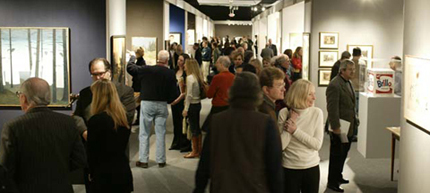
The Art Show. Photo by Holger Thoss, courtesy of ADAA

THE NEW CRITERION
APRIL 2010

Gallery Chronicle
by James Panero

On The Armory Show at the Chelsea Piers, ADAA’s Art Show & the Winter Antiques Show at the Park Avenue Armory, “William Bailey: New Work” at the Betty Cuningham Gallery & “Milton Avery: Industrial Revelations” at Knoedler & Company.

Has the art world forgotten the recession? The contemporary art fair known as The Armory Show, which took place inside two terminals on the Hudson River piers in March, certainly tried to ward off the onset of sobriety.[1] Rather than downsize, Armory went even bigger this year. The vibe was very 2007, when the art world’s money-crazed carnival was still in full swing. Nearly 300 international galleries set up shop in this warren of exhibition space. A record 60,000 visitors showed up for the five-day run. The artist Reed Seifer attempted to capture the zeitgeist with a two-ounce perfume called “Spray to Forget,” which was for sale for $25 just outside the “VIP Lounge.” Concealing current troubles with a pleasing body spray, the fair sought to remind us of the art world’s former self-intoxication and self- regard. You may have had a bad year, but, rest assured, you could still be a VIP here, along with thousands of other very important people flashing their own all-access cards.

Why should we want to jump-start the art market by embracing the tackiest commercial practices of the past? Are we concerned that new art cannot last without artificial stimulation? Art could benefit from a period of retrenchment; art that thrives in the wilderness can be the most enduring. I wish the twelve-year-old Armory Show would revisit its more humble roots, when exhibitors first rented rooms in the old Gramercy Park Hotel. Instead, it has become an unruly bazaar, dividing its extensive goods between contemporary art in the cavernous hanger of Pier 94 and modern art inside the long Pier 92—an afterthought of exhibition space that seemed decidedly less impressive than even a year ago, when this extension of the fair began.

The Armory Show has come to anchor an art extravaganza that spans the city, from a constellation of fairs to star-studded museum openings like the Whitney Biennial and an exhibition at The New Museum curated by Jeff Koons. At the same time, in a very different way, the Art Dealers Association of America hosts its own art fair known as “The Art Show” at the Park Avenue Armory. In previous years I have commented on these competing powerhouses. Both the ADAA Art Show and The Armory Show are commercial “art fairs”—ticketed conventions where galleries rent exhibition booths. Yet one manages to emphasize art (ADAA) while the other (Armory) puts a spotlight on spectacle.

Art fairs serve the purposes of art only when they seek to develop new collectors rather than make quick sales. Unlike the vast expanse of the piers, the limited acreage provided by the Park Avenue Armory—aided perhaps by the venue’s patrician environs—seems to focus the numerous fairs that rent space there each year, from the IFPDA Print Fair in November to the AIPAD Photography Show in late March.

In addition to the change in venue, what distinguishes The Art Show at the Park Avenue Armory from The Armory Show at the piers is The Art Show’s selection of exhibitors.[2] The Art Dealers Association of America, the sponsor of The Art Show, is an invitation-only member organization of America’s leading commercial galleries. Membership in this 170-gallery organization already guarantees a level of seriousness. Of these galleries, only seventy or so make the Art Show’s cut each year. Securing an exhibition space here is competitive. The result is a fair that brings together the best American galleries under one roof, each presenting excellent mini-exhibitions.

If The Armory Show is about horse-trading and blockbuster openings, the more collegial Art Show is about building relationships. The galleries are on display as much as the art on their walls. The best exhibitors at ADAA assemble focused shows, either around formal themes or single artists.

This year June Kelly presented “The Primacy of Color” with a show-stopping new abstraction by James Little. Hans Kraus was back, this time with nineteenth-century photographs of open landscapes. The solo shows ranged from Shirley Jaffe (Tibor de Nagy) to April Gornik (Danese), Jacob Lawrence (DC Moore), William Kentridge (Marian Goodman), Martin Kippenberger (David Nolan), and Alighiero e Boetti (Sperone Westwater). Galerie St. Etienne featured an exhibition of nude drawings by Gustav Klimt and Egon Schiele, where the confidence of Schiele’s late line (from the 1910s) still astonishes.

The Art Show wasn’t the first excellent fair at the Park Avenue Armory in 2010. That distinction belongs to the Winter Antiques Show, which ran for more than a week in late January.[3] This fair only gets better as it expands its range year by year. The Winter Antiques Show has long offered everything from antiquarian books (Bauman) to arms and armor (Peter Finer), American folk art (Giampietro), master portraits (this year, Rembrandt Peale’s George Washington at Hirschl & Adler), and Indian art of the Pacific Northwest (Donald Ellis).

By not limiting the work to just paintings or prints, the fair allows its vendors to turn their booths into complete domestic spaces, filled with furniture and decorative objects. The best exhibitors create full dioramas of their pieces in private settings. Hostler Burrows, which specializes in Scandinavian furniture and houseware, decorated its booth with wallpaper by the mid-century Swedish designer Josef Frank. Hans Kraus Fine Photographs put together a museum-quality show of the photographs of William Henry Fox Talbot that included a replica of the oriel window at Talbot’s Wiltshire home, Lacock Abbey—the subject of one of Talbot’s first photographs from 1835—as well as a handful of haunting photographic etchings.

This year the fair wisely advanced its cut-off date to include collectible work made through the late 1960s. The move allowed the first-time exhibitor Lost City Arts to display a remarkable selection of hand-made metal sculpture by Harry Bertoia, including a few of his “sonambient” sculptural instruments.

Whether by luck or by design, many galleries around the city seem to schedule their more important shows around the March run of the fairs. Woodward Gallery mounted a shimmering survey of recent abstractions by Natalie Edgar, an artist who once studied with Mark Rothko and Ad Reinhardt. Lesley Heller Workspace brought some of Austin Thomas’s Bushwick artists to the Lower East Side. The ambitious large paintings of Noah Landfield and Sara Klar went up at Sideshow Gallery.

Betty Cuningham Gallery featured its third exhibition of nudes and still lifes by the painter William Bailey.[4] This artist’s limited subject matter and reserved paint handling have often been seen as conservative challenges to the orthodox radicalism of modern art. The meaning of Bailey’s work as it relates to the history of art has been a subject of debate since his painting first appeared on the cover of Newsweek in the early 1980s. At the time Bailey was hailed as one of the new artists “of the real.” For me, such discussions have limited utility. They may give Bailey an aura of relevance, but they do little to explain the mysterious power of his work.

Like Giorgio Morandi, another great modern realist, Bailey imbues quiet paintings with intense energy. The latest Cuningham show, with its equal pairing of still lifes and nudes, pointed me to the sensuous sources of Bailey’s dynamics. Bailey’s work is so surprising, so novel, when compared to the canon of modern art because its fecundity shows no limit or irony. The egg shape that appears repeatedly in his still lifes and reappears in his nudes and figurative work, for example as the door knob in House by the Sea (2009), comes across as a central motif. The egg recalls the curved vessels of his still lifes and the rounded faces of his figures. One could even say the motif appears again in the egg-shell finish Bailey meticulously applies to every square inch of his canvas.

As a teacher at Yale, Bailey trained a generation of younger artists to paint in the realist mode. The Cuningham show suggests that more than merely reviving lost technique, Bailey’s lasting legacy may be his concern for the sensuousness of the female form. Artists like John Currin and Lisa Yuskavage never inherited their master’s fine hand, but they took Bailey’s primary theme and made it their own through exaggeration and farce. Bailey may not be as well-known as some of his pupils, but his simple work is all the more extraordinary and enduring.

A revelatory exhibition at Knoedler of Milton Avery’s work from the 1930s called, appropriately, “Industrial Revelations ” examines the machine-age origins of this modernist painter of color and countryside.[5] A poor artist searching for subject matter beyond his Upper West Side studio, Avery roamed New York in his early years. He settled on the railroad tracks, bridges, and waterways at the edges of the city. Absent bright colors and his signature hatched paint handling, the work that came out of these wanderings reveal the artist’s uncanny understanding of composition. Avery distilled each landscape down to squares and curves. Over a solid square structure, the arcing bridges, railroad beds, water towers, and tugboat wheelhouses bend the eye across the canvas. The result is an artist already working in an essential mode.

I had always thought Avery did not hit his stride until the 1940s, but the Knoedler show suggests he reached a mature style much earlier. I doubt the gritty results will win over those who expect salmon landscapes, but paintings like Under the Bridge (c. 1930) and Railroad Yards (1931) and watercolors like Under the Bridge/Houseboat (c. 1930s) are treasures. They also remind us that this great artist once gazed along the banks of the Harlem River, looked out over the West Side El, and changed the course of American art through what he saw by building a bridge from the American Scene to the abstract art of mid-century.

It should be noted that the name of Knoedler’s former director Ann Freedman does not appear in the show’s catalogue, but her fingerprints seem to be all over it; while “Industrial Revelations” is extensive, her departure from the gallery last fall leaves this show with its only absence.

Notes
Go to the top of the document.

  1. The Armory Show 2010 was on view at Piers 92 and 94, New York, from March 3 through March 7, 2010. Go back to the text.
  2. The Art Show was on view at the The Park Avenue Armory, New York, from March 3 through March 7, 2010. Go back to the text.
  3. The Winter Antiques Show was on view at the Park Avenue Armory, New York, from January 22 through January 31, 2010. Go back to the text.
  4. “William Bailey: New Work” was on view at Betty Cuningham Gallery, New York, from February 18 through March 27, 2010. Go back to the text.
  5. “Milton Avery: Industrial Revelations” opened at Knoedler & Company, New York, on February 18 and remains on view through May 1, 2010. Go back to the text.