WSJ: A Brief History of Idol Smashers

WALL STREET JOURNAL, January 20, 2018

A Brief History of Idol-Smashers, From Moses to de Blasio

By James Panero

New York Mayor Bill de Blasio set up an Advisory Commission on City Art, Monuments and Markers last September to review “all symbols of hate on city property,” as he said in a tweet. The commission’s conclusion, released last week, is that there is but one offending object in need of removal: a statue of J. Marion Sims, a founder of American gynecology who experimented on slaves, on Manhattan’s Fifth Avenue.

Although several members pushed for a harder-line approach, the commission’s sensible findings—which also recommend adding context to existing monuments and erecting new public works—would seem to signal an end to last summer’s monument fever. They are also politically expedient for Mr. de Blasio, allowing him to trumpet leftist sympathies while still appealing to voters who like their monuments the way they are.

Yet the problem with monuments is not going away anytime soon—and the trouble long predates the issue of Confederate memorials and the deadly protests of August 2017 that surrounded one of them in Charlottesville, Va.

A contempt for false idols is written deep into human nature. It is found in the biblical commandment “Thou shalt not make unto thee any graven image.” History is punctuated by waves of symbolic destruction, both sectarian and secular, left and right.

Exodus 32:20 tells of Moses ’ angry discovery of one problematic symbol upon his descent from Mount Sinai. His brother, Aaron, had grown anxious during Moses’ 40-day absence and forged a golden calf as an idol for worship. When Moses saw what Aaron had done, “he took the calf which they had made, and burnt it in the fire, and ground it to powder, and strawed it upon the water, and made the children of Israel drink of it.”

In the year 455, a horde of Vandals from the Germanic north sacked Rome in a schismatic dispute with the empire’s Nicene Christians. According to Victor of Vita, a contemporaneous African bishop, the Vandals “gave bent to their wicked ferocity with great strength against the churches and basilicas of the saints, cemeteries and monasteries, so that they burned houses of prayer with fires greater than those used against the cities and all the towns.”

Today we recall this episode through the term that resulted, “vandalism,” a coinage that gained currency during the French Revolution—another period of iconoclasm that saw churches and relics targeted, alongside the monarchy during the Reign of Terror. In 1789, a statue of Louis XV was torn down in the same square, renamed the Place de la Revolution, that saw the execution of Louis XVI four years later.

A few generations later, during the Paris Commune of 1871, France witnessed another round of destruction, which culminated in the toppling of the Vendome Column. This 72-day radical takeover of the city inspired the “communism” of Lenin and the wholesale demolition of Russian churches following the 1917 October Revolution.

By every measure, we are again in an era defined by a hostility to graven images. Islamic terror draws on that faith’s contempt for idolatry as a psychological weapon and a tool of recruitment. The Mughals, the Persians and the Afghan kings all turned their guns on the Buddhas of Bamiyan, in today’s Afghanistan, before the Taliban finally obliterated the sixth-century Silk Road statues in March 2001. “We are destroying the statues in accordance with Islamic Law,” declared Mullah Mohammed Omar, the Taliban’s supreme commander. “Muslims should be proud of smashing idols.”

The 9/11 attacks on the U.S. six months later were as much about the destruction of the monumental symbols of the Twin Towers and the Pentagon as they were about the murder of the people inside them. So too was the Islamic State concerned with “cultural cleansing” along with its campaign of murder—the Roman city of Palmyra, the Assyrian Lamassu sculptures of Mosul, and irreplaceable churches and Shia mosques were all targeted in ISIS ’ Sunni Salafist march across the Levant.

Symbolic violence often signals real, and uncontrolled, human violence to come. In the case of terrorism, the two types of violence become one and the same.

As George Washington warned, the erasure even of bad symbols should not be undertaken impulsively. Many Americans point proudly to the toppling and disfigurement of the statue of George III, in Manhattan’s Bowling Green, by the Sons of Liberty in 1776. Its lead was melted down into 40,000 musket balls to be used by the Continental Army. Yet Washington resented his soldiers’ engaging in this show of “popular effervescence,” according to Washington Irving’s “Life of Washington,” and he “censured it in general orders, as having much the appearance of a riot and a want of discipline.”

America’s Confederate monuments are false idols to a “lost cause” rooted in systematic racial supremacy. Yet their destruction or removal has signaled a radical zeal that is not easily contained. This fervor led hundreds of academics to write an open letter last month to Mr. de Blasio’s monument commission urging the elimination of New York’s grand public statues of Christopher Columbus, Theodore Roosevelt and others, each an “embodiment of white supremacy.” The broadening scope of censoriousness suggests this frenzy is less about Confederate monuments and more about a toxic relationship with the past itself.

And despite the commission’s report, landmarked city monuments, such as the Bronx’s Hall of Fame for Great Americans, have already been effaced without review. Last summer New York’s Gov. Andrew Cuomo ordered busts of Robert E. Lee and Stonewall Jackson removed from this outdoor sculpture gallery designed by McKim, Mead & White. The statues of Roosevelt and Columbus are also routinely defaced by latter-day vandals.

Injunctions against false idols now target paintings, statues, buildings and all matter of material culture. Yet in our hyperdigital present, public monuments stand as a tangible connection to the ideas of the past and a bridge to the people who held them. This connection can be their ultimate offense. It is also the one most in need of preservation.

    Gallery Chronicle (January 2018)

    THE NEW CRITERION, January 2018

    Gallery Chronicle

    On “The Sculpture of Gonzalo Fonseca” at The Noguchi Museum, “Lois Dodd: Selected Paintings” at Alexandre Gallery, “Kenneth Noland: Circles, Early + Late, 1959–1962, 1999–2002” at Yares Art & “Elizabeth Murray: Painting in the ’80s” at Pace.

    The Noguchi Museum must be close to the ideal conception of a place for art. In 1985, near the end of his remarkable life, the artist Isamu Noguchi established this museum in a converted factory building in Long Island City, Queens, as a home for his art and a reflection of his practice. A dual artistic citizen, Noguchi maintained passports to both the avant-gardes of the West and the cultural traditions of the East. Most renowned for his sculpture, but equally influential for his dance sets and playground designs, not to mention his Akari lamps and modernist furniture, Noguchi understood that works of art do not exist in isolation. Instead, they interact with what is around them. “If sculpture is the rock,” Noguchi once wrote, “it is also the space between rocks and between the rock and a man, and the communication and contemplation between.”

    Gonzalo Fonseca in his quarry studio in Saravezza, Italy, 1979. Photo: Estate of Gonzalo Fonseca

    Gonzalo Fonseca in his quarry studio in Saravezza, Italy, 1979. Photo: Estate of Gonzalo Fonseca

    Noguchi created his museum as a garden for his art. Its indoors, its outdoors, and its in-between areas guide and cultivate our engagement with his work while nurturing his sculptures in deferential space. By design, there are no wall labels, no didactic texts, not even numbered works, just a checklist by the door in each room. While many art museums have looked to become all things to all people, often, in the process, devolving into a form of hectoring entertainment, the Noguchi Museum still operates closer to a gallery. Here art is allowed to speak for itself—and to talk to us.

    Over the last decade, this museum has looked to expand, through exhibitions and programs, in ways that broaden its scope beyond its collection while remaining faithful to the vision of its founder. Such initiatives often fail, but the museum’s Senior Curator, Dakin Hart, has done it in a way that has been sensitive and wise. I thought his placement of Noguchi sculptures in the Brooklyn Botanic Garden a few years ago—some of them practically hidden, as though released into the wild and now roaming free—reflected a perfect understanding of art with a life of its own.

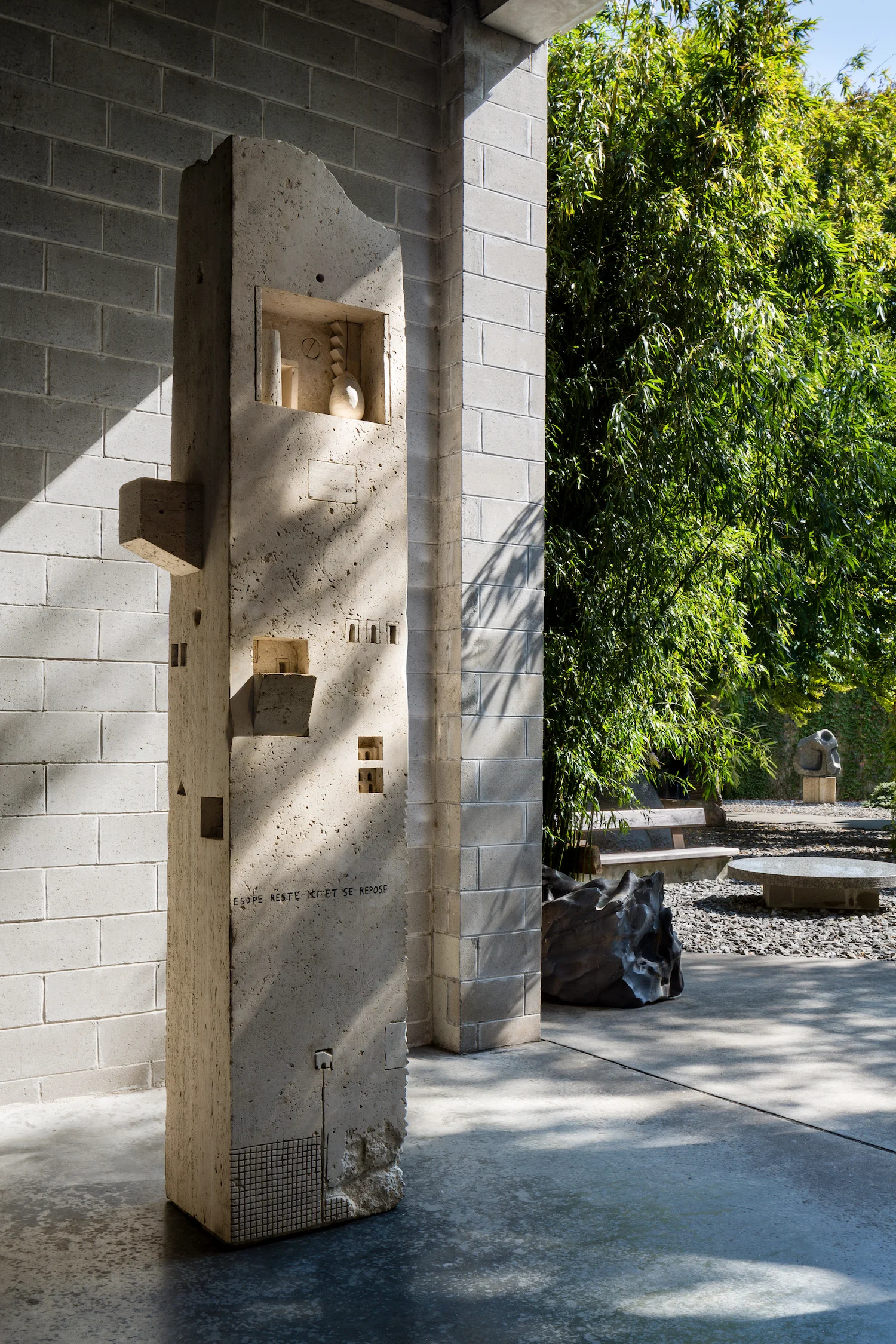
    The latest project at the museum is “The Sculpture of Gonzalo Fonseca.”1 A better title for this exhibition, curated by Hart and organized in partnership with the artist’s estate, might be “Fonseca and Noguchi,” or perhaps “Noguchi and Fonseca.” Stirred into the mix of the collection, especially as the show opens on the museum’s ground floor, the sculptures of Fonseca (1922–97) are almost certain to be confused by many museum-goers with Noguchi’s own.

    Installation view, “The Sculpture of Gonzalo Fonseca.” Photo: Nicholas Knight / The Isamu Noguchi Foundation and Garden Museum.

    Installation view, “The Sculpture of Gonzalo Fonseca.” Photo: Nicholas Knight / The Isamu Noguchi Foundation and Garden Museum.

    Fonseca deserves a full retrospective. This exhibition is not that. But short of such an expectation, the museum’s intimate if quirky treatment of the Uruguayan artist reveals much, in particular through his affinities with the American sculptor. Just as Noguchi emerged from the studio of Constantin Brancusi to become a border-crossing artist, Fonseca looked beyond his training with Joaquín Torres-García to an expansive cultural application of modernist form. As Noguchi turned to Japan for influence, Fonseca saw Italy as a primary source for his creative archeology. Equally accomplished as an architect and draftsman as a sculptor, Fonseca recombined fragmentary forms, seemingly unearthed from the classical past, in imaginary, Swiftian worlds.

    The exploration of scale, in addition to time and place, was Fonseca’s remarkable accomplishment. One of this exhibition’s two small, wordless chapbooks, published in lieu of an exhibition catalogue, examines the theme. Fonseca’s worlds of doors, windows, and ladders, often carved into single slabs, could be Lilliputian in size, or they could be the representation of something much larger. The outsize scale of the Tuscan stone quarry in which he worked helped Fonseca take these questions to extremes. What resulted were microcosms of culture in wood and stone, often delightful cultural excavations, with tiny forms embedded into a sculptural architecture. Considered in another scale, Fonseca’s sculptures became his personal museum, not unlike Noguchi’s own.

    Lois Dodd, View Through Elliot’s Shack, Looking South, 1971, Oil on linen, Alexandre Gallery.

    Lois Dodd, View Through Elliot’s Shack, Looking South, 1971Oil on linenAlexandre Gallery.

    Born in 1927, Lois Dodd studied at New York’s Cooper Union in the 1940s. She was one of the founders of New York’s pioneering Tanager Gallery in the 1950s. Yet unlike much of the rest of the New York School, who were painting windows to their souls, Dodd has spent a lifetime painting windows to windows. Her body of work, now continuing into her tenth decade, has always been a window to an independent artistic spirit. Whether looking out the window from her East Village tenement, or from her childhood home in Montclair, New Jersey, or from her cottage in Cushing, Maine, Dodd has revealed the mood of nature, shelter, and viewpoint through an economy of form and brushstroke.

    Noting her “complex, highly poetic pictorial compositions based on the structures and settings and shifting light” around “windows and doorways,” our late colleague Hilton Kramer rightly championed Dodd as among the “class of highly accomplished American painters whose work has been consistently rejected by the New York museum establishment.” Hilton lamented that the establishment would fail to catch up with Dodd in his lifetime. In her own, at least, Dodd is now the subject of a new monograph, her first, written by the curator and critic Faye Hirsch and published by Lund Humphries as part of its series on contemporary painters.

    Now through January 27, Alexandre Gallery, Dodd’s steadfast representation, has mounted a must-see survey show occasioned by the publication.2

    “Of the many recurrent observational subjects that Dodd has treated throughout her career,” Hirsch writes of Dodd in the monograph, “none has been more conspicuously ongoing than that of her windows.” Even when painting en plein air, as depicted in the diminutive Shadow Painter of 2008, Dodd’s most successful compositions are fenestral visions. Cropped by the frames, reordered by the sashes, the images in her paintings form a Mondrian-like grid that may reflect, or look out upon, additional windows in view.

    Lois Dodd, Moonlit Road, NJ, 1976, Oil on masonite, Alexandre Gallery.

    Lois Dodd, Moonlit Road, NJ, 1976Oil on masoniteAlexandre Gallery.

    At the right moments, light, color, and form punctuate—see, for example, the window behind the window, framed in the lower left sash, in View Through Elliot’s Shack, Looking South (1971); the boogie-woogie rhythm of Men’s Hotel with 11 Windows Lit (2016); and the fields of fog filling up the panes, just slightly askew, of Steamed Window (1980).

    Moonlit Road, NJ (1976) is a tour de force of Symbolist mood and structure. Where the compositions become too orderly and large, such as in some recent still lifes of wildflowers, I miss the spontaneity of the quick glances and the sideways views. Dodd is a painter whose spare compositions and thin brushstrokes recall the Yankee thrift of Milton Avery, who was said to make his paint last longer than anyone. At Alexandre, in a small side gallery, we find Dodd at her best. Here, in tiny images painted right on metal flashing, we see fleeting glimpses captured in timeless poetry.

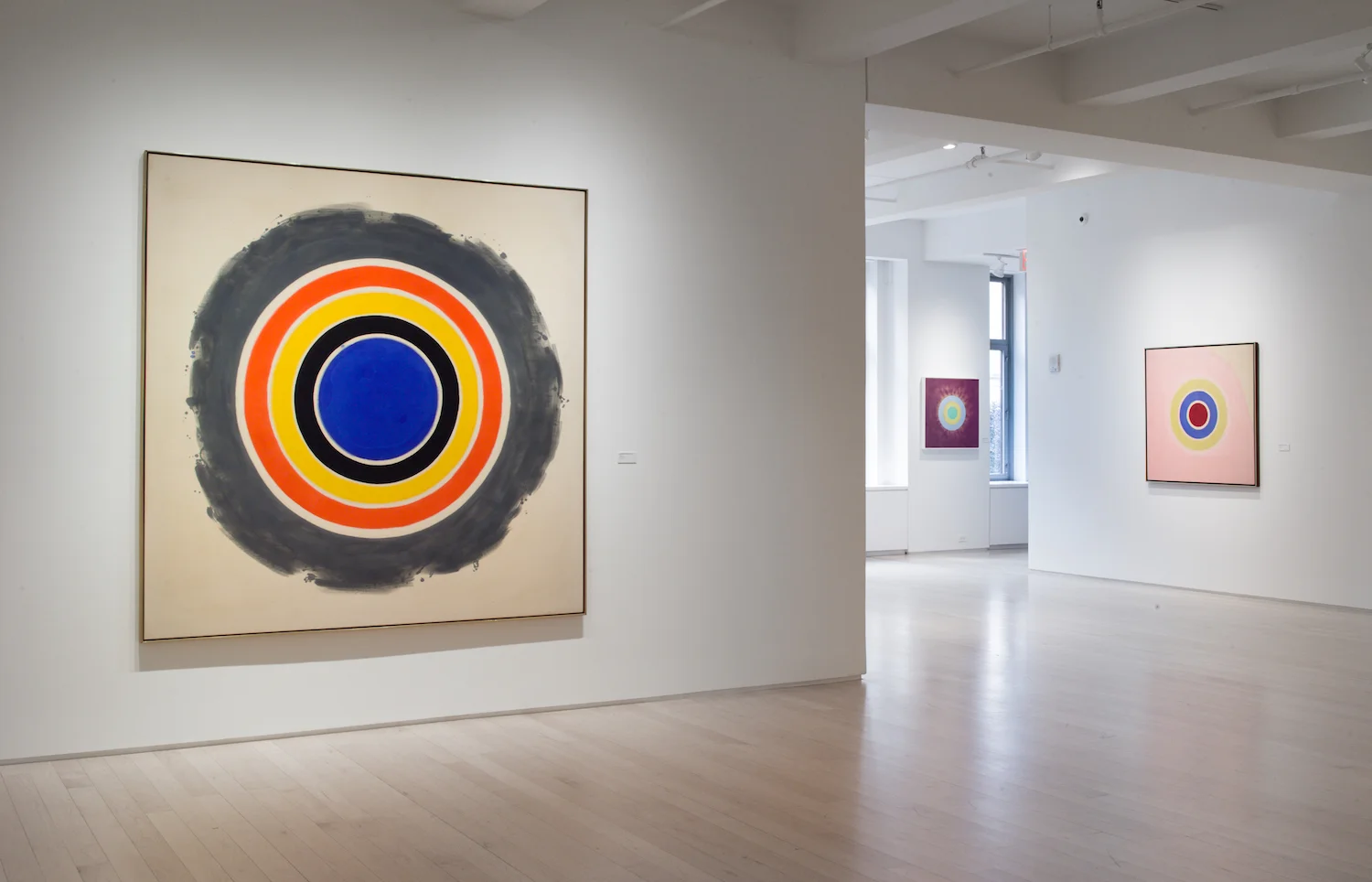
    Installation view, “Circles: Early + Late” at Yares Art. Photo: Yares Art

    Installation view, “Circles: Early + Late” at Yares Art. Photo: Yares Art

    In the late 1950s, Kenneth Noland (1924–2010) ran circles around American abstraction. Color-rich and cool, his “Circle” paintings were radically reticent departures from the expressionism of the New York School. Then, four decades on, Noland circled back on the motif. Last month,“Circles: Early + Late” at Yares Art joined the two “Circle” periods together in an exhibition that told us “everything he discovered over a half century of painting,” as Karen Wilkin writes in her catalogue essay.3

    A famous studio visit organized by the critic Clement Greenberg in 1953, which also included Morris Louis, introduced Noland to Helen Frankenthaler and her technique of staining unprimed canvas. Noland soon went on to soak his own paintings in circular bands of inky acrylic. The thinning of the picture plane produced abstractions that appear to thicken as they pour, spin, and explode into view.

    The “Circles” of the 1950s and ’60s were like silent detonations in the history of modern art. As familiar as they have become, in person they remain powerful and original. Elusive in meaning, yet emerging at the height of the Cold War, the compositions may recall fallout maps with bands of visual radiation. The red-hot Spring Call of 1961 can even seem to contain a thermonuclear core at its moment of detonation.

    Or maybe they are something else altogether. Like the mandalas of Tantric Eastern art, which helped teach Noland “what a circle could do,” these concentric abstractions came to represent both ends and beginnings— especially for Noland himself.

    In the 1990s, Noland employed new paints, rich in chroma and embedded with microscopic metals, to return to the circle. The two series of “Circles” “bracket Noland’s long and distinguished working life,” Wilkin writes. In their reconsideration, the artist found ways to flip his late circles inside out. Rather than leaving areas unprimed, Noland covered every square inch of his late canvases in sparkling, nebular color. At the far end of his long career, the centrifugal spinning of Noland’s paintings from the 1950s and ’60s became, in the 1990s and 2000s, an increasingly inward, centripetal, absorbing, and mesmerizing pull.

    Kenneth Noland, Magic Theatre, 2000, Acrylic on canvas, Yares Art

    Kenneth Noland, Magic Theatre, 2000Acrylic on canvasYares Art

    In the 1980s, Elizabeth Murray (1940–2007) exploited the cracks of modernism with paintings that could not help but crack up. Through fun shapes and funkier colors, she cracked open her canvases in cartoonish bursts and zig-zag patterns. Now at Pace through January 13, “Elizabeth Murray: Painting in the ’80s” takes the picture plane on a barnstorming joyride, beginning with the sloshing, shattered coffee of Wake Up (1981) on up through increasingly wild, expanding forms of oil on canvas that seemingly bend, crunch, and splat.4

    Elizabeth Murray, Wake Up, 1981, Oil on canvas, Pace Gallery. Photo: Ellen Labenski.

    Elizabeth Murray, Wake Up, 1981Oil on canvas, Pace Gallery. Photo: Ellen Labenski.

    For all of its amusements, “Painting in the ’80s” makes a serious, and often overlooked, case for Murray as a leading light of the neo-Expressionists, one who found innovative ways to reinvigorate oil on canvas from the minimalist doldrums of the 1970s. It was an early engagement with Cézanne that convinced Murray to refocus her talents on painting rather than commercial art as a student at the School of the Art Institute of Chicago. The structures of Post-Impressionism and Cubism continued to undergird her colors and forms, even, or especially, as her palette grew more outlandish and her canvases more distended.

    With cracked compositions, the walls and rooms of the gallery space become part of the structural matrix. Ultimately, in both her departure from and her embrace of modernist painting, Murray’s disintegration of substances and surfaces was informed by a history of vanguard art. Her accomplishments, one-on-one, may seem cartoonish and slight, an impish raspberry in the face of modernism. But through this amusing and illuminating show, especially in her larger, vertiginous work, Murray has the last laugh.

    1 “The Sculpture of Gonzalo Fonseca” opened at The Noguchi Museum, Queens, on October 25, 2017 and remains on view through March 11, 2018.

    2 “Lois Dodd: Selected Paintings” opened at Alexandre Gallery, New York, on December 2, 2017 and remains on view through January 27, 2018.

    3 “Kenneth Noland: Circles, Early + Late, 1959–1962, 1999–2002” was on view at Yares Art, New York, from November 11 through December 30, 2017.

    4 “Elizabeth Murray: Painting in the ’80s” opened at Pace, New York, on November 2, 2017 and remains on view through January 13, 2018.