BAKU
Fall 2014
Video Games
by James Panero
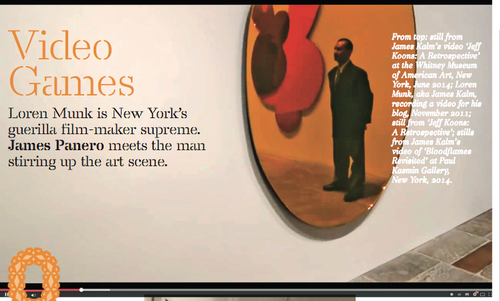
Loren Munk is New York's guerrilla film-maker supreme.
One day, when art historians take stock of the 2008 Whitney Biennial, the first artist to come to mind won’t be someone who appeared in the exhibition. It will be the artist who was thrown out of the exhibition for recording it with a tiny digital camera and posting it on YouTube. “The ironic part is they can film you with their security cameras, and you don’t give them permission for that, but God forbid you are there getting pictures of the art,” reflects this social media provocateur.
Working under the pseudonym James Kalm, since 2006 Loren Munk has made more than 1,000 videos just like 2008 Whitney Biennial Busted. They all start the same way: a shaky glimpse of a bike locked on a New York street, a pan to a gallery or museum door and a heavy-breathing voice-over announcing, “This is James Kalm, the guy on the bike, welcoming you to another half-assed production.” Then with a cut, or maybe not, we watch in point-of-view style as the camera takes us in, glances around and moves in closer to look at individual works on display. All the while, a wry voice leads us through, giving us first impressions, striking up conversations and sometimes striking out with gallery security. “People told me this is the stupidest thing they’d ever heard of,” Munk says of when he first explained his video project to friends. “I heard that, and I said, ‘Man, I’ve hit a gold mine!’”
The reason art historians of the 2008 Whitney Biennial will one day think of Munk is that, frankly, there is no better record of the exhibition than his half- hour-plus video walkthrough. Munk posts everything he films free on YouTube, either as the ‘James Kalm Report’ or ‘James Kalm Rough Cut’, and if you can’t remember what appeared to the right of the lift on the fifth floor, just tune in. Beyond that, his 2008 reportage has become something of a turning-point for a form of radical art documentation. “If you are showing exciting art that has cultural significance, by discriminating against all those people who can’t see it in person, you are holding back society,” says Munk.
Back in 2008 the Whitney thought otherwise. “Excuse me, sir,” says a guard fve minutes into the clip. “They are telling me right now that you are using that camera. Sir, if you don’t stop now, they are going to come over here and take you out of the building. OK?”
“They are going to take me out of the building?” Munk asks.
“Turn it off, please. The camera. Last time I ask you.”
Next thing we see is Munk’s feet being escorted down the stairs, as he explains to the viewer how he was just threatened with a lawsuit and copyright infringement. “This is James Kalm getting kicked out of the 2008 Whitney Biennial,” he concludes, offering his trademark sign-off: “Thanks, Kate,” a nod to his wife. He later returns to film four more segments, vowing to leave his camera on while declaring it a performance piece called The Camera is Off.
“That ended up being one of the biggest videos up to that point,” Munk says. Far from landing him in court, the Whitney linked to it and soon started posting their own YouTube videos. Today, the Whitney invites Munk to all its press previews and director Adam Weinberg comes over and shakes his hand. “It has gone from something they were throwing me out for six years ago, to something they now view as valid.”
Compared to the polished look of TV news, Munk’s videos take a bit of getting used to, but the art world is coming round to the 62-year-old performance documentarian. His appearance at a gallery opening has become a sign of critical arrival, and gallerists now know who to look for: a tall, paint- splattered balding man wearing an old bike helmet, the only person in the room whispering into a camera.
His videos are equally distinctive. Without ever showing the host’s face, they are less like classic documentary and more like going to an art opening inside the head of a knowledgeable friend. “I want it to be closer to the way someone really experiences the art scene, grabbing the artist, swinging back, zooming in, with their buddy and a couple of beers.”
As part of his practice, rain or shine, Munk bikes nearly everywhere from his 353sq m loft in Red Hook, Brooklyn. The audible breathing, the shakiness, are there because he’s just pedaled miles through busy streets, over the Brooklyn Bridge, and doesn’t wait to catch his breath, always filming in one take. “The immediacy is important,” he says. “It is changing the way people look at video. But people still say, ‘Your shaking is making me nauseous and your commentary is idiotic’.” But as we have grown used to the look of video in the smartphone era, Munk’s work now seems ahead of its time.
As the internet has leveled the field of arts journalism and newspapers have cut back on coverage, a freelancer with an online following can also hold increasing sway. By the last count, more than three million viewers have logged on to see Munk’s YouTube videos. His audience is growing internationally, too. “I’ve got people keeping up with me in the UAE, in Morocco, in China,” says Munk. “I get these letters from artists in Algeria saying, ‘I love your videos, will you look at my website?’” Even a school of Papulankutja aboriginal people in the outback of Australia tunes in. “We are 500 miles from the next big town,” their teacher emailed Munk, “but my kids can feel like they are part of the Williamsburg art scene” – referring to one of the alternative Brooklyn neighborhoods, like Bushwick, that Munk documents as often as he does Chelsea.

Loren Munk in his studio (Todd Heisler/The New York Times)
Today Munk covers every corner of the New York art scene with tireless energy but never for any financial gain (he turns down offers of online advertising). “Munk’s obsession with art, art history and the New York art world is evidently more than one person can handle. So he created James Kalm,” Roberta Smith, the chief critic of The New York Times, wrote in 2011. She went on to praise him for giving “dizzying visual expression to some of what lures the art-driven to the city: the sense of possibility in the air and of history beneath our feet.”
Anyone can film a gallery opening but Munk’s films are different in that they have attracted a particular community and this has led him to find new artists, curators, critics, collectors and gallerists who have been excited by his work.
“A key difference for Loren is the community that has formed around his video works,” says Hrag Vartanian, the editor of the Brooklyn-based arts magazine Hyperallergic, who as a curator included Munk in an exhibition of social-media art in 2010. “His generosity in his video work is clear, he doesn't have to be doing this but he does. Though, I do think doing the videos did help him reestablish himself on the art scene. All artists go through ebbs and flows in their career, and while some artists may complain when their careers dip, Loren found new ways to think about art and share his passion through video.”
If there’s a context for Munk’s films, it’s that they share something with the handheld clips coming out of war zones, and something with our culture’s obsessive digital documentation. Other artists have used YouTube but little else matches the breadth of Munk’s work.
So where will his videos end up? Probably not as something sold in a gallery, unlike an earlier generation of video art. “The old model is the opposite,” says Munk of video from the pre-internet age. “They were doing something in response to television, using technology in a hermetic, esoteric way, and you can access it only if you jump through the hoops to see it in a gallery.”
The videos have also reinvigorated Munk’s first passion for painting and have already paid off for him through his paintings, which consist of complex diagrams, maps and flowcharts of the art world. “He’s really synthesized a lot of things in his practice,” says Nick Lawrence, gallerist at Chelsea’s Freight and Volume, who began representing Munk two years ago. “There’s something unjaded and pure about it, and it shows up in his paintings. There’s a certain against-the- grain, countercultural approach in what he covers, how he covers it, in his technique. And his paintings are painted with an obsessive quality. The lines that connect in his paintings are exactly how he zigzags around the room at an opening. They are very spontaneous, very provisional.”
Munk agrees: “Often that’s the best way. I just walk through the doors and say, ‘This is pretty cool,’ and I just turn on the video and let it go.”
expanded from the print edition