A Helluva Show

Theater_review_on_the_town

Clyde Alves, Tony Yazbeck, Jay Armstrong Johnson and the cast of On the Town

CITY JOURNAL 

March 26, 2015

A Helluva Show
by James Panero

A new production of On the Town captures the spirit of New York City.

With music by Leonard Bernstein and book and lyrics by Betty Comden and Adolph Green, the original 1944 production of On the Town was a celebration of the freedom and energy that New York City represented in wartime. The musical rightly brought fame to its three wunderkind creators, all in their twenties, who drew their inspiration from the Jerome Robbins ballet Fancy Free.

Now, as the spectacular, must-see revival of On the Town returns to Broadway at 42nd Street’s Lyric Theatre, the musical reflects a city that has itself been revived in a synergy of past and present. Then as now, it’s the right time to see On the Town. After all, could there be a greater paean to urban life? The ultimate love interest in this musical of three American sailors on shore leave is, of course, “New York, New York, a helluva town,” where “The Bronx is up, but the Battery’s down” and “the people ride in a hole in the groun’.” The city captivates and animates the storyline, beginning with that famous opening number. One sailor, Chip (Jay Armstrong Johnson), calls the city “a visitor’s place!” and announces his ambitious touring schedule (“10:30 Bronx Zoo, 10:40 Statue of Liberty”).

The famous places to visit are so many, 
Or so the guidebooks say. 
I promised Daddy I wouldn’t miss on any. 
And we have just one day. 
Got to see the whole town 
From Yonkers on down to the Bay.

Ozzie (Clyde Alves), meanwhile, has other attractions in mind: “Manhattan women are dressed in silk and satin,/ Or so the fellas say;/ There’s just one thing that’s important in Manhattan,/ When you have just one day.” A poster on the subway convinces Gabey (Tony Yazbeck), the shy sailor, to seek out Ivy Smith (Megan Fairchild), the winner of “Miss Turnstiles for the month of June.” The sailors’ 24-hour trek spans Carnegie Hall and the uptown museums to midtown nightclubs and Coney Island. Eventually, they assemble together with their dates—the fizzy anthropologist Claire de Loon (Elizabeth Stanley) with Ozzie, the brassy taxi driver Brunhilde “Hildy” Esterhazy (Alysha Umphress) with Chip, and Ivy Smith with Gabey—only to have to say their goodbyes at the Navy docks just as another three sailors slide down the gangplank, singing the same opening tune.

The team behind this current On the Town—lead producers Howard and Janet Kagan and director John Rando—captured the revival spirit of both the musical and the city with a promotional music video released last summer. The video closely tracks the familiar opening shots of the 1949 movie film version starring Frank Sinatra and Gene Kelly. Rather than running off their ship onto the Brooklyn Navy Yard, though, our three sailors emerge in their starched white suits running down the gangplank of the Intrepid—the sea, air, and space museum in the aircraft carrier docked on the Hudson River. Then these spirits of World War II-era New York are seen singing and dancing around today’s city. Some locations have thankfully changed little since the 1940s—the Brooklyn Bridge, Coney Island, Bethesda Fountain, the Statue of Liberty, the American Museum of Natural History. Yet, for their bike ride through Central Park, the sailors rent Citibikes. And between shots of Chinatown and a carriage ride through the park, they visit the Apple Store on 59th Street and Fifth Avenue. If anything, the city looks far clearer and better than it did on film 60 years ago.

The preternatural and, at times, winking exuberance of this revival gets carried through the musical, which is lavishly staged with a live 28-piece orchestra at the Lyric. The revival is surprisingly faithful to the original Broadway production. Each performance begins with the cast, led by Phillip Boykin, joining the audience in a rendition of “The Star Spangled Banner.” This patriotic feeling continues throughout the show, especially as Stephen DeRosa, on the night I attended, singled out a veteran in the audience for special recognition of his service.

But just like the original musical, this revival is far more red-blooded and grittier than the sanitized Hollywood production. Not only did “helluva town” get changed to “wonderful town” in the 1949 film, but many of the best musical numbers were cut, in particular Hildy’s “I Can Cook Too,” which includes a full serving of double entendre (“I’m a man’s ideal of a perfect meal/ Right down to the demi-tasse./ I’m a pot of joy for a hungry boy,/ Baby, I’m cookin’ with gas.”) A new cast recording of this revival has just been released by PS Classics.

In addition to the possibilities presented by the city (where density and public transportation play a leading role), On the Town also hints at the more desperate side of the urban experience, especially for the women. Ivy Smith, a celebrity in the eyes of Gabey, is being hustled by an alcoholic dance teacher (Jackie Hoffman) who insists that she debase herself working at an after-hours gentlemen’s club on Coney Island to pay for her classes. Claire de Loon cracks in an unhappy marriage, which her fly-by-night relationship with Ozzie finally destroys. Hildy, fired from her job as a taxi driver, lives with a sick roommate in an apartment overlooking a brick wall.

Yet for its lows, the New York of On the Town is ultimately one of great heights, finally reached in the dream dance sequence between Gabey and Ivy. Inspired by the heated choreography of Jerome Robbins, the nine-minute pas de deux, choreographed by Joshua Bergasse, finds the dancers sweating it out in a boxing ring before soaring into one another’s arms. That Ivy is danced by Fairchild, the famous principal dancer of the New York City Ballet, speaks to the talent that only a city can gather. Here is a production that only Broadway can stage and a story that only New York can tell.

Tobacco Hour

"Tobacco Hour," poems by Dara Mandle, art by Brece Honeycutt, second edition

available for $10

Dara writes:

I have been overwhelmed by the support you've shown for my chapbook of poems, "Tobacco Hour." I am excited to announce the edition is now sold out, and I'm so happy the books are in such good hands! A second, unlimited perfect-bound edition is now available. Thank you to everyone who made it to Luhring Augustine Bushwick for the reading, to those who bought copies and ordered online, to our publisher Jason Andrew of Norte Maar, to my fellow readers John Talbird and Leslie Kerby, to the painter Philip Taaffe, and of course to my artist collaborator Brece Honeycutt


Screen Shot 2015-03-19 at 4.00.51 PM

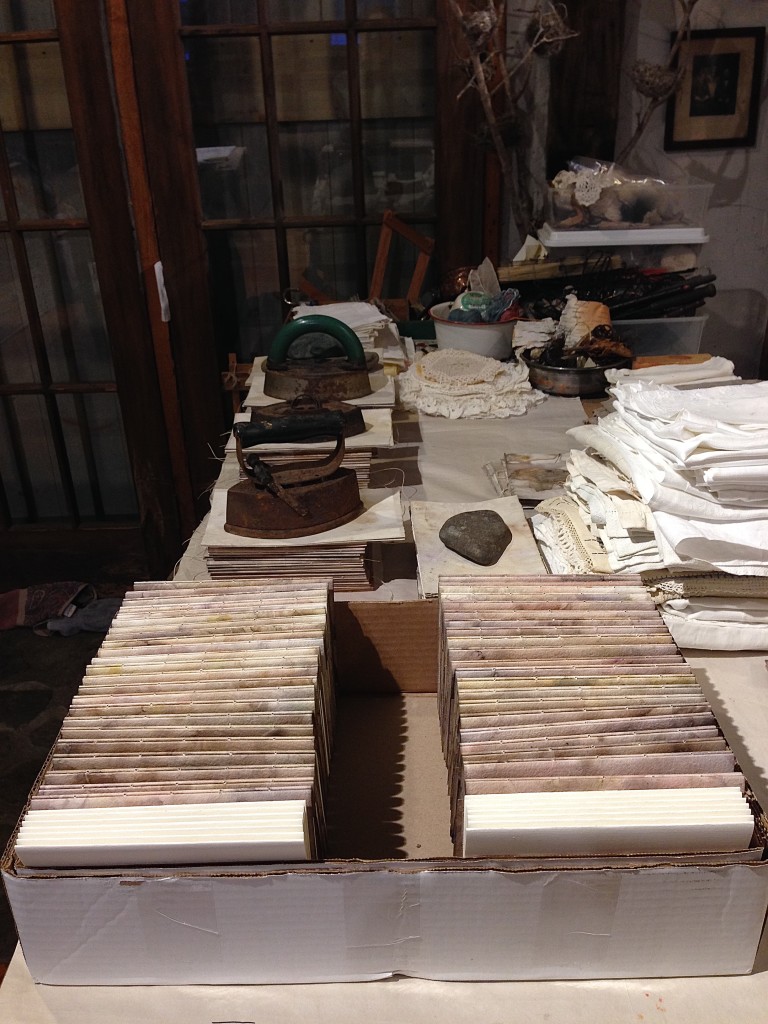
pictured: Brece Honeycutt's ecodyed covers prepare to be hand-bound and stamped for Tobacco Hour. Photo: BH

We are delighted to announce the launch of Tobacco Hour, a limited-edition collaborative chapbook of poems by Dara Mandle and art by Brece Honeycutt published by Norte Maar.

Please join us for a celebration and reading of the book on Sunday, April 19, 4-6 pm, at Luhring Augustine Bushwick, 25 Knickerbocker Avenue, Brooklyn, New York.

Tobacco Hour is the product of a three-year collaboration between Dara Mandle and Brece Honeycutt. Published by Norte Maar in an edition of 75, featuring twenty new poems by Dara Mandle, each numbered copy of Tobacco Hour has been hand made by Brece Honeycutt.

Working together, artist and poet have designed Tobacco Hour to be an experimental cross between book printing and art making. Based in an 18th-century colonial farmhouse in Sheffield, Massachusetts, drawing on her impressions of Mandle's poems of devotion and desire, Honeycutt has used flora and found objects to dye and texture the covers of each book individually

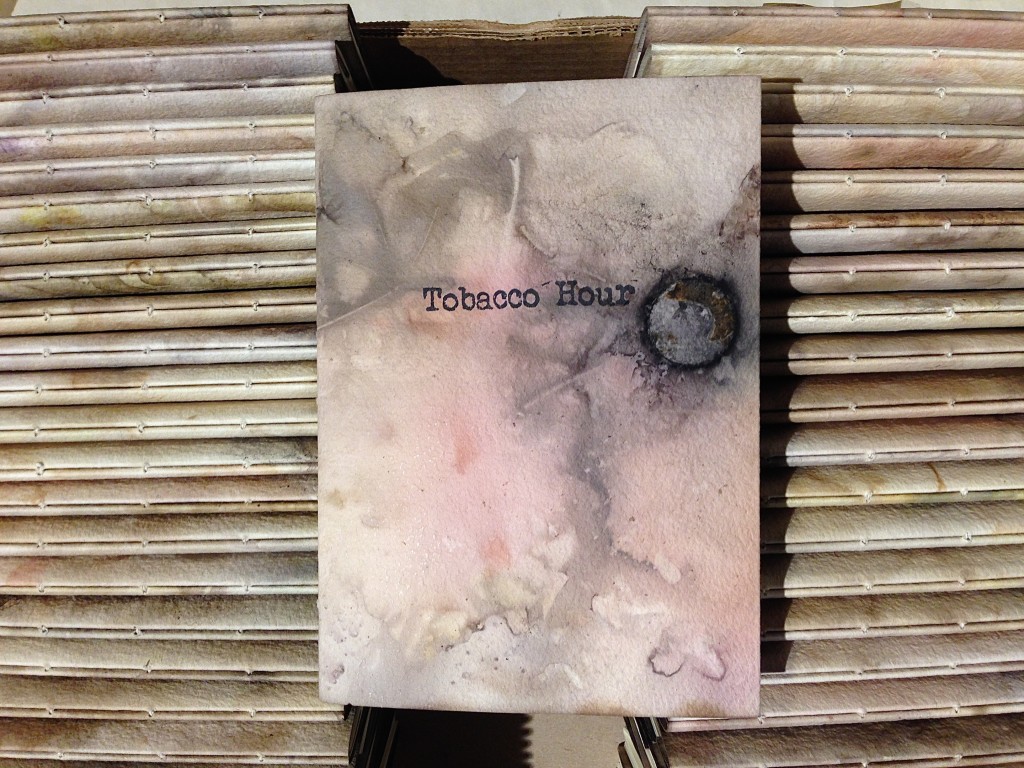
The chapbook is the size of a small prayer book, linking it to the many prayer poems in the text, which Brece has hand-stitched without glue in a special binding. For the covers, barberry, goldenrod, mugwort, rhododendron, and mint, along with metal washers, were interleaved in between white sheets of paper, put between two sheets of copper, and immersed in a dye bath. This process, called eco-dyeing, uses materials from the land that are then returned to the land.

Norte Maar, the Bushwick-based nonprofit dedicated to collaboration in the arts, is publishing the edition as part of its series of artist-writer collaborations, which will also include A Modicum of Mankind, short stories by John Talbird with art by Leslie Kerby. 

The April 19 event for both books is generously hosted by Luhring Augustine Bushwick, where the exhibition Philip Taaffe: New Paintings will be on view. 

Dara Mandle earned her BA in English from Yale University, where she was awarded the Clapp poetry prize, and her MFA in poetry from Columbia University. Her poetry has appeared in the Brooklyn Review, Painted Bride Quarterly, and Harpur Palate, among other journals. For the past nine years she has hosted the Young Poets series at the National Arts Club. She maintains a blog of her work at www.supremefiction.com.

Brece Honeycutt lives and works in Sheffield, MA. She makes history-based drawings, sculptures and installations. She received a B.S. in Art History from Skidmore College and a M.F.A. from Columbia University. Her installations have been placed in exterior locations including university campuses, historic houses, inner city parks and in office buildings, libraries, urban markets and galleries. She collaborates and works with the National Park Service, artists, students, historians, gardeners, non-profit organizations, poets, and dancers. In 2014, Honeycutt exhibited in New York, Massachusetts and Italy. She received two artist fellowships from the D.C.C.A.H. and an anonymous grant for an “artist working in a particular American vein.” She has served on the boards of the Arlington Arts Center, Arlington, VA, as treasurer and the Washington Sculptors Group. www.brecehoneycutt.com


6a00d83456391369e2017ee89efc15970d

Brece and Dara look over prototype pages in production in the Sheffield studio. Brece's stand-alone paper sculptures hang on the back wall. Photo: JP


6a00d83456391369e2017d412b2033970c

Brece uses found objects as resists as she presses pages together to set overnight. When she opens them up, she discovers how foliage and other elements have left their marks on the paper. Photo: JP


6a00d83456391369e2017c36fbca8d970b

On one wall Brece has pinned prototype pages for the book. Here Brece has written out one of Dara's poems on hand-made paper (above) and hand-stitched the binding of some pages (below). Dara and Brece experimented with different page formats and worked through ideas of how best to translate Brece's handmade book art to multiple production. Photo: JP


Screen Shot 2015-01-30 at 10.33.39 PM

Folded covers for Tobacco Hour awaiting barberry bath. Photo: BH


6a00d83456391369e2017ee89efdc4970d

Goldenrod, drying in the attic, used for book's ecodyes. Photo: JP 


Screen Shot 2015-01-30 at 10.33.24 PM

Ecodyed covers prepared for goldenrod bath. Photo: BH


IMG_2191-768x1024

Cover paper in Brece's press. Photo: BH


IMG_2811-768x1024

Hand-bound copies of Tobacco Hour ready for release. Photo: BH


IMG_2818-1024x768

A finished copy of Tobacco Hour. Photo: BH


Screen Shot 2015-03-19 at 9.20.19 PM

Tobacco Hour. Photo by Sharon Butler. 

'The infinite Spanking Jerry Saltz'

Jerry-Saltz

James writes:

In this week's Capital New York, Nicole Levy has written a smart and well researched profile of Jerry Saltz, the award winning art critic for New York Magazine and social media phenomenon. I say "smart" and "well researched" in particular because Levy article, titled "The Infinite Spanking of Jerry Saltz," picks up on "My Jerry Saltz Problem," the essay I wrote for The New Criterion on the evolving online relationship between artists and critics, which Saltz embodies through his Facebook presence. As I observed at the time:

On Facebook and now elsewhere online, Saltz regularly mixes portentous metaphysical questions with internet messianism, unctuous flattery of his followers, treacly self-doubt, and gaseous emissions of political cant. The ultimate topic of discussion is not art or even his devoted followers but Jerry Saltz himself.      

Read Nicole Levy's entire piece here