Rear Window

Rear window

On “Edward Hopper’s New York” at the Whitney Museum of American Art.

Edward Hopper (1882–1967) was the painter of small-town America. This we know. That his small town happened to be New York City, his home for nearly sixty years, we may not know. “Edward Hopper’s New York,” now on view at the Whitney Museum of American Art, tells the hometown story of an artist we thought we knew all along in a novel and illuminating way.1

It is certainly an achievement when an exhibition of a famous artist is able to surprise. When such an exhibition can also instruct and delight—and do so without resorting to the clichés of contemporary theory—this is a rare triumph. And when the subject is a dead white male painter—a conservative, anti–New Deal Republican, no less, who rejected every school and trend to look to the loneliness of the human condition—here is a show that must be seen to be believed. “Edward Hopper’s New York” is such an exhibition and will open many eyes to this artist’s elegiac vision.

Hopper treated New York as his own small town. Born just up the Hudson River in Nyack, he arrived in the big city as an art student at the turn of the twentieth century at a moment of dynamic change—and he wanted nothing to do with it. As the world looked ahead and up, he looked back and down to the remnants of what was left behind: the out-of-date storefronts and obsolete buildings and lost souls left to wander the urban stage. “Edward likes the surface of the earth,” observed his wife, Josephine (Jo) Nivison; “he likes to stay close to it.”

Then, well into the second half of the twentieth century, despite his burgeoning national renown, Hopper lived like a nineteenth-century recluse on the top-floor walkup of the same cold-water row house at 3 Washington Square North where he had settled in 1913. “We’re not spectacular and we’re very private,” Jo said at the height of her husband’s fame, “and we don’t drink and we hardly ever smoke.” To which Edward added: “I get most of my pleasure out of the city itself.” Hopper could be taciturn, difficult, a creature of habit. “Sometimes talking with Eddie is just like dropping a stone in a well,” said Jo, “except that it doesn’t thump when it hits bottom.” Yet when times demanded, he and Jo pushed back, refusing to move or modernize when Robert Moses, New York University, and the urban planners came calling—“progress” be damned.

In his art, Hopper looked not to the familiar sights and sounds of the city but to the experiences of living in it—that longing for stability in a world in motion. As curated by Kim Conaty, the Steven and Ann Ames Curator of Prints and Drawings at the Whitney, with senior curatorial assistant Melinda Lang, “Edward Hopper’s New York” wanders much as the artist did in life. “The City in Print,” “Washington Square,” “The Horizontal City,” “The Window,” “Theater,” “Sketching New York,” and “Reality and Fantasy” are the thematic sections of this peripatetic exhibition that brings together some two hundred paintings, watercolors, prints, and drawings.

“Brings together” might be misleading, since a great majority of the exhibition comes out of the Whitney’s own extensive holdings by the artist. In 1968, after her husband’s death, Jo willed 2,500 of his works to the museum, supplementing the institution’s own acquisitions going back to Gertrude Vanderbilt Whitney’s purchase of Early Sunday Morning for her Studio Club in 1930, the same year Hopper painted the famous streetfront scene. And even these thousands have since been supplemented by another six hundred objects. Works by Hopper now total an astonishing 12 percent of the museum’s permanent collection. (It must also be said that the Whitney’s sweeping downtown views, of the former Meatpacking District and the recast High Line, now further echo the artist’s urban impressions.)

Edward Hopper’s New York” finds its pace even with so much from which to choose. The exhibition begins with a wall of early work by the commuting art student and illustrator. In this section called “First Impressions,” with several small drawings and paintings from the turn of the century arranged salon-style, we can already find elements of the Hopperesque rising out of his Ashcan beginnings (Robert Henri was his teacher).

Edward Hopper, Blackwell's Island, 1911. Oil on canvas, 24 3/8 × 29 5/16 in. (61.9 × 74.5 cm). Whitney Museum of American Art, New York; Josephine N. Hopper Bequest 70.1188. © 2022 Heirs of Josephine N. Hopper/Licensed by Artists Rights Society (ARS), New York

Works such as Ferry Slip (ca. 1904–06), an oil on cardboard, and Tugboat with Black Smokestack (1908), an oil on canvas, speak less of their purported subject matter and more of the viewer observing them. Here we see Hopper’s own world as though glancing out the window of the ferry during his commute to town. These are snapshot views of the city—quick, uncomposed, and not altogether well lit. “Unmonumental” is one way to describe them. This is a New York not of tourists but of the workaday schlub.

Hopper was soon one of them. With his talents as a draftsman he found ready work in the trades. Several examples are here on display—illustrations for the Bulletin of the New York Edison Company (1906–07), Wells Fargo Messenger (1917–25), and Hotel Management (1917–25), articles on “What Makes Men Buy?” (1912) and “The Spur of Pay and Promotion” (1913), and ads for Bricklayer’s Coffee Break (1907–10), Scaffolding by Chesebro Whitman Co. Inc (ca. 1911–12), and Knothe Unseen Suspenders (ca. 1917–20).

Hopper disliked it all, but the commercial assignments paid the bills even as his painting career went nowhere. At the same time his own work reflected his dejection and a sense of dislocation. Compositions such as Blackwell’s Island (1911) and The El Station (1908) find us glancing just far enough over the side of the Fifty-ninth Street Bridge to see the moon reflecting in the East River, contrasting with the blackness of the city far below, and a long New York shadow obscuring the platform and tracks of the elevated train as we presumably rumble by. These are lonely visions, largely unpeopled, vertiginous and isolated. Solitary Figure in a Theater (ca. 1902–04), of the back of a head in silhouette, only reminds us that there’s another figure, solitary and out of view just a few rows back, observing this empty scene.

Hopper spent his time wandering the city for its nooks and crannies, collecting impressions of the forgotten buildings, bridges, and streetscapes that became his signature motifs. In the Teens, he hauled a printing press up to his studio and began making small etchings of these vignettes. They brought him some of his first attention as a fine artist. Night on the El Train (1918), Evening Wind (1921), and The Lonely House (1922) find the city at its most unguarded state. These impressions became the backlot sets in his larger compositions.

Hopper’s view of the city was out of time and place, much like his own artistic style. “In a period of groups, manifestos, and rampant aesthetic partisanship, Edward Hopper never declared a project,” notes Darby English in the exhibition catalogue. When Hopper traveled to Paris in the heady first decade of the century, he set himself against the nascent avant-garde. After seeing the Salon d’Automne of 1906, with works by Henri Matisse, he noted that it was “for the most part very bad.” He longed to return. Writing home to his mother, he said he found Paris a “very graceful and beautiful city, almost too formal and sweet to the taste after the raw disorder of New York.”

Edward Hopper, Morning Sun, 1952. Oil on canvas, 28 1/8 × 40 1/8 in. (71.4 × 101.9 cm). Columbus Museum of Art, Ohio: Museum Purchase, Howald Fund. © 2022 Heirs of Josephine N. Hopper/Licensed by Artists Rights Society (ARS), New York

By the early 1920s, Hopper was in his forties, childless, unmarried, and an artist who had not sold a painting for ten years. Then in the summer of 1923 he crossed paths with Jo in Gloucester, Massachusetts. She was an artist herself who had also studied with Robert Henri at the New York School of Art. A year later they married. Jo moved into Hopper’s seventy-four-step walkup, with its shared bathroom down the hall, its views of Washington Square, and its skylit studio. As the loquacious spouse gave voice to the couple, the red-haired Jo also became Hopper’s lifetime model. Study of Jo Hopper Reading (1925), Jo Painting (1936), Study of Jo Hopper Seated (ca. 1945–50), Morning in a City (1944), Morning Sun (1952)—for the empty stage of his cityscapes, Hopper now had his lead actress.

In the 1920s Hopper found a new audience as modern art returned to classicism and realism. For all this he never really diverged from painting in the nineteenth-century tradition of Thomas Eakins—an artist, he prided in noting (at least on belief), who once lived at 3 Washington Square North. Yet rather than the heroic doctors or strapping rowers Eakins depicted, Hopper’s figures were the fallen angels of the new century.

Edward Hopper, New York Movie, 1939. Oil on canvas, 32 1/4 × 40 1/8 in. (81.9 × 101.9 cm). The Museum of Modern Art; given anonymously. © 2022 Heirs of Josephine N. Hopper/Licensed by Artists Rights Society (ARS), New York. Image courtesy Art Resource

The New York theater was a regular destination for the Hoppers. They saved their many ticket stubs, now on display. For his own backdrops Hopper looked to the architecture of the city’s broken skyline, ignoring the modern highrises and instead focusing on the city’s aging tenements. He noted

our native architecture, with its hideous beauty, its fantastic roofs, pseudo-Gothic, French Mansard, Colonial . . . with eye-searing color or delicate harmonies of faded paint, shouldering one another along interminable streets. . . . There is a certain fear and anxiety and a great visual interest in the things that one sees coming into a great city.

Hopper set his anonymous characters in these tableaux, increasingly looking to reflect an “Everytown USA,” even as he mined the specificities of the city. The raking light of New York became his spotlight, illuminating the stage for Morning in a City (1944), Sunlight in a Cafeteria (1958), and City Sunlight (1954). He used the city’s windows to frame these compositions, often with windows onto windows. The glimpses of Automat (1927), Tables for Ladies (1930), Room in New York (1932), and Office at Night (1940) open the curtains while also exposing our own voyeurism of the scenes. The awkwardness of each encounter might just about be exposed in the reflection of a storefront pane or the rattling window of the elevated train. Thus Hopper turned his viewer into his subject, just as he flipped the script for his many images of theater interiors, where the faceless spectators and distracted ushers become the actors.

Hopper’s windows not only opened up unexpected sight lines. Through their weathered frames they also exposed a city in the rearview mirror. Starting in 1946, the Hoppers fought desperately to preserve their own nineteenth-century walkup from the encroachment of a twentieth-century institution. “It is regrettable that in [our] taking over the building in which you reside it will be necessary for you to look for accommodations elsewhere,” New York University kindly wrote to the tenants of the building it sought to evict as the school saw its enrollment balloon after the war.

The Hoppers’ public fight during the last twenty years of their lives over the fate of their building and the park it overlooked became an inspiration for the city’s preservationist movement, which originated in their neighborhood of Greenwich Village. Hopper’s New York was “one that people with their restless need for change have overlooked: it is a part of its backwaters untouched by the swift current of the main tide,” observed his friend Guy Pène du Bois. “His realities are in the past of his youth.” Edward Hopper was not only the savior of a city gone by. He was also a preservationist of the souls who lived there.
  1.   “Edward Hopper’s New York” opened at the Whitney Museum of American Art, New York, on October 19, 2022, and remains on view through March 5, 2023.

A library by the book

THE NEW CRITERION, December 2022

A library by the book

On the politicization of the American library.

Adapted for The Wall Street Journal of November 11, 2022

In 2006 the American Library Association issued a button to its members. It read, “radical, militant librarian.” We should have taken the message at its word. The American library, until recently a refuge of neutral quietude, has become a booming battleground in the culture wars.

In 2018 the ALA dropped the name of Laura Ingalls Wilder from its annual children’s literature award. The reason? The supposed “culturally insensitive portrayals” in her landmark Little House on the Prairie series. Three years later, the organization published its “Resolution to Condemn White Supremacy and Fascism as Antithetical to Library Work.” The edict claimed that “libraries have upheld and encouraged white supremacy both actively through discriminatory practices and passively through a misplaced emphasis on neutrality.” The proclamation charged the ALA’s “Working Group on Intellectual Freedom and Social Justice” to “review neutrality rhetoric and identify alternatives.”

The quiet, neutral library was out. Full-throated progressive politics were in. As Emily Drabinski, a self-described “Marxist lesbian” who was recently elected president of the ALA, stated on her campaign website: “So many of us find ourselves at the ends of our worlds. The consequences of decades of unchecked climate change, class war, white supremacy, and imperialism have led us here.”

The condemnation of the history of the American library, by its own gatekeepers, has done more than bring “Drag Queen Story Hour” to every children’s reading room. It has also upended the traditional role of the library as an organization primarily dedicated to the acquisition, preservation, and circulation of books. This is a radical overhaul, and it has been brought to us by some of America’s largest cultural philanthropies.

In October the Mellon Foundation hosted a panel discussion on the American library featuring Mellon president Elizabeth Alexander, the ALA executive director Tracie D. Hall, and the Los Angeles City Librarian John F. Szabo. “Library workers are on the front lines of some of our most pressing social justice issues,” began the discussion. They are “no longer relegated to the reference desk.” What does this all mean? For one, that today’s librarians mock “the shushing part” of the traditional library: “I can’t think of too many contemporary library spaces I’ve been in where the librarian is going to be a shusher,” said Hall. “I probably was the librarian that others might have wanted to shush.” Through sewing classes, coworking spaces, and “incubators,” the panel spoke of “fulfilling the promise of what libraries were meant to be in terms of equity.” “It is our responsibility to ensure that no one is left out of the voting process,” Hall added. “That is one of our core values at the American Library Association.” And by actively appealing to voters on one side of the political spectrum, the library organization helps move election outcomes in a desired direction.

As librarians now champion controversial books such as the graphic novel Flamer, they also call parental attempts to limit what children read as evidence of a “period of unprecedented book banning and censorship”—one that “far eclipses even the McCarthy era.” Meanwhile, truly deplatformed titles, such as When Harry Became Sally, Ryan T. Anderson’s critique of modern transgender theory that Amazon erased from its e-commerce platform, are never mentioned in these one-sided agonies. “This is the third great wave of librarianship and libraries—as a social project,” concluded Hall. What was, until recently, a widely popular American institution has been nearly broken by unrestrained progressive politicization.

“I suspect that the human species—the only species—teeters at the verge of extinction, yet that the Library—enlightened, solitary, infinite, perfectly unmoving, armed with precious volumes, pointless, incorruptible, and secret—will endure.” It is easy to see how Jorge Luis Borges in the early 1940s, in his oft-quoted short story “The Library of Babel,” might have drawn such a conclusion. Yet today it appears that the library, especially the library that is “enlightened, solitary, infinite, perfectly unmoving, armed with precious volumes, pointless, incorruptible, and secret,” is the entity that most teeters at the verge of extinction.

It is a crisis of the Left’s own devising, one designed to turn the library into a scarred landscape. It is also based on a straw-man argument, with rhetoric disconnected from the historical record. Far from upholding “fascism” and “white supremacy,” the American library has been, in fact, one of the country’s most enlightened and democratic institutions.

Through what remains of this legacy, beyond the spurious “banned books” displays and the circulation-desk sermonizing, today’s libraries can still be places of reverie, uplift, and reflection. This effect is due not just to the abundance of books that are—at least for now—still available for perusal. It is also an effect of the library building itself, its history of form, which records the values of an earlier era in bricks and stone.

For its ubiquity and richness, especially in those examples that survive from before the Second World War, the American library building stands as a reflection of the country’s enlightened calling. Over the nineteenth century and into the early decades of the twentieth, library design paired historicized style with the latest innovative solutions for the safe housing and circulation of its collections. The references to the history of art and civilization that these buildings displayed on their faces—and the great expense dedicated to their creation and upkeep by their underwriters—reflected a reverence for the culture of the book contained within.

Henri Labrouste, Bibliothèque Ste.-Geneviéve, Paris, 1859, Print, from Memoirs of Libraries, London.

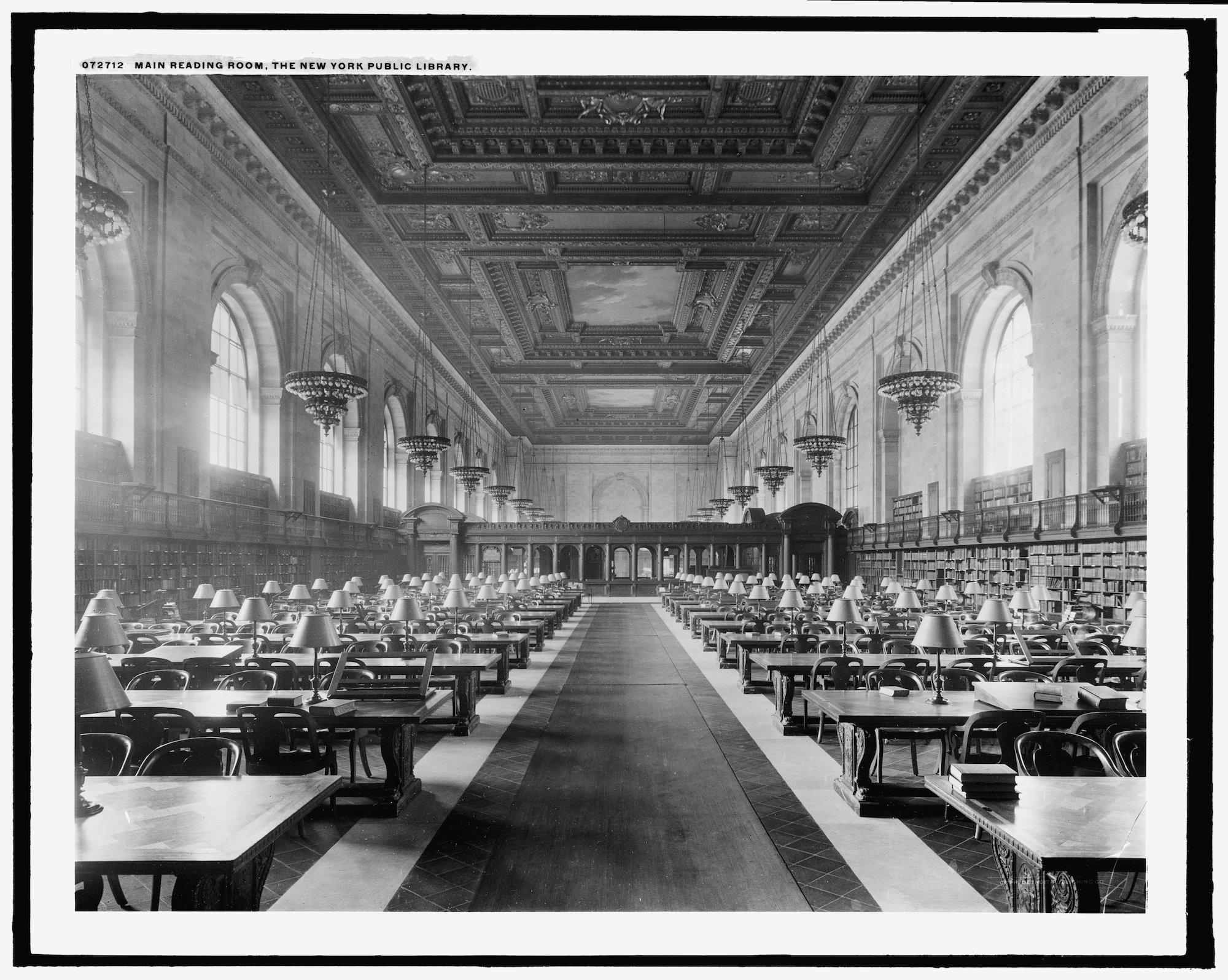
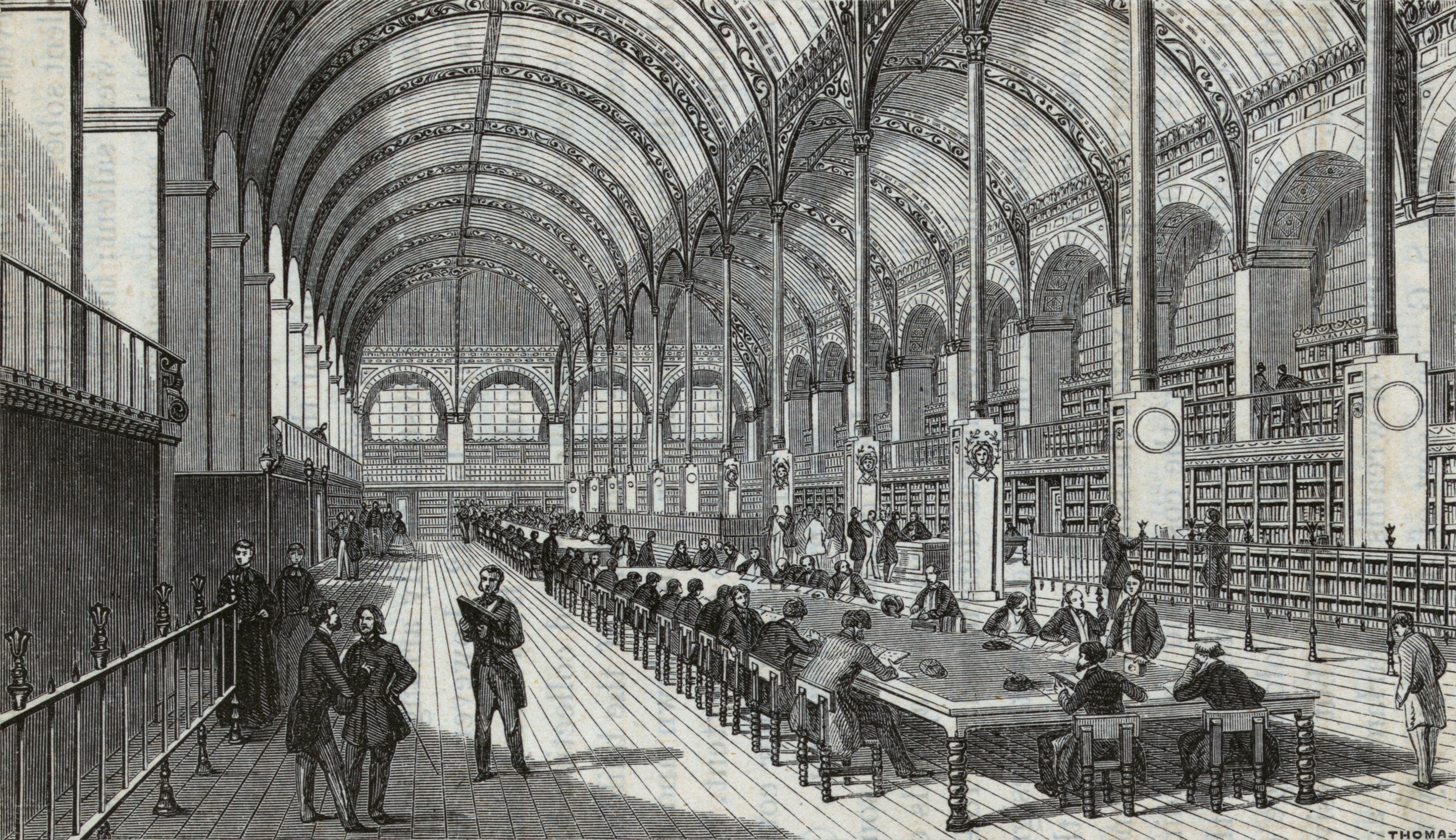
American Libraries: 1730–1950, written by Kenneth Breisch for a series by the Library of Congress and published in 2017, tells this history in a visual and compelling way.1 While the eighteenth century saw the creation of important American private and subscription libraries, only Benjamin Franklin’s Library Company of Philadelphia (founded in 1731) and the New York Society Library (founded in 1754) had buildings dedicated to their collections by the turn of the nineteenth century. America’s interest in library design began in earnest after 1800. Over the following century and into the early years of the twentieth, libraries took the country by storm. Planners found inspiration in the grand mid-nineteenth-century examples of the Bibliothèque Sainte-Geneviève in Paris (designed by Henri Labrouste and constructed between 1844–50) and the Reading Room of the British Museum in London (Sydney Smirke, 1854–57). American library construction took off after the Civil War to reach the pinnacle of the movement as seen in such edifices as the main branch of the Boston Public Library (McKim, Mead & White, 1895), the main branch of the New York Public Library (Carrère & Hastings, 1911), and Yale’s Sterling Memorial Library (James Gamble Rogers, 1931).

Unlike the museum, the library is an ancient form. The Ambrosian Library in Milan (Lelio Buzzi and Francesco Maria Richini, 1603–09) and the Bodleian Library at Oxford (Thomas Holt, 1610–13) provided the “hall model” for early American library construction, one that lined the high walls of the main rooms with books. Centuries later, private showcase collections such as New York’s J. Pierpont Morgan Library (McKim, Mead & White, 1902–06), Rhode Island’s John Carter Brown Library (Shepley, Rutan & Coolidge, 1904), California’s Huntington Library (Myron Hunt, 1920), and Washington’s Folger Shakespeare Library (Paul P. Cret and Alexander B. Trowbridge, 1928–32) continued the tradition of the Renaissance treasure-house design.

As a modification of the hall design, the alcove model, with double-height C-shaped book walls, became the American standard by the mid-nineteenth century. At Harvard, Gore Hall (Richard Bond, 1837–41; demolished in 1913 for the construction of Widener Library) became the university’s first freestanding library and a standard of alcove design. The form was continued in Yale’s Dwight Hall (Henry Austin, 1842–47; converted into the Dwight Memorial Chapel in 1930–31) and the successive buildings of the New York Society Library of 1840 and 1856. Merging the literary and ecclesiastical, both Gore and Dwight Halls drew their inspiration from King’s College Chapel in Cambridge, England.

Two influential manuals of the 1840s—A. F. Schmidt’s Handbuch der Bibliothekswissenschaft (1840) and Léopold Auguste Constantin Hesse’s Bibliothéconomie (1841)—encouraged multistory alcove design. Yet it was the widely emulated work of Henry Hobson Richardson, a onetime Harvard undergraduate who had studied in Gore Hall, that assured the alcove’s popularity, thanks to his library designs for the Massachusetts towns of Woburn, North Easton, Quincy, and Malden (1876–85). With its monumental ashlar masonry supporting fanciful arches and turrets, the Richardsonian Romanesque-revival style can still be seen in libraries throughout New England.

Not everyone was a supporter of Richardson’s alcove system—in particular those librarians who worked with collections housed in these arrangements. Justin Winsor, the superintendent of the Boston Public Library from 1868 to 1877, and William Frederick Poole, the librarian of the Boston Athenaeum from 1856 to 1869, were both critical of multi-story book halls and alcove shelving for their inefficient use of space, the challenge of retrieving the volumes, and the uneven heating of the rooms, which would often cook the books on the higher shelves. Their solution was the more utilitarian stack system, which located books in dedicated spaces on multiple tiers of iron shelves. The British Museum Reading Room employed, in part, such a multi-tiered system.

As American universities began to emulate the research-based German model, library collections grew. A more modular and efficient stack system soon became a necessity. Gore Hall was built in 1841 to house forty-four thousand books—the extent of Harvard’s collection at the time. The building was filled by 1863 and supplemented by a stack annex, the first in America, in 1876. Nevertheless, by 1910 an architectural survey determined that “no amount of tinkering can make it really good.” As with other alcove libraries, Gore was said to be “hopelessly overcrowded” and “intolerably hot in summer.” In 1913 Harvard demolished Gore and replaced the influential nineteenth-century complex with Horace Trumbauer’s Harry E. Widener Memorial Library, with metal stacks capable of storing over 3.5 million volumes. What was lost in bibliographic visualization—with the architectural use of books now replaced by card catalogues—such stack libraries gained in essential storage and efficiency. By the time of the construction of Yale’s Sterling Memorial Library, its Gothic Revival façade concealed a fourteen-story stack tower capable of housing five million volumes.

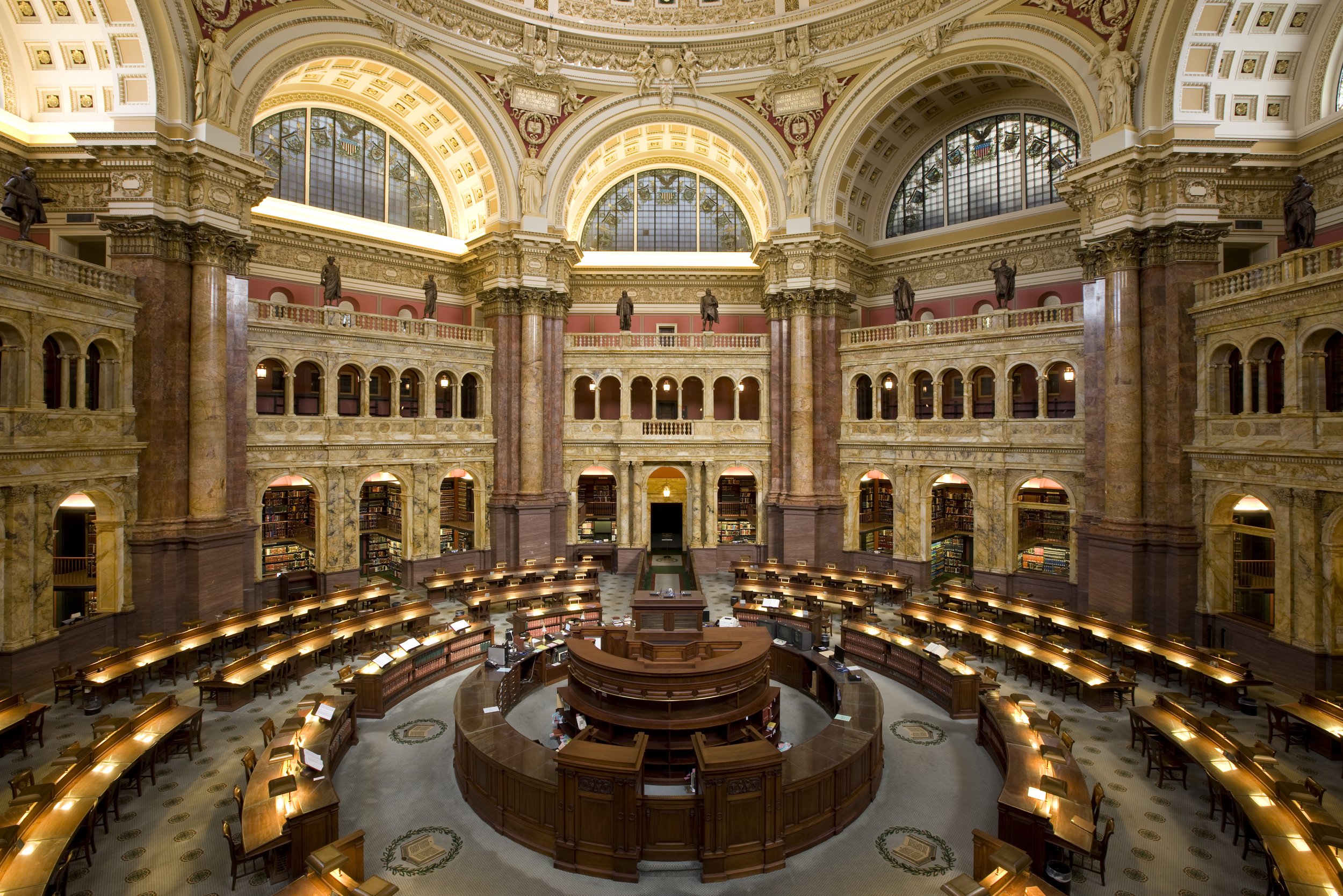
Thomas Jefferson was a man ahead of his time—in library- as well as nation-building. His legacy is woven into the story of the American library in more ways than one. By the early years of the republic, Jefferson had amassed a personal collection of six to seven thousand volumes. It was the largest and most extensive library in the country at the time. After the British army sacked Washington, D.C., and burned the Capitol in 1814, destroying the congressional library housed within, Jefferson sold his collection to the federal government a year later. Even though a second fire destroyed two-thirds of these volumes in 1851, Jefferson’s collection continues to form the nucleus of the Library of Congress, which has grown to become the largest library collection in the world.

Jefferson Reading Room, Library of Congress. Photo: Carol Highsmith, 2009.

Jefferson’s library influence continued with his designs for his University of Virginia. In 1822, construction began on his Rotunda library. The design departed from the hall model and adopted the shape of the ancient Roman Pantheon to form a focal point for his university’s classically designed Academical Village. When completed in 1828, two years after Jefferson’s death on July 4, 1826, and as the final and most monumental building on the new campus, the two-story Rotunda became the first freestanding academic library in the country.

Half a century later, library designers returned to Jefferson’s classical vernacular and the rotunda form to create some of the greatest monuments of American library architecture. Again Sydney Smirke’s innovative British Museum Reading Room of 1856 provided the model for a domed central rotunda featuring a panoptic administration area at the center with freestanding bookstacks surrounding a core. Smirke’s innovative reading room, the first to use iron stacks, featured twenty-five miles of reference shelving with twenty thousand popular circulating volumes arranged in numbered alcoves a floor below.

When the U.S. government authorized a competition for a new Library of Congress building in 1873, the winning design coalesced around a similar rotunda-and-stack arrangement. Completed twenty-five years later in 1897, what is now known as the loc’s Thomas Jefferson Building spared no expense in its construction and decorative program. Edward Casey, the son of Thomas Lincoln Casey, the engineer who oversaw the library’s construction before his death in 1896, attended to the library’s lavish assembly of sculptures, murals, and mosaics. Illustrations on its walls depict the evolution of the book from the oral tradition through the invention of the printing press. The collar of its central dome features allegories of the world’s civilizations. Surrounding this program are forty-three miles of shelving manufactured by the Snead & Company Iron Works of Louisville, Kentucky, which can accommodate two million volumes.

The Library of Congress’s rich artistic program was arguably surpassed at the Boston Public Library, where Charles McKim tasked Puvis de Chavannes with producing a mural cycle for the library’s grand staircase. Puvis created the work relying on measurements sent by McKim and a sample of the yellow Siena marble to match the tonalities of the staircase enclosure. Using a scale model of the staircase and working on canvas in his French studio, the seventy-two-year-old artist created a cycle of paintings that were then shipped to Boston and adhered by his assistants to the walls. The long cycle atop the entrance to Bates Hall presents “The Muses of Inspiration Hail[ing] the Spirit, the Harbinger of Light.” Surrounding panels depict allegories of Philosophy, Astronomy, History, Chemistry, Physics, and Pastoral, Dramatic, and Epic Poetry. Below, carved lions by Louis Saint-Gaudens guard this grand staircase.

In the years after the completion of the loc’s Jefferson building, American architects revisited the rotunda model in even more impressive distillations of the classical style as taught by the École des Beaux-Arts. In the first decade of the twentieth century, two institutions—New York University and Columbia—developed new uptown campuses that had many parallels. Most notable were the domed rotunda libraries at their core: nyu’s Gould Memorial Library of 1896–1903 and Columbia’s Low Memorial Library of 1909. Both designed by the firm of McKim, Mead & White, each building carries the sensibility of one side of the partnership, with McKim’s restrained, detailed classicism on display at Low and White’s theatrical exuberance at Gould.

Beyond the triumphant designs of America’s turn-of-the-century central libraries, it was the development of the smaller branch library that arguably had the greatest effect on twentieth-century literacy and education. As early as 1885, William Frederick Poole was advocating for smaller circulating libraries, ones that might contain thirty thousand volumes and be easily accessible to the American reader. A supporter of libraries of all sizes, the philanthropist Andrew Carnegie answered this call in the early years of the twentieth century in ways that changed the landscape of the American library. By 1917, Carnegie and his foundation, which he started in 1911, had endowed 1,679 library buildings in the United States. In New York City alone, he spent $5.2 million to construct sixty-seven neighborhood branch libraries. In segregated Tennessee, he funded a Negro Branch library. At the request of Booker T. Washington, he donated $20,000 for the library at Alabama’s Tuskegee Institute. The ubiquitous construction of these Carnegie libraries, mostly classical in style, called for a simple panoptic design where “one librarian can oversee the entire library from a central point,” in the words of James Bertram, Carnegie’s personal secretary.

Through an astonishing combination of municipal underwriting and philanthropic giving (New Hampshire became the first state to authorize taxation for libraries in 1849), today there are 5,400 libraries with a thousand or more books in the United States. What has been lost in this abundance is an understanding of the forces that created it and an appreciation for the styles that formed it. Following the Second World War, library designers turned away from historical models to look to the modern office building and department store for inspiration, with disastrous effects. The Beinecke Rare Book & Manuscript Library at Yale (Gordon Bunshaft, 1963) and the Phillips Exeter Academy Library (Louis Kahn, 1972) are the rare exceptions to this general rule.

Departing from the simple flagstone design of Franklin Roosevelt’s “presidential library” (Louis Simon, 1939–40)—the first such executive initiative—the libraries of Lyndon Johnson (Skidmore, Owings & Merrill, 1967–71) and Bill Clinton (Polshek Partnership, 2000–04) are brutalist and impenetrable. The same goes for the James Madison Memorial Building (De Witt, Poor & Shelton, 1966–81), the much-criticized extension of the Library of Congress built at a cost of $131 million, where the first challenge is finding the monolith’s front door. Even after the government requested a review of the design by the American Institute of Architects in 1967, little changed in its final construction.

Detroit Publishing Company, Main reading room, the New York Public Library, ca. 1910, Dry plate negative, Library of Congress.

Now a radical “third great wave” seeks to wash over the American library to complete its transformation into a “social project.” A decade ago, the leadership of the New York Public Library unveiled a real estate consolidation scheme called the “Central Library Plan.” The aim was to transform the library’s flagship research branch—arguably the finest integration of public spaces and book storage in the country—by gutting its stacks. By removing the “seven floors of outdated bookshelves under the Rose Main Reading Room,” read the announcement, the plan promised to transform the reference library into a newly circulating “people’s palace.” Meanwhile millions of books from the library’s “core research collections” would be moved off-site—undermining the legacy of John Jacob Astor, who left the initial bequest of $400,000 for the foundation and support of a free public reference library in 1848.

An eleventh-hour appeal by the architectural critic Ada Louise Huxtable and others tanked the scheme, but the episode reveals the lengths to which library leaders will now go to destroy America’s great history of literary access for progressive ends. For them the real problem is not “book banning” but the easy availability of books they despise and the history these books represent, which our great library collections offer up neutrally, and impartially, by design. A library of the book, by the book, and for the book is the ultimate defense against their control—and the true democratic legacy of this American institution.

  1. American Libraries: 1730–1950, by Kenneth Breisch; W. W. Norton & Company, 320 pages, $75.